Research Group for Theoretical Models of Eco-evolutionary Dynamics, Department of Evolutionary Theory, Max-Planck Institute for Evolutionary Biology, Plön, Germany.
Department of Evolutionary Theory, Max-Planck Institute for Evolutionary Biology, Plön, Germany.
PLoS Comput Biol. 2021 Oct 1;17(10):e1009431. doi: 10.1371/journal.pcbi.1009431. eCollection 2021 Oct.
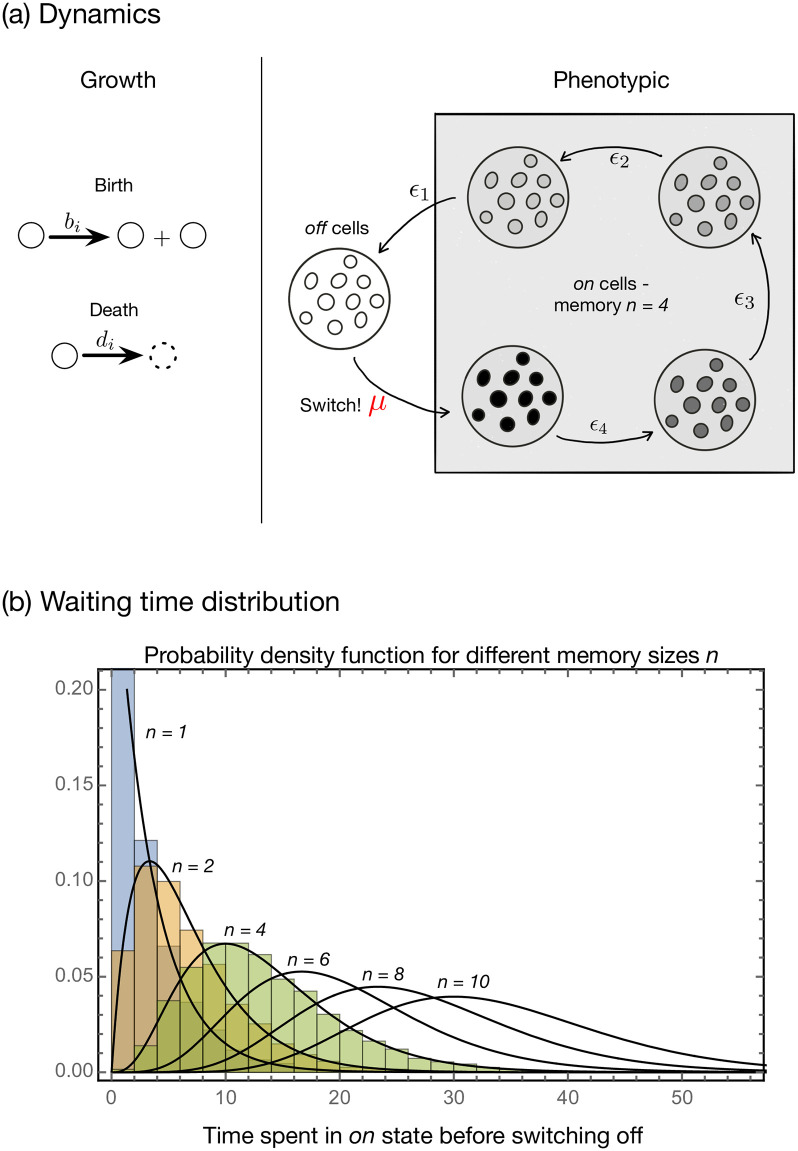
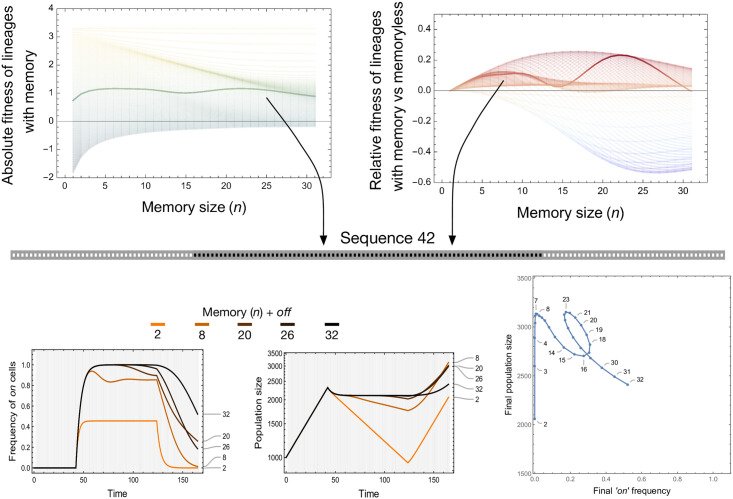
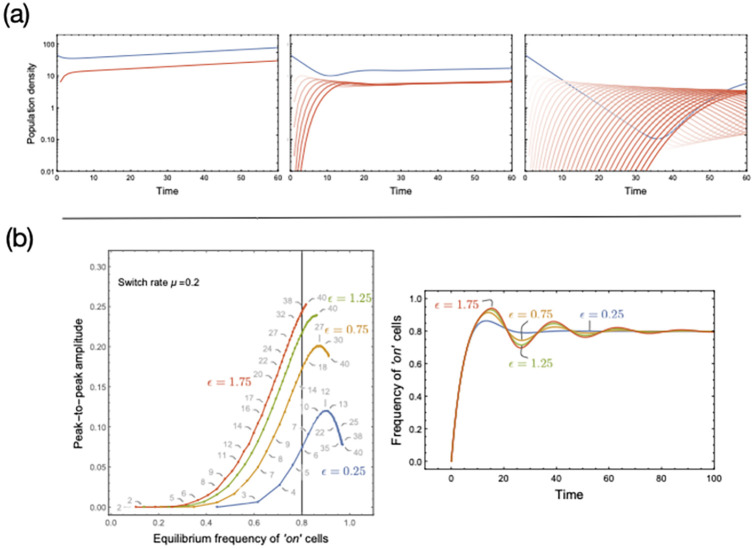
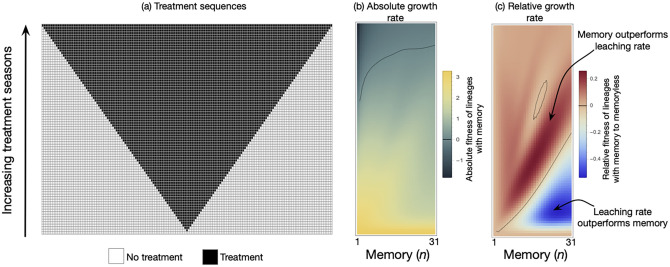
Correct decision making is fundamental for all living organisms to thrive under environmental changes. The patterns of environmental variation and the quality of available information define the most favourable strategy among multiple options, from randomly adopting a phenotypic state to sensing and reacting to environmental cues. Cellular memory-the ability to track and condition the time to switch to a different phenotypic state-can help withstand environmental fluctuations. How does memory manifest itself in unicellular organisms? We describe the population-wide consequences of phenotypic memory in microbes through a combination of deterministic modelling and stochastic simulations. Moving beyond binary switching models, our work highlights the need to consider a broader range of switching behaviours when describing microbial adaptive strategies. We show that memory in individual cells generates patterns at the population level coherent with overshoots and non-exponential lag times distributions experimentally observed in phenotypically heterogeneous populations. We emphasise the implications of our work in understanding antibiotic tolerance and, in general, bacterial survival under fluctuating environments.
正确的决策对于所有生物体在环境变化下茁壮成长都是至关重要的。环境变化的模式和可用信息的质量定义了多种选择中最有利的策略,从随机采用表型状态到感知和对环境线索做出反应。细胞记忆——跟踪和调节转换到不同表型状态的时间的能力——可以帮助抵抗环境波动。记忆在单细胞生物中是如何表现出来的?我们通过确定性建模和随机模拟相结合的方法,描述了微生物中表型记忆的全种群后果。超越二元开关模型,我们的工作强调了在描述微生物适应策略时需要考虑更广泛的开关行为范围。我们表明,个体细胞中的记忆在种群水平上产生的模式与表型异质种群中实验观察到的过冲和非指数滞后时间分布一致。我们强调了我们的工作在理解抗生素耐药性以及一般来说细菌在波动环境下生存方面的意义。