Eelderink-Chen Zheng, Bosman Jasper, Sartor Francesca, Dodd Antony N, Kovács Ákos T, Merrow Martha
Institute of Medical Psychology, Faculty of Medicine, LMU Munich, Goethestrasse 31, 80336 Munich, Germany.
Department of Bioinformatics, Hanze University of Applied Sciences, Groningen, Zernikeplein 11, 9747 AS Groningen, Netherlands.
Sci Adv. 2021 Jan 8;7(2). doi: 10.1126/sciadv.abe2086. Print 2021 Jan.
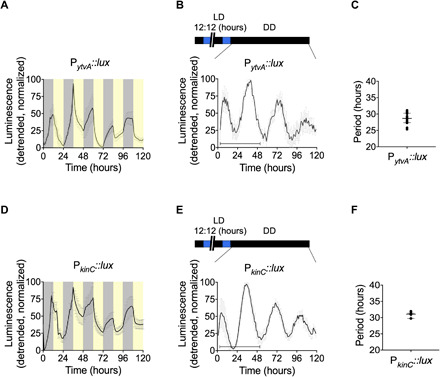
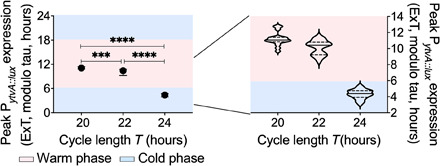
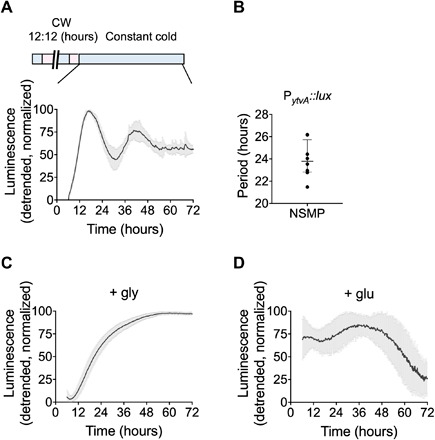
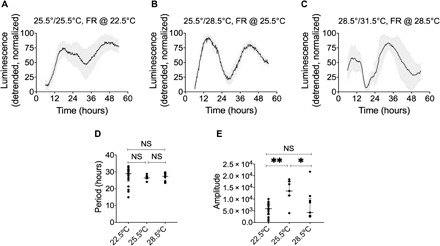
Circadian clocks create a 24-hour temporal structure, which allows organisms to occupy a niche formed by time rather than space. They are pervasive throughout nature, yet they remain unexpectedly unexplored and uncharacterized in nonphotosynthetic bacteria. Here, we identify in circadian rhythms sharing the canonical properties of circadian clocks: free-running period, entrainment, and temperature compensation. We show that gene expression in can be synchronized in 24-hour light or temperature cycles and exhibit phase-specific characteristics of entrainment. Upon release to constant dark and temperature conditions, bacterial biofilm populations have temperature-compensated free-running oscillations with a period close to 24 hours. Our work opens the field of circadian clocks in the free-living, nonphotosynthetic prokaryotes, bringing considerable potential for impact upon biomedicine, ecology, and industrial processes.
昼夜节律时钟创造了一个24小时的时间结构,使生物体能够占据由时间而非空间形成的生态位。它们在自然界中普遍存在,但在非光合细菌中却仍未得到充分探索和表征,这令人意外。在这里,我们在[具体研究对象]中鉴定出具有昼夜节律时钟典型特性的昼夜节律:自由运行周期、同步化和温度补偿。我们表明,[具体研究对象]中的基因表达可以在24小时的光照或温度周期中同步,并表现出同步化的相位特异性特征。在释放到恒定的黑暗和温度条件下,细菌生物膜群体具有温度补偿的自由运行振荡,周期接近24小时。我们的工作开启了自由生活的非光合原核生物中昼夜节律时钟的研究领域,为对生物医学、生态学和工业过程产生影响带来了巨大潜力。