Department of Surgery, Emory University School of Medicine, Atlanta, GA, United States of America; Department of Medicine, Emory University School of Medicine, Atlanta, GA, United States of America.
Department of Surgery, Emory University School of Medicine, Atlanta, GA, United States of America.
Transplant Rev (Orlando). 2021 Dec;35(4):100654. doi: 10.1016/j.trre.2021.100654. Epub 2021 Sep 22.
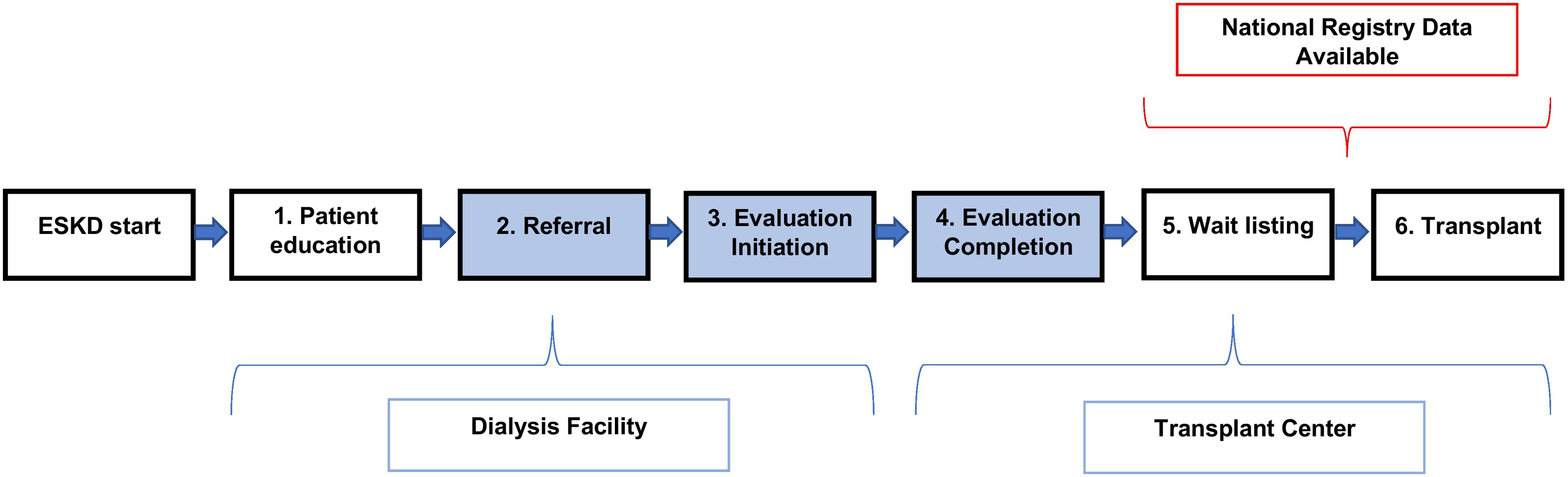
In the United States (US), barriers in access to later steps in the kidney transplantation process (i.e. waitlisting) have been well documented. Barriers in access to earlier steps (i.e. referral and evaluation) are less well described due to the lack of national surveillance data. In this review, we summarize the available literature on non-medical barriers in access to kidney transplant referral and evaluation.
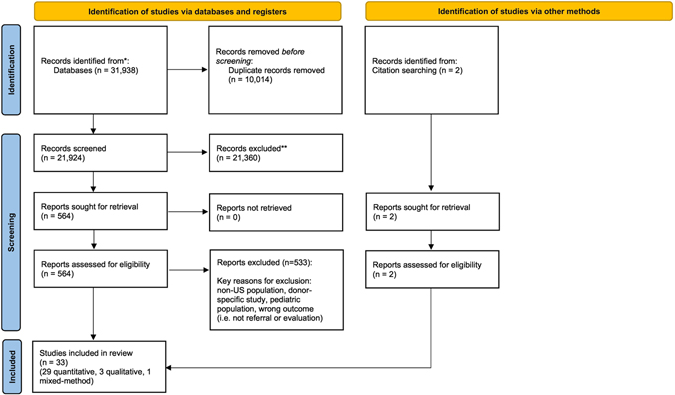
Following PRISMA guidelines, we conducted a scoping review of the literature through June 3, 2021. We included all studies (quantitative and qualitative) reporting on barriers to kidney transplant referral and evaluation in the US published from 1990 onwards in English and among adult end-stage kidney disease (ESKD) patients (PROSPERO registration number: CRD42014015027). We narratively synthesized results across studies.
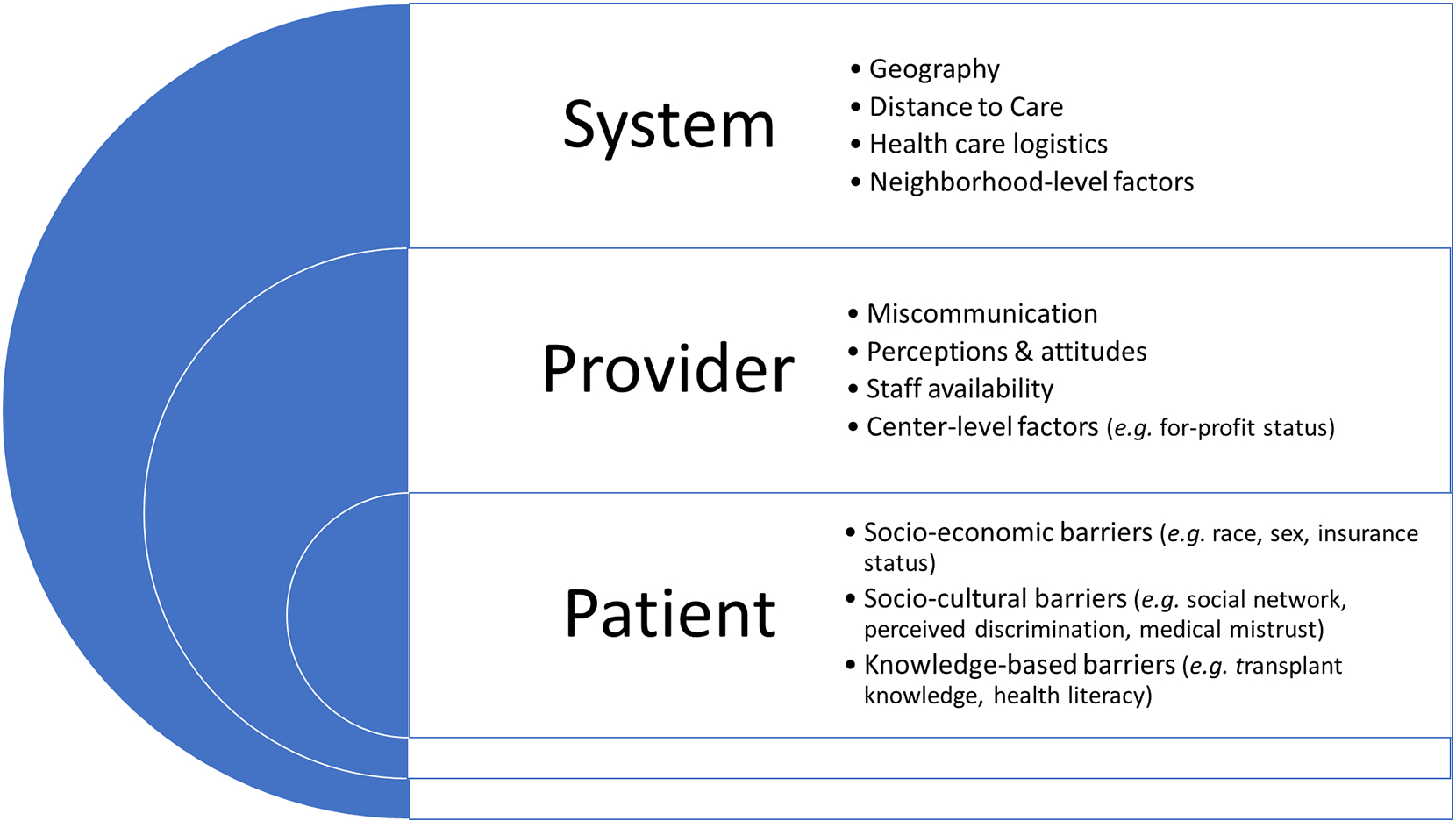
We retrieved information from 33 studies published from 1990 to 2021 (reporting data between 1990 and 2018). Most studies (n = 28, 85%) described barriers among patient populations, three (9%) among provider populations, and two (6%) included both patients and providers. Key barriers were identified across multiple levels and included patient- (e.g. demographic, socioeconomic, sociocultural, and knowledge), provider- (e.g. miscommunication, staff availability, provider perceptions and attitudes), and system- (e.g. geography, distance to care, healthcare logistics) level factors.
A multi-pronged approach (e.g. targeted and systemwide interventions, and policy change) implemented at multiple levels of the healthcare system will be necessary to reduce identified barriers in access to early kidney transplant steps. Collection of national surveillance data on these early kidney transplant steps is also needed to enhance our understanding of barriers to referral and evaluation.
在美国,获得肾脏移植过程中后续步骤(即等待名单)的障碍已得到充分记录。由于缺乏全国性监测数据,因此对获得早期步骤(即转诊和评估)的障碍的描述较少。在本综述中,我们总结了有关获得肾脏移植转诊和评估的非医学障碍的现有文献。
根据 PRISMA 指南,我们通过 2021 年 6 月 3 日对文献进行了范围审查。我们纳入了所有报告美国成人终末期肾病(ESKD)患者(PROSPERO 注册号:CRD42014015027)中自 1990 年以来以英文发表的有关肾脏移植转诊和评估障碍的研究(包括定量和定性研究)。我们对研究结果进行了叙述性综合。
我们从 1990 年至 2021 年发表的 33 项研究中检索到信息(报告的数据在 1990 年至 2018 年之间)。大多数研究(n=28,85%)描述了患者人群中的障碍,3 项研究(9%)描述了提供者人群中的障碍,2 项研究(6%)包括患者和提供者。在多个层面上都确定了关键障碍,包括患者(例如,人口统计学,社会经济,社会文化和知识),提供者(例如,沟通不畅,人员配备,提供者的看法和态度)和系统(例如,地理位置,与护理的距离,医疗保健物流)因素。
需要在医疗保健系统的多个层面上采取多管齐下的方法(例如,有针对性和系统性的干预措施以及政策变更),以减少早期肾脏移植步骤中发现的障碍。还需要收集有关这些早期肾脏移植步骤的国家监测数据,以增进我们对转诊和评估障碍的了解。