Department of Population Science, Jatiya Kabi Kazi Nazrul Islam University, Mymensingh, Bangladesh
Independent Researcher, Dhaka, Bangladesh.
BMJ Open. 2021 Oct 1;11(10):e047516. doi: 10.1136/bmjopen-2020-047516.
Increasing numbers of Rohingya refugees have been found to be infected with HIV since they arrived in Bangladesh after being ousted from Myanmar in 2017. This study aimed to examine the knowledge about HIV transmission among Rohingya refugee women and to identify factors that are associated with that knowledge.
A cross-sectional survey was conducted using a structured questionnaire that was based on the standard questionnaire of the Demographic and Health Survey programme.
Rohingya settlements in the Kutupalong refugee camp at Ukhiya, Cox's Bazar, Bangladesh.
Interviews were conducted with 508 women who had married or given birth in the 2 years before the survey was done.
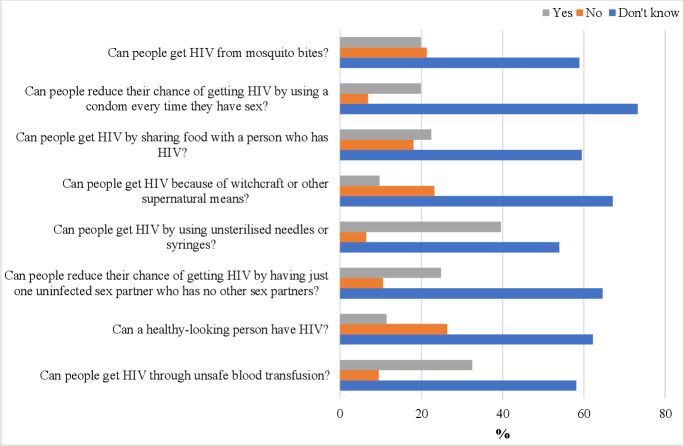
The participants were asked to answer a set of questions to assess their knowledge about HIV transmission.
Around 70% of the women could not accurately answer four of the eight questions, and there were substantial misconceptions about the modes of HIV transmission. Knowledge regarding HIV transmission among participants increases in conjunction with the age at which they were first married. Women who were involved in work outside their households or those whose husbands were employed were more likely than others to demonstrate relatively good knowledge of transmission. Women who had received some formal education were 2.37 times likely to show relatively good knowledge of HIV transmission than those who had not received any education. Availability of healthcare facilities in the blocks where women resided is also associated with better knowledge. However, knowledge of HIV transmission among Rohingya women was significantly lower than among women in Bangladesh and Myanmar.
Most Rohingya women have inadequate knowledge of HIV transmission. Targeted interventions are needed to provide HIV education and to assist with prevention and behavioural changes.
自 2017 年罗兴亚人被逐出缅甸后抵达孟加拉国以来,越来越多的罗兴亚难民被发现感染了艾滋病毒。本研究旨在调查罗兴亚难民妇女对艾滋病毒传播的认识,并确定与这种认识相关的因素。
采用横断面调查,使用基于人口与健康调查方案标准问卷的结构化问卷进行。
孟加拉国考克斯巴扎尔的 Ukhiya 库图帕隆难民营的罗兴亚人定居点。
对在调查前 2 年内结婚或生育的 508 名已婚妇女进行了访谈。
要求参与者回答一组问题,以评估他们对艾滋病毒传播的认识。
大约 70%的女性不能准确回答 8 个问题中的 4 个,对艾滋病毒传播方式存在严重误解。参与者对艾滋病毒传播的认识随着首次结婚年龄的增加而增加。从事家庭以外工作的妇女或其丈夫受雇的妇女比其他妇女更有可能对传播有相对较好的认识。接受过一些正规教育的妇女比没有接受过任何教育的妇女更有可能对艾滋病毒传播有相对较好的认识。妇女居住的街区是否有医疗保健设施也与更好的知识相关。然而,罗兴亚妇女对艾滋病毒传播的认识明显低于孟加拉国和缅甸的妇女。
大多数罗兴亚妇女对艾滋病毒传播的认识不足。需要采取有针对性的干预措施,提供艾滋病毒教育,并协助预防和行为改变。