Istituto di Scienze dell'Atmosfera e del Clima (ISAC-CNR), Str. Prv. Lecce-Monteroni km 1.2, Lecce, Italy.
Istituto di Scienze Polari (ISP-CNR), Via Torino (Mestre), 155, Venice, Italy.
Environ Sci Pollut Res Int. 2022 Feb;29(10):13905-13916. doi: 10.1007/s11356-021-16737-7. Epub 2021 Oct 1.
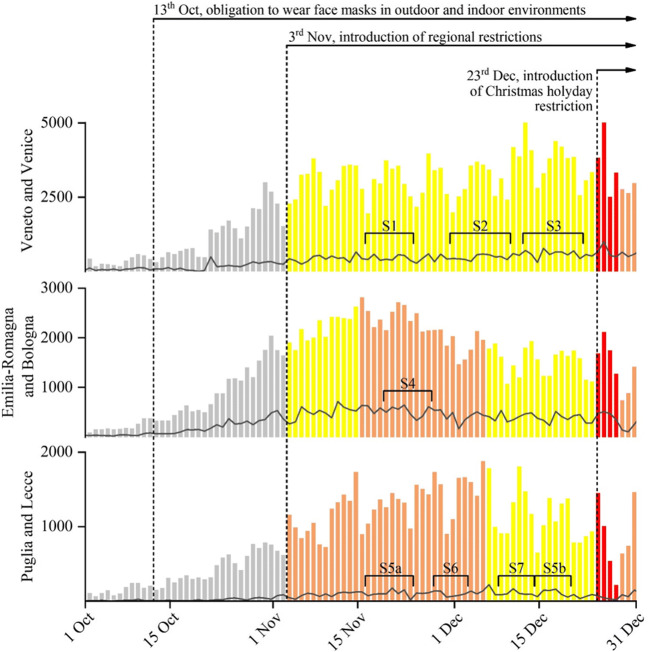
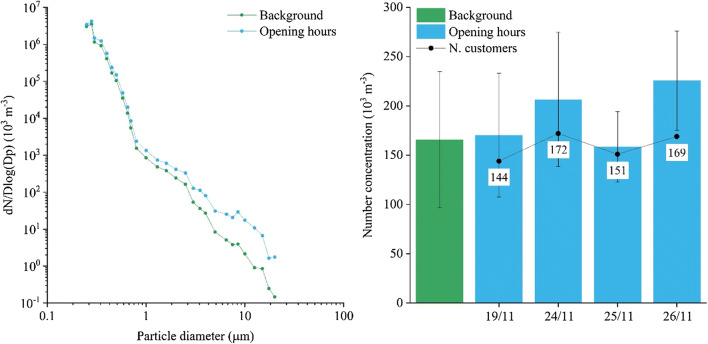
COVID-19 pandemic raised a debate regarding the role of airborne transmission. Information regarding virus-laden aerosol concentrations is still scarce in community indoors and what are the risks for general public and the efficiency of restriction policies. This work investigates, for the first time in Italy, the presence of SARS-CoV-2 RNA in air samples collected in different community indoors (one train station, two food markets, one canteen, one shopping centre, one hair salon, and one pharmacy) in three Italian cities: metropolitan city of Venice (NE of Italy), Bologna (central Italy), and Lecce (SE of Italy). Air samples were collected during the maximum spread of the second wave of pandemic in Italy (November and December 2020). All collected samples tested negative for the presence of SARS-CoV-2, using both real-time RT-PCR and ddPCR, and no significant differences were observed comparing samples taken with and without customers. Modelling average concentrations, using influx of customers' data and local epidemiological information, indicated low values (i.e. < 0.8 copies m when cotton facemasks are used and even lower for surgical facemasks). The results, even if with some limitations, suggest that the restrictive policies enforced could effectively reduce the risk of airborne transmissions in the community indoor investigated, providing that physical distance is respected.
COVID-19 大流行引发了关于空气传播作用的争论。关于社区室内载病毒气溶胶浓度的信息仍然很少,而普通公众面临的风险以及限制政策的效率如何也尚不明确。本研究首次在意大利调查了 SARS-CoV-2 RNA 在三个意大利城市(意大利东北部的威尼斯大都市区、意大利中部的博洛尼亚和意大利东南部的莱切)的不同社区室内(一个火车站、两个食品市场、一个餐厅、一个购物中心、一个美发沙龙和一个药房)空气中的样本中的存在情况。空气样本是在意大利第二波大流行传播高峰期(2020 年 11 月和 12 月)采集的。使用实时 RT-PCR 和 ddPCR 对所有采集的样本进行检测,均未检测到 SARS-CoV-2 的存在,且在有和没有顾客的情况下采集的样本之间没有观察到显著差异。使用顾客流量数据和当地流行病学信息来模拟平均浓度表明,使用棉质口罩时浓度值很低(即 <0.8 拷贝 m ,而使用外科口罩时甚至更低)。这些结果,即使存在一些局限性,也表明实施的限制政策可以有效地降低在所调查的社区室内空气传播的风险,前提是要保持身体距离。