Perelman School of Medicine, University of Pennsylvania, Philadelphia, PA, USA.
Office of the Chief Medical Information Officer, Penn Medicine, Philadelphia, PA, USA.
Curr Cardiol Rep. 2021 Oct 1;23(11):153. doi: 10.1007/s11886-021-01584-2.
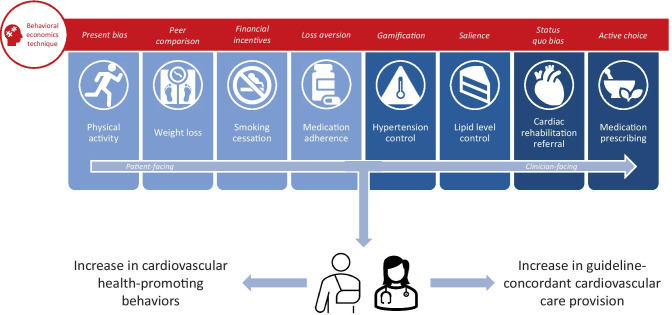
Behavioral economics represents a promising set of principles to inform the design of health-promoting interventions. Techniques from the field have the potential to increase quality of cardiovascular care given suboptimal rates of guideline-directed care delivery and patient adherence to optimal health behaviors across the spectrum of cardiovascular care delivery.
Cardiovascular health-promoting interventions have demonstrated success in using a wide array of principles from behavioral economics, including loss framing, social norms, and gamification. Such approaches are becoming increasingly sophisticated and focused on clinical cardiovascular outcomes in addition to health behaviors as a primary endpoint. Many approaches can be used to improve patient decisions remotely, which is particularly useful given the shift to virtual care in the context of the COVID-19 pandemic. Numerous applications for behavioral economics exist in the cardiovascular care delivery space, though more work is needed before we will have a full understanding of ways to best leverage such applications in each clinical context.
行为经济学提供了一系列很有前景的原则,可用于指导促进健康的干预措施的设计。该领域的技术有可能提高心血管护理的质量,因为目前指南指导的护理提供率和患者对最佳健康行为的依从性都不理想,而这些技术适用于心血管护理提供的各个方面。
心血管健康促进干预措施已经成功地运用了行为经济学的一系列原则,包括损失框架、社会规范和游戏化。除了健康行为这一首要终点外,这些方法还越来越复杂,专注于临床心血管结局。许多方法可用于远程改善患者决策,鉴于在 COVID-19 大流行背景下向虚拟护理的转变,这一点尤其有用。行为经济学在心血管护理提供领域有许多应用,但在充分了解如何在每种临床环境中最好地利用这些应用之前,还需要做更多的工作。