de Souza T F, Martins M L, Tavares-Silva C M, Fonseca-Gonçalves A, Maia L C
Faculty of Dentistry, Universidade Federal do Rio de Janeiro, Rio de Janeiro, RJ, Brazil.
Department of Pediatric Dentistry and Orthodontics, Faculty of Dentistry, Universidade Federal Do Rio de Janeiro, Rua Professor Rodolpho Paulo Rocco, 325 Cidade Universitária, Rio de Janeiro, RJ, CEP 21941-617, Brazil.
Eur Arch Paediatr Dent. 2022 Oct;23(5):777-785. doi: 10.1007/s40368-021-00669-4. Epub 2021 Oct 2.
To compare the Atraumatic Restorative Treatment (ART) associated with Brix3000™ to ART considering treatment time, pain experienced, and acceptability to children.
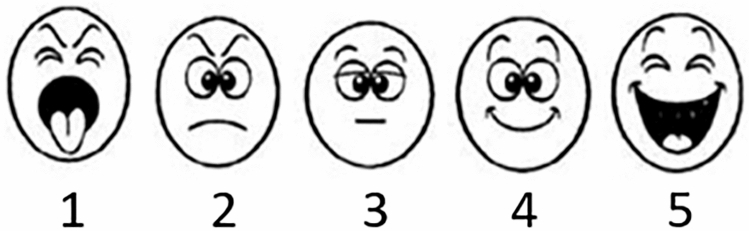
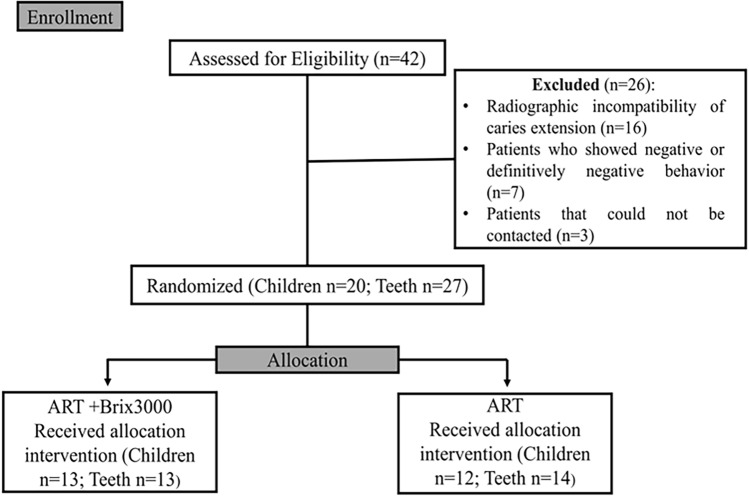
This study was accepted in Research Ethics Committee in July 2019 (number 3469402). Healthy patients (n = 20) aged 3-9 years, with at least one primary molar with occlusal dentine caries without cusp involvement were randomly allocated to either the ART + Brix3000™ group or the ART-only group. The sample was characterised by sex, age, tooth location and caries experience. Time spent and pain experience scores were recorded at prophylaxis, caries removal and restoration. The pain experience (intense, moderate, or mild) was evaluated by the Face, Legs, Activity, Cry, Consolability-revised scale (FLACC-r). Acceptability was assessed by a five-point hedonic facial scale (dichotomised into 'like' and 'indifferent/dislike' bins) and by an open-question interview. Mann-Whitney, Chi-square, and Fisher's exact tests were applied to discern differences in time, pain/sample characterisation and acceptability, respectively.
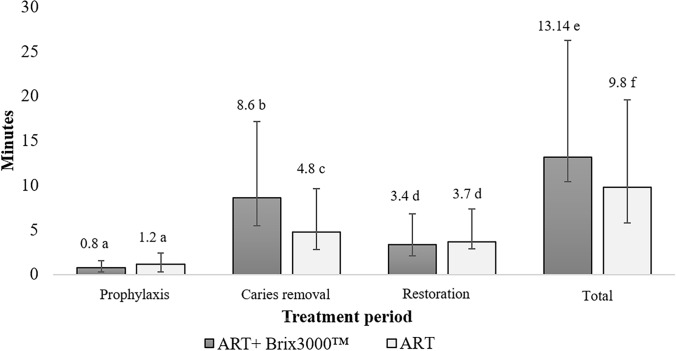
The ART + Brix3000™ group required 8.6 ± 3.1 min to remove caries tissue, whereas the ART group required only 4.8 ± 2.0 min (p = 0.03). The total time spent with treatments was 13.1 ± 4.0 min for ART + Brix3000™, and 9.8 ± 2.7 min for ART (p = 0.03). There was no difference in pain experience and acceptability found among the groups (p > 0.05).
Although the ART + Brix3000™ technique demanded more treatment time than the ART alone, there were no differences in either pain experience or acceptability.
比较采用Brix3000™的非创伤性修复治疗(ART)与传统ART在治疗时间、患儿疼痛感受及接受度方面的差异。
本研究于2019年7月获研究伦理委员会批准(编号3469402)。选取年龄在3至9岁、至少有一颗咬合面牙本质龋且未累及牙尖的健康患儿(n = 20),随机分为ART + Brix3000™组和单纯ART组。对样本的性别、年龄、患牙位置及龋病经历进行记录。在预防性治疗、龋洞清理和修复过程中记录治疗时间及疼痛感受评分。采用面部、腿部、活动、哭闹、安慰修订量表(FLACC - r)评估疼痛感受(剧烈、中度或轻度)。通过五点享乐面部量表(分为“喜欢”和“ indifferent/不喜欢”两类)及开放式访谈评估接受度。分别应用曼 - 惠特尼检验、卡方检验和费舍尔精确检验来分析治疗时间、疼痛/样本特征及接受度方面的差异。
ART + Brix3000™组清除龋坏组织需8.6 ± 3.1分钟,而单纯ART组仅需4.8 ± 2.0分钟(p = 0.03)。ART + Brix3000™组的总治疗时间为13.1 ± 4.0分钟,单纯ART组为9.8 ± 2.7分钟(p = 0.03)。两组在疼痛感受及接受度方面无差异(p > 0.05)。
尽管ART + Brix3000™技术比单纯ART需要更多的治疗时间,但在疼痛感受及接受度方面并无差异。