Unit of Cardiovascular and Nutritional Epidemiology, Institute of Environmental Medicine, Karolinska Institutet, 17177 Stockholm, Sweden.
Unit of Medical Epidemiology, Department of Surgical Sciences, Uppsala University, 75185 Uppsala, Sweden.
J Clin Endocrinol Metab. 2022 Jan 18;107(2):e467-e474. doi: 10.1210/clinem/dgab713.
The causal role of endogenous estradiol in cancers other than breast and endometrial cancer remains unclear.
This Mendelian randomization study assessed the causal associations of endogenous 17β-estradiol (E2), the most potent estrogen, with cancer risk in women.
As primary genetic instrument, we used a genetic variant in the CYP19A1 gene that is strongly associated with serum E2 levels. Summary statistics genetic data for the association of the E2 variant with breast, endometrial, and ovarian cancer were obtained from large-scale consortia. We additionally estimated the associations of the E2 variant with any and 20 site-specific cancers in 198 825 women of European descent in UK Biobank. Odds ratios (OR) of cancer per 0.01 unit increase in log-transformed serum E2 levels in pmol/L were estimated using the Wald ratio.
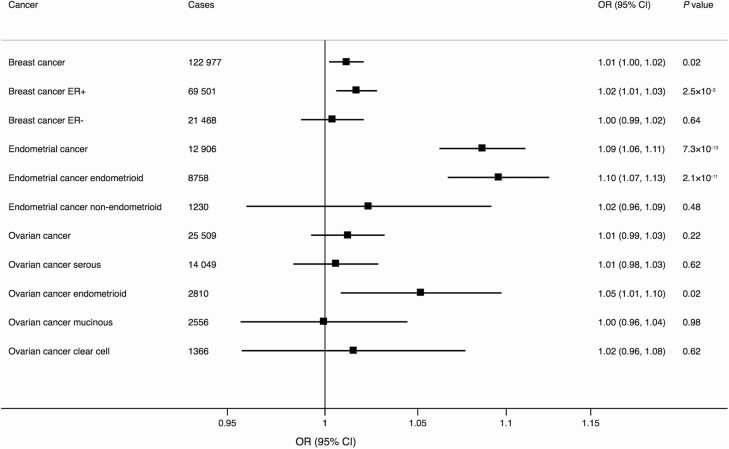
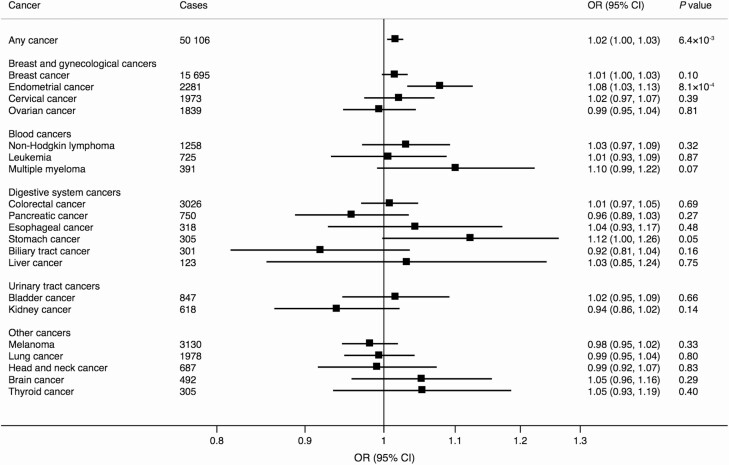
Genetic predisposition to higher serum E2 levels was associated with increased risk of estrogen receptor (ER)-positive breast cancer (OR 1.02; 95% CI, 1.01-1.03; P = 2.5 × 10⁻³), endometrial cancer overall (OR 1.09; 95% CI, 1.06-1.11; P = 7.3 × 10⁻¹³), and endometrial cancer of the endometrioid histology subtype (OR 1.10; 95% CI, 1.07-1.13; P = 2.1 × 10⁻¹¹). There were suggestive associations with breast cancer overall (OR 1.01; 95% CI, 1.00-1.02; P = 0.02), ovarian cancer of the endometrioid subtype (OR 1.05; 95% CI, 1.01-1.10; P = 0.02), and stomach cancer (OR 1.12; 95% CI, 1.00-1.26; P = 0.05), but no significant association with other cancers.
This study supports a role of E2 in the development of ER-positive breast cancer and endometrioid endometrial cancer but found no strong association with other cancers in women.
内源性雌二醇在乳腺癌和子宫内膜癌以外的癌症中的因果作用尚不清楚。
本孟德尔随机研究评估了内源性 17β-雌二醇(E2),即最强的雌激素,与女性癌症风险的因果关系。
作为主要的遗传工具,我们使用了 CYP19A1 基因中的一个遗传变异,该变异与血清 E2 水平强烈相关。从大型联盟获得了与 E2 变异与乳腺癌、子宫内膜癌和卵巢癌关联的关联的汇总统计数据。我们还在英国生物银行的 198825 名欧洲血统女性中,估计了 E2 变异与任何和 20 个特定部位癌症的关联。使用 Wald 比估计血清 E2 水平每增加 0.01 个单位的对数转换时癌症的优势比(OR)。
较高的血清 E2 水平遗传易感性与雌激素受体(ER)阳性乳腺癌(OR 1.02;95%CI,1.01-1.03;P=2.5×10⁻³)、子宫内膜癌总体(OR 1.09;95%CI,1.06-1.11;P=7.3×10⁻¹³)和子宫内膜癌的子宫内膜样组织学亚型(OR 1.10;95%CI,1.07-1.13;P=2.1×10⁻¹¹)的风险增加相关。总体乳腺癌(OR 1.01;95%CI,1.00-1.02;P=0.02)、子宫内膜癌的子宫内膜样亚型(OR 1.05;95%CI,1.01-1.10;P=0.02)和胃癌(OR 1.12;95%CI,1.00-1.26;P=0.05)存在提示性关联,但与其他癌症无显著关联。
本研究支持 E2 在 ER 阳性乳腺癌和子宫内膜样子宫内膜癌发展中的作用,但在女性中未发现与其他癌症的强烈关联。