Magalhães João P, Hetherington-Rauth Megan, Júdice Pedro B, Correia Inês R, Rosa Gil B, Henriques-Neto Duarte, Melo Xavier, Silva Analiza M, Sardinha Luís B
Exercise and Health Laboratory, CIPER, Faculdade de Motricidade Humana, Universidade de Lisboa, Lisboa, Portugal.
CIDEFES - Centro de Investigação em Desporto, Educação Física e Exercício e Saúde, Universidade Lusófona, Lisbon, Portugal.
Front Physiol. 2021 Sep 16;12:698971. doi: 10.3389/fphys.2021.698971. eCollection 2021.
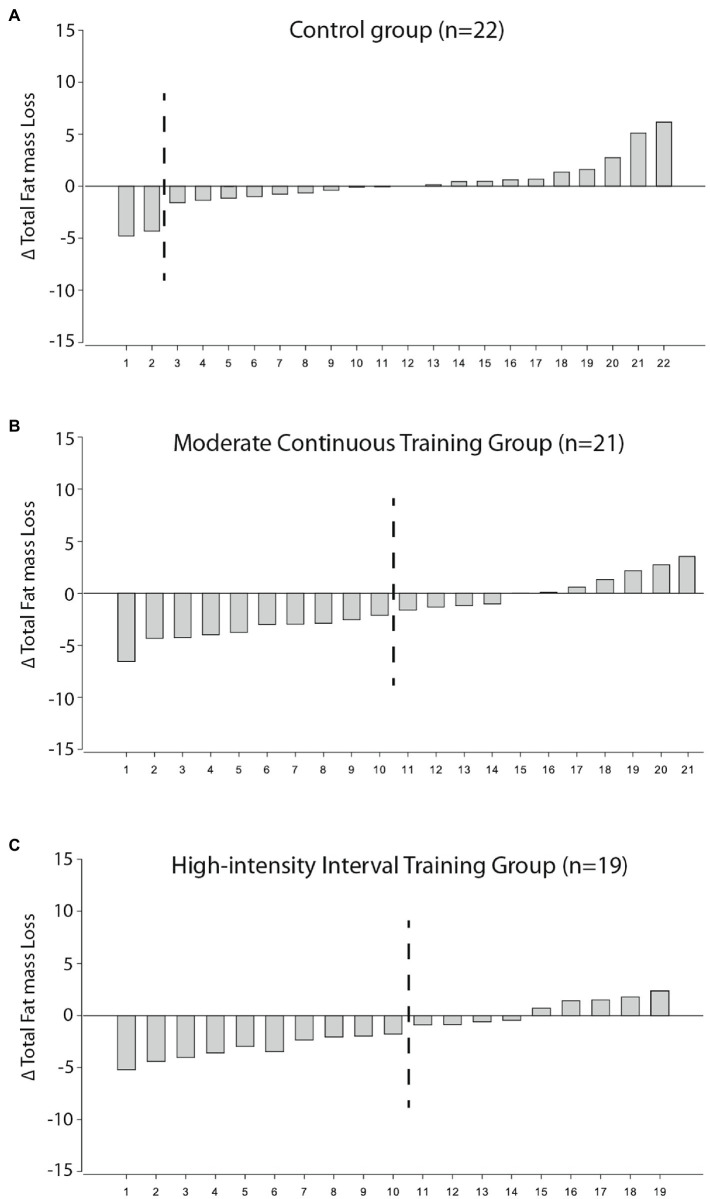
: Little is known about the interindividual variability in fat mass (FM) loss in response to high-intensity interval training (HIIT) and moderate continuous training (MCT) in individuals with type 2 diabetes mellitus (T2DM). Moreover, the impact on health-related outcomes in those who fail to reduce FM is still unclear. The aims of this investigation were (1) to assess if the individuals with T2DM who FM differed across MCT, HIIT, and control groups over a 1-year intervention and (2) to assess the changes on glycemic control and vascular function in the exercising patients who failed to lose FM. : Adults with T2DM were randomized into a 1-year intervention involving a control group (=22), MCT with resistance training (RT; =21), and HIIT with RT (=19). FM was assessed using dual-energy X-ray absorptiometry and a change in total body FM above the typical error was used to categorize FM responders. Glycemic control and vascular stiffness and structure were assessed. A chi-square test and generalized estimating equations were used to model the outcomes. : Both MCT (=10) and HIIT (=10) had a similar proportion of individuals who were categorized as high responders for FM, with the percent change in FM on average -5.0±9.6% for the MCT and -6.0±12.1% for the HIIT, which differed from the control group (0.2±7.6%) after a 1-year intervention (<0.05). A time-by-group interaction for carotid artery intima-media thickness (cIMT) (p for interaction=0.042) and lower-limb pulse wave velocity (LL PWV; p for interaction=0.010) between those categorized as low FM responders and the control group. However, an interaction was observed between the high responders for FM loss and controls for both brachial and carotid hemodynamic indices, as well as in cIMT, carotid distensibility coefficient, carotid beta index, and LL PWV (p for interactions <0.05). No interactions were found for glycaemic indices (p for interaction >0.05). : Our results suggest that the number of FM responders did not differ between the MCT or HIIT, compared to the control, following a 1-year exercise intervention in individuals with T2DM. However, low responders to FM may still derive reductions in arterial stiffness and structure. : Comparing Moderate and High-intensity Interval Training Protocols on Biomarkers in Type 2 Diabetes Patients (D2FIT study) - number: NCT03144505 (https://clinicaltrials.gov/ct2/show/NCT03144505).
对于2型糖尿病(T2DM)患者,高强度间歇训练(HIIT)和中等强度持续训练(MCT)后脂肪量(FM)减少的个体间差异知之甚少。此外,未能减少FM的患者对健康相关结局的影响仍不清楚。本研究的目的是:(1)评估T2DM患者在1年干预期间,MCT组、HIIT组和对照组之间FM是否存在差异;(2)评估未能减少FM的运动患者的血糖控制和血管功能变化。:成年T2DM患者被随机分为三组,进行为期1年的干预,包括对照组(n = 22)、MCT联合抗阻训练(RT;n = 21)和HIIT联合RT(n = 19)。使用双能X线吸收法评估FM,并将全身FM高于典型误差的变化用于对FM反应者进行分类。评估血糖控制、血管硬度和结构。使用卡方检验和广义估计方程对结果进行建模。:MCT组(n = 10)和HIIT组(n = 10)中被归类为FM高反应者的个体比例相似,MCT组FM平均变化百分比为 -5.0±9.6%,HIIT组为 -6.0±12.1%,1年干预后与对照组(0.2±7.6%)不同(P<0.05)。FM低反应者与对照组之间在颈动脉内膜中层厚度(cIMT)(交互作用P = 0.042)和下肢脉搏波速度(LL PWV;交互作用P = 0.010)方面存在时间×组间交互作用。然而,FM减少的高反应者与对照组在肱动脉和颈动脉血流动力学指标以及cIMT、颈动脉扩张系数、颈动脉β指数和LL PWV方面均观察到交互作用(交互作用P<0.05)。血糖指标未发现交互作用(交互作用P>0.05)。:我们的结果表明,在对T2DM患者进行1年运动干预后,与对照组相比,MCT组或HIIT组中FM反应者的数量没有差异。然而,FM低反应者仍可能在动脉硬度和结构方面有所改善。:比较2型糖尿病患者中等强度和高强度间歇训练方案对生物标志物的影响(D2FIT研究) - 编号:NCT03144505(https://clinicaltrials.gov/ct2/show/NCT03144505)