Weyland Charlotte Sabine, Chen Min, Potreck Arne, Jäger Laura Bettina, Seker Fatih, Schönenberger Silvia, Bendszus Martin, Möhlenbruch Markus
Neurologische Klinik, UniversitätsKlinikum Heidelberg, Heidelberg, Germany.
Front Neurol. 2021 Sep 17;12:711558. doi: 10.3389/fneur.2021.711558. eCollection 2021.
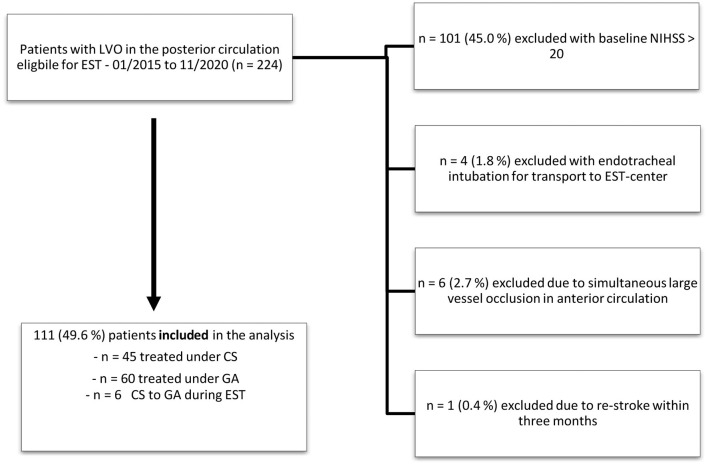
To compare safety and efficacy of conscious sedation (CS) vs. general anesthesia (GA) in endovascular stroke treatment (EST) of the posterior circulation (PC). Retrospective single-center analysis of patients receiving EST for large-vessel occlusion (LVO) in PC between January 2015 and November 2020. Exclusion criteria were severe stroke syndromes (NIHSS > 20), decreased level of consciousness, intubation for transport, and second stroke within 3 months of follow-up. The primary endpoint was a favorable clinical outcome 90 days after stroke onset (mRS 0-2 or 3 if pre-stroke mRS 3). Secondary endpoints were the rate of EST failure and procedural complications. Of 111 included patients, 45/111 patients (40.5%) were treated under CS and 60/111 (54.0%) under GA. In 6/111 cases (5.4%), sedation mode was changed from CS to GA during EST. Patients treated under CS showed a lower mRS 90 days after stroke onset [mRS, median (IQR): 2.5 (1-4) CS vs. 3 (2-6) GA, = 0.036] and a comparable rate of good outcome [good outcome, (%): 19 (42.2) CS vs. 15 (32.6) GA, = 0.311]. There was no difference in complication rates during EST (6.7% CS vs. 8.3% GA) or intracranial bleeding in follow-up imaging [ (%): 4 (8.9) CS vs. 7 (11.7) GA), = 0.705]. The rate of successful target vessel recanalization did not differ (84.4% CS vs. 85.0 % GA). In this retrospective study, EST of the posterior circulation under conscious sedation was for eligible patients comparably safe and effective to patients treated under general anesthesia.
比较清醒镇静(CS)与全身麻醉(GA)在后循环(PC)血管内卒中治疗(EST)中的安全性和有效性。对2015年1月至2020年11月期间因PC区大血管闭塞(LVO)接受EST治疗的患者进行回顾性单中心分析。排除标准为严重卒中综合征(美国国立卫生研究院卒中量表评分>20)、意识水平下降、转运时插管以及随访3个月内发生第二次卒中。主要终点是卒中发作90天后的良好临床结局(改良Rankin量表评分0 - 2分,若卒中前改良Rankin量表评分为3分则评分为3分)。次要终点是EST失败率和手术并发症。在纳入的111例患者中,45/111例患者(40.5%)接受CS治疗,60/111例患者(54.0%)接受GA治疗。在6/111例(5.4%)病例中,EST期间镇静模式从CS改为GA。接受CS治疗的患者在卒中发作90天后改良Rankin量表评分较低[改良Rankin量表评分,中位数(四分位间距):CS组为2.5(1 - 4),GA组为3(2 - 6),P = 0.036],且良好结局率相当[良好结局,(%):CS组为19(42.2),GA组为15(32.6),P = 0.311]。EST期间并发症发生率无差异(CS组为6.7%,GA组为8.3%),随访影像学检查中颅内出血发生率也无差异[(%):CS组为4(8.9),GA组为7(11.7),P = 0.705]。目标血管成功再通率无差异(CS组为84.4%,GA组为85.0%)。在这项回顾性研究中,对于符合条件的患者,后循环EST在清醒镇静下与全身麻醉下治疗同样安全有效。