Yoshino Tetsuhiro, Shimada Saori, Homma Masato, Makino Toshiaki, Mimura Masaru, Watanabe Kenji
Center for Kampo Medicine, Keio University School of Medicine, Tokyo, Japan.
Department of Pharmaceutical Sciences, Division of Clinical Medicine, Faculty of Medicine, University of Tsukuba, Tsukuba, Japan.
Front Nutr. 2021 Sep 17;8:719197. doi: 10.3389/fnut.2021.719197. eCollection 2021.
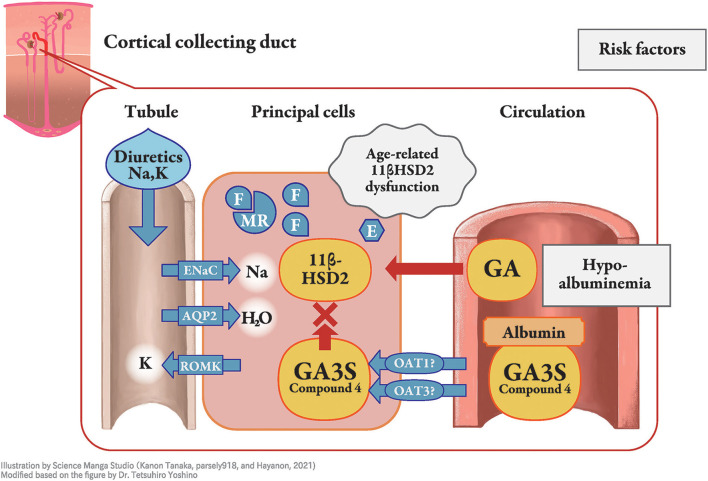
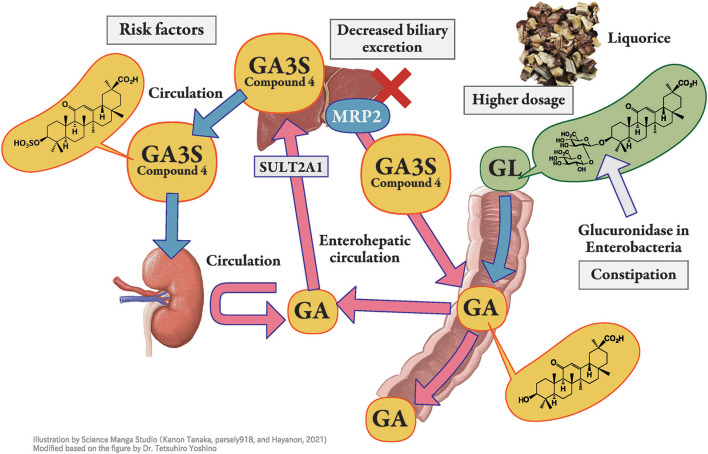
Licorice, the dried root or stolon of or , is commonly used worldwide as a food sweetener or crude drug. Its major ingredient is glycyrrhizin. Hypokalemia or pseudoaldosteronism (PsA) is one of the most frequent side effects of licorice intake. Glycyrrhizin metabolites inhibit type 2 11β-hydroxysteroid dehydrogenase (11βHSD2), which decomposes cortisol into inactive cortisone in the distal nephron, thereby inducing mineralocorticoid receptor activity. Among the several reported glycyrrhizin-metabolites, 18β-glycyrrhetyl-3--sulfate is the major compound found in humans after licorice consumption, followed by glycyrrhetinic acid. These metabolites are highly bound to albumin in blood circulation and are predominantly excreted into bile via multidrug resistance-associated protein 2 (Mrp2). High dosage and long-term use of licorice are constitutional risk factors for PsA. Orally administered glycyrrhizin is effectively hydrolyzed to glycyrrhetinic acid by the intestinal bacteria in constipated patients, which enhances the bioavailability of glycyrrhizin metabolites. Under hypoalbuminemic conditions, the unbound metabolite fractions can reach 11βHSD2 at the distal nephron. Hyper direct-bilirubin could be a surrogate marker of Mrp2 dysfunction, which results in metabolite accumulation. Older age is associated with reduced 11βHSD2 function, and several concomitant medications, such as diuretics, have been reported to affect the phenotype. This review summarizes several factors related to licorice-induced PsA, including daily dosage, long-term use, constipation, hypoalbuminemia, hyper direct-bilirubin, older age, and concomitant medications.
甘草,即光果甘草、胀果甘草或甘草的干燥根及根茎,在全球范围内普遍用作食品甜味剂或天然药物。其主要成分是甘草酸。低钾血症或假性醛固酮增多症(PsA)是摄入甘草最常见的副作用之一。甘草酸代谢产物抑制2型11β-羟类固醇脱氢酶(11βHSD2),该酶在远端肾单位将皮质醇分解为无活性的可的松,从而诱导盐皮质激素受体活性。在几种已报道的甘草酸代谢产物中,18β-甘草次酸-3-硫酸酯是食用甘草后在人体中发现的主要化合物,其次是甘草次酸。这些代谢产物在血液循环中与白蛋白高度结合,并主要通过多药耐药相关蛋白2(Mrp2)排泄到胆汁中。高剂量和长期使用甘草是PsA的体质危险因素。口服的甘草酸在便秘患者中被肠道细菌有效水解为甘草次酸,这提高了甘草酸代谢产物的生物利用度。在低白蛋白血症情况下,未结合的代谢产物部分可在远端肾单位到达11βHSD2。高直接胆红素可能是Mrp2功能障碍的替代标志物,这会导致代谢产物积累。年龄较大与11βHSD2功能降低有关,并且已报道几种伴随用药,如利尿剂,会影响其表型。本综述总结了与甘草诱导的PsA相关的几个因素,包括每日剂量、长期使用、便秘、低白蛋白血症、高直接胆红素、年龄较大和伴随用药。