Howlett Michael G, Scanes Robert J H, Fletcher Stephen P
Department of Chemistry, Chemistry Research Laboratory, University of Oxford, Oxford OX1 3TA, United Kingdom.
JACS Au. 2021 Aug 16;1(9):1355-1361. doi: 10.1021/jacsau.1c00138. eCollection 2021 Sep 27.
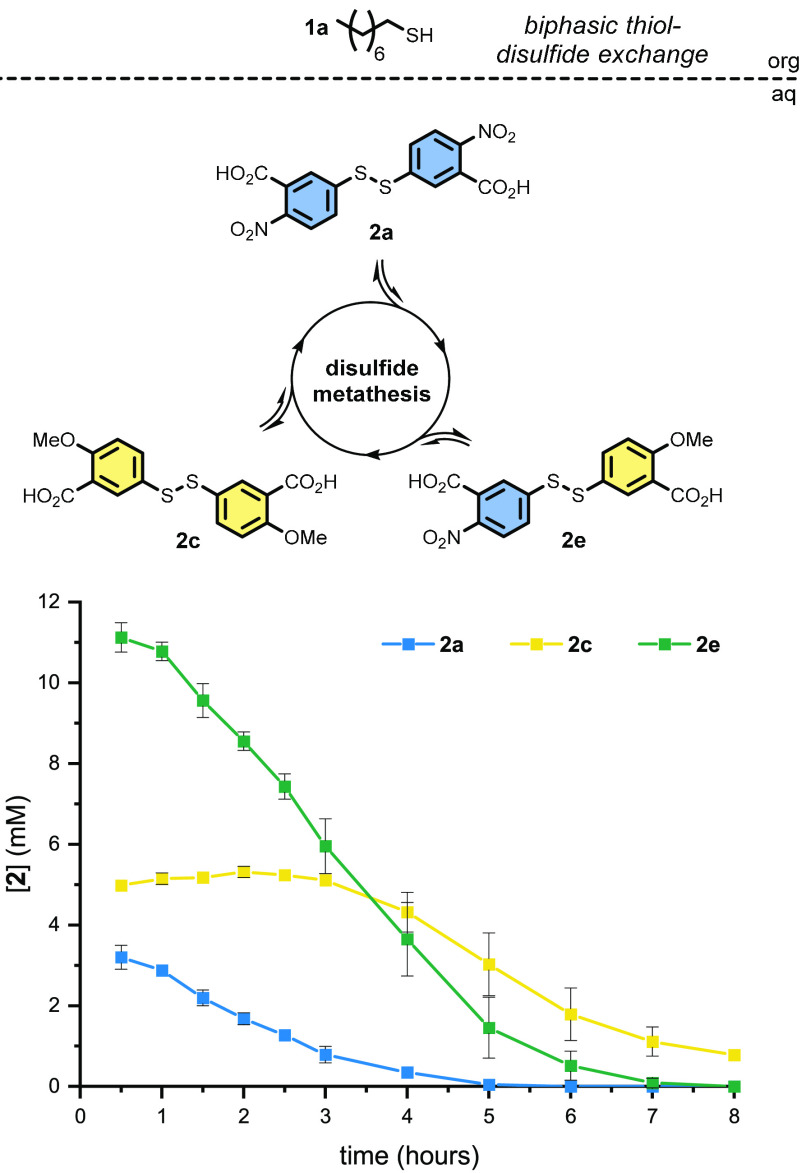
Models of chemical evolution are central to advancing origins of life research. To design more lifelike systems, we must expand our understanding of molecular selection mechanisms. Here, we show two selection modes that produce evolving populations of self-reproducing species, formed through thiol-disulfide exchange. Competition between thiol precursors can give clear succession patterns based on steric factors, an intrinsic property. A separate, emergent selection mechanism-dynamic activating metathesis-was found when exploring competing disulfide precursors. These experiments reveal that additional species generated in the mixture open up alternative reaction pathways to form self-reproducing products. Thus, increased compositional complexity provides certain species with a unique competitive advantage at the expense of others.
化学进化模型是推进生命起源研究的核心。为了设计更逼真的系统,我们必须扩展对分子选择机制的理解。在这里,我们展示了两种选择模式,它们通过硫醇 - 二硫键交换产生自我复制物种的进化种群。硫醇前体之间的竞争可以基于空间因素(一种固有属性)给出清晰的演替模式。在探索竞争性二硫键前体时发现了一种独立的、新兴的选择机制——动态活化复分解反应。这些实验表明,混合物中产生的其他物种开辟了形成自我复制产物的替代反应途径。因此,增加的组成复杂性以牺牲其他物种为代价为某些物种提供了独特的竞争优势。