Department of Chinese Pharmaceutical Sciences and Chinese Medicine Resources, China Medical University, Taichung, Taiwan.
Department of Physical Medicine and Rehabilitation, National Taiwan University Hospital, Bei-Hu Branch, Taipei, Taiwan.
Eur J Pain. 2022 Feb;26(2):445-462. doi: 10.1002/ejp.1871. Epub 2021 Oct 26.
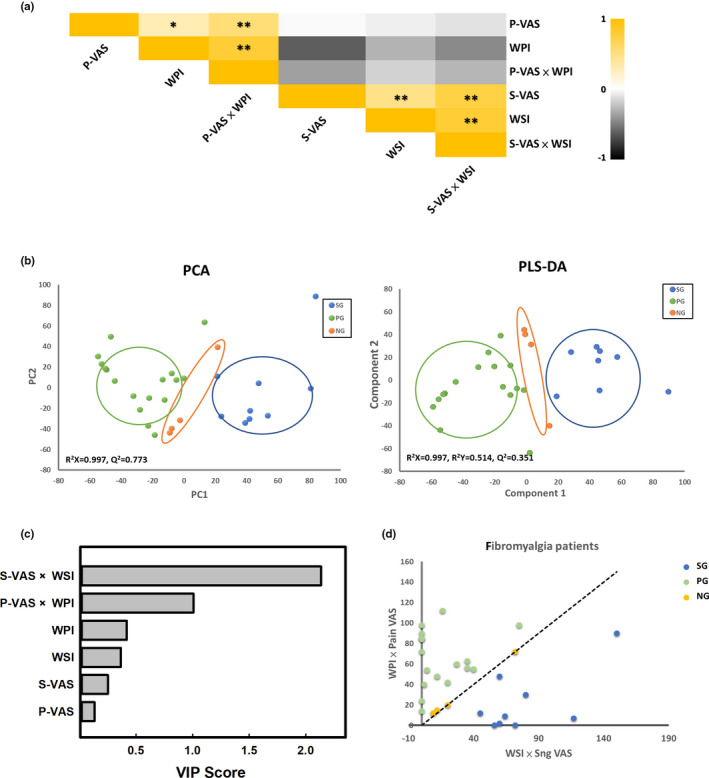
Fibromyalgia (FM) is characterized by chronic widespread pain. Its pathophysiological mechanisms remain poorly understood, and effective diagnosis and treatments are lacking. This study aimed to identify significantly changed biosignatures in FM and propose a novel classification for FM based on pain and soreness (sng) symptoms.
Urine and serum samples from 30 FM patients and 25 controls underwent metabolomic and proteomic profiling.
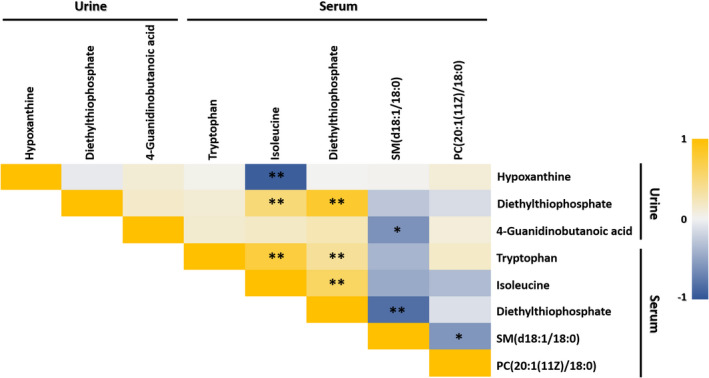
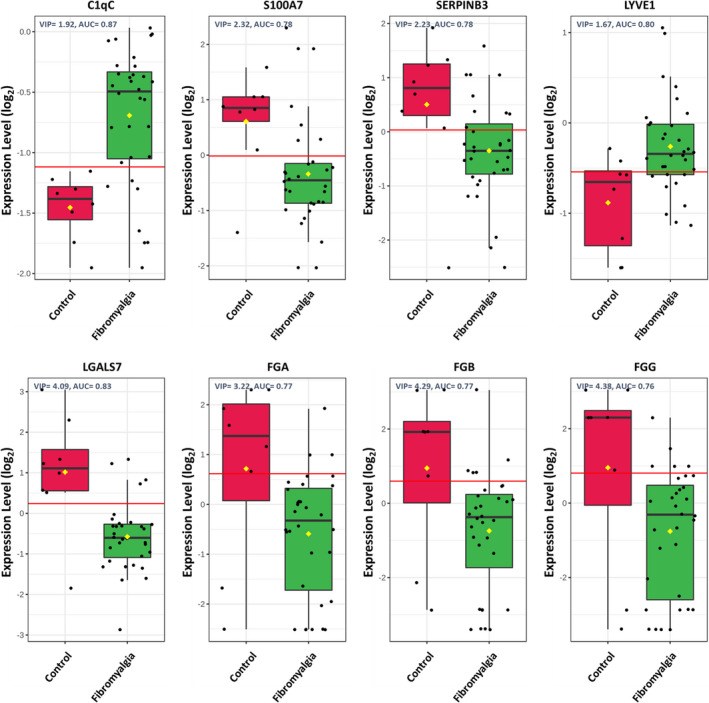
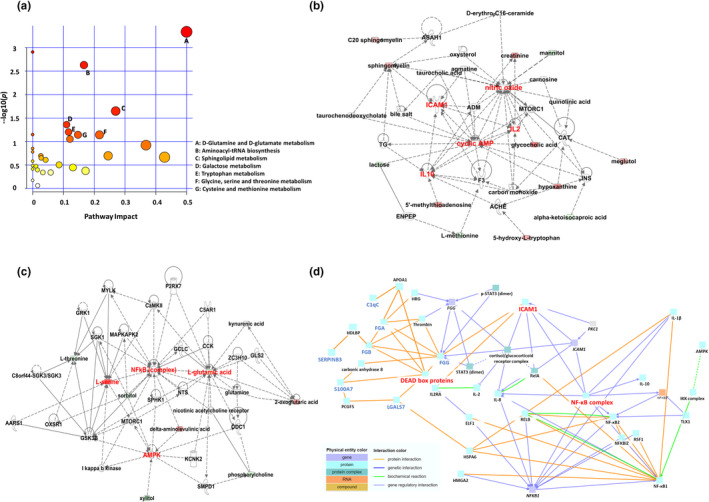
Compared with controls, FM patients showed significant differential expression of three metabolites in urine and five metabolites and eight proteins in serum. Of them, DETP, 4-guanidinobutanoic acid, SM(d18:1/18:0), PC(20:1(11Z)/18:0), S100A7, SERPINB3, galectin-7 and LYVE1 were first reported as potential biomarkers for FM. Furthermore, lactate, 2-methylmaleate and cotinine in urine and lactate, SM(d18:1/25:1), SM(d18:1/26:1) and prostaglandin D2 (PGD2) and PCYOX1, ITIH4, PFN1, LRG1, C8G, C8A, CP, CDH5 and DBH in serum could differentiate pain- (PG) and sng-dominant groups (SG). Lactate, 2-methylmaleate, cotinine, PCYOX1, ITIH4, PFN1 and DBH have a higher level in SG. SM(d18:1/25:1), SM(d18:1/26:1), PGD2, LRG1, C8G, C8A, CP and CDH5 in SG are lower than PG. The omics results indicated disordered free radical scavenging, and lipid and amino acid metabolism networks and resulting NF-κB-dependent cytokine generation in FM. Lactate level was altered simultaneously in urine and serum and significantly higher in sng-dominant patients than others.
In this study, we identified potential biomarkers from FM patients. The selected biomarkers could discriminate sng and pain phenotypes in FM patients. These results could help elucidate the underlying pathological mechanisms for more effective diagnosis and therapy for FM.
纤维肌痛症(FM)的特征是慢性广泛性疼痛。其病理生理机制仍知之甚少,且缺乏有效的诊断和治疗方法。本研究旨在确定 FM 中明显改变的生物标志物,并基于疼痛和压痛(sng)症状提出一种新的 FM 分类方法。
对 30 名 FM 患者和 25 名对照者的尿液和血清样本进行代谢组学和蛋白质组学分析。
与对照组相比,FM 患者尿液中有 3 种代谢物和血清中有 5 种代谢物和 8 种蛋白质的表达水平有显著差异。其中,DETP、4-胍基丁酸、SM(d18:1/18:0)、PC(20:1(11Z)/18:0)、S100A7、SERPINB3、半乳糖凝集素-7 和 LYVE1 被首次报道为 FM 的潜在生物标志物。此外,尿液中的乳酸、2-甲基马来酸和可替宁以及血清中的乳酸、SM(d18:1/25:1)、SM(d18:1/26:1)和前列腺素 D2(PGD2)以及 PCYOX1、ITIH4、PFN1、LRG1、C8G、C8A、CP、CDH5 和 DBH 可以区分疼痛主导(PG)和压痛主导(SG)组。SG 组中乳酸、2-甲基马来酸、可替宁、PCYOX1、ITIH4、PFN1 和 DBH 的水平较高。SG 组中 SM(d18:1/25:1)、SM(d18:1/26:1)、PGD2、LRG1、C8G、C8A、CP 和 CDH5 的水平较低。组学结果表明 FM 中存在自由基清除紊乱、脂质和氨基酸代谢网络以及由此产生的 NF-κB 依赖性细胞因子生成。乳酸水平在尿液和血清中同时发生改变,在压痛主导的患者中明显高于其他患者。
本研究从 FM 患者中鉴定出潜在的生物标志物。这些标志物可区分 FM 患者的 sng 和疼痛表型。这些结果有助于阐明潜在的病理生理机制,从而为 FM 的更有效诊断和治疗提供帮助。