School Health, Federation University Australia, Victoria, Australia.
Menzies Institute for Medical Research, University of Tasmania, Tasmania, Australia.
BMC Health Serv Res. 2021 Oct 5;21(1):1052. doi: 10.1186/s12913-021-07072-1.
Recruiting and retaining medical, nursing, and allied health professionals in rural and remote areas is a worldwide challenge, compromising continuity of care and population health outcomes in these locations. Specifically, pharmacists play an essential and accessible frontline healthcare role, and are often the first point of contact for health concerns. Despite several incentives, there remains a maldistribution and undersupply of pharmacists in rural and remote areas across many parts of the world. Although current systematic reviews have focussed on factors affecting pharmacists' retention generally, literature specifically focused on rural pharmacist workforce in a global context remains limited. The aim of this systematic review is to identify factors associated with recruitment and retention of the pharmacist workforce in rural and remote settings. Better understanding of these contributors will inform more effective interventional strategies to resolve pharmacist workforce shortages.
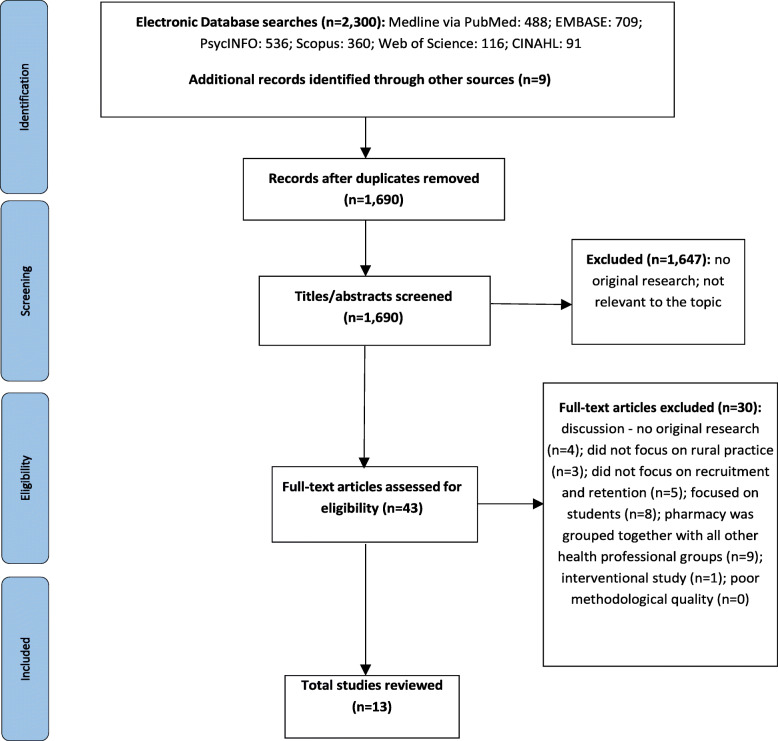
A systematic search of primary studies was conducted in online databases, including Medline, Embase, CINAHL, Scopus, Web of Science and PsycINFO, and by hand-searching of reference lists. Eligible studies were identified based on predefined inclusion/exclusion criteria and methodological quality criteria, utilising the Critical Appraisal Skills Programme (CASP) and Good Reporting of A Mixed Methods Study (GRAMMS) checklists.
The final review included 13 studies, with quantitative, qualitative, or mixed methods research design. Study-specific factors associated with recruitment and retention of pharmacists in rural practice were identified and grouped into five main themes: geographic and family-related, economic and resources, scope of practice or skills development, the practice environment, and community and practice support factors.
The results provide critical insights into the complexities of rural recruitment and retention of pharmacists and confirms the need for flexible yet multifaceted responses to overcoming rural pharmacist workforce challenges. Overall, the results provide an opportunity for rural communities and health services to better identify key strengths and challenges unique to the rural and remote pharmacist workforce that may be augmented to guide more focussed recruitment and retention endeavours.
在农村和偏远地区招募和留住医疗、护理和相关健康专业人员是一个全球性挑战,这会影响这些地区的医疗服务连续性和人口健康结果。具体来说,药剂师在医疗保健中扮演着至关重要且易于接触的前线角色,他们通常是解决健康问题的第一站。尽管有多项激励措施,但在世界许多地区,农村和偏远地区的药剂师仍然分布不均且供应不足。尽管目前的系统评价侧重于影响药剂师留任的一般因素,但在全球背景下专门针对农村药剂师劳动力的文献仍然有限。本系统评价的目的是确定与农村和偏远地区药剂师劳动力招聘和留任相关的因素。更好地了解这些因素将为制定更有效的干预策略以解决药剂师劳动力短缺问题提供信息。
在在线数据库中进行了系统的初级研究搜索,包括 Medline、Embase、CINAHL、Scopus、Web of Science 和 PsycINFO,并通过手工搜索参考文献列表。根据预先确定的纳入/排除标准和方法学质量标准,利用批判性评估技能计划(CASP)和混合方法研究报告的良好标准(GRAMMS)检查表来确定符合条件的研究。
最终的综述包括 13 项研究,研究设计采用定量、定性或混合方法。确定并将与农村实践中招募和留住药剂师相关的研究特定因素分为五个主要主题:地理和家庭相关、经济和资源、实践范围或技能发展、实践环境以及社区和实践支持因素。
研究结果深入了解了农村地区招募和留住药剂师的复杂性,并证实需要灵活但多方面的应对措施来克服农村药剂师劳动力的挑战。总体而言,结果为农村社区和卫生服务部门提供了一个机会,可以更好地了解农村和偏远地区药剂师劳动力所特有的关键优势和挑战,这些优势和挑战可以加以利用,以指导更有针对性的招聘和留任工作。