Xiao Jianpeng, Dai Jiya, Hu Jianxiong, Liu Tao, Gong Dexin, Li Xing, Kang Min, Zhou Yan, Li Yihan, Quan Yi, He Guanhao, Zhong Ruoxi, Zhu Zhihua, Huang Qiong, Zhang Yingtao, Huang Jianhua, Du Qingfeng, Li Yan, Song Tie, Hu Wenbiao, Zhong Haojie, Ma Wenjun
Guangdong Provincial Institute of Public Health, Guangzhou, 511430, China.
Guangdong Provincial Center for Disease Control and Prevention, Guangzhou, 511430, China.
Lancet Reg Health West Pac. 2021 Dec;17:100282. doi: 10.1016/j.lanwpc.2021.100282. Epub 2021 Oct 1.
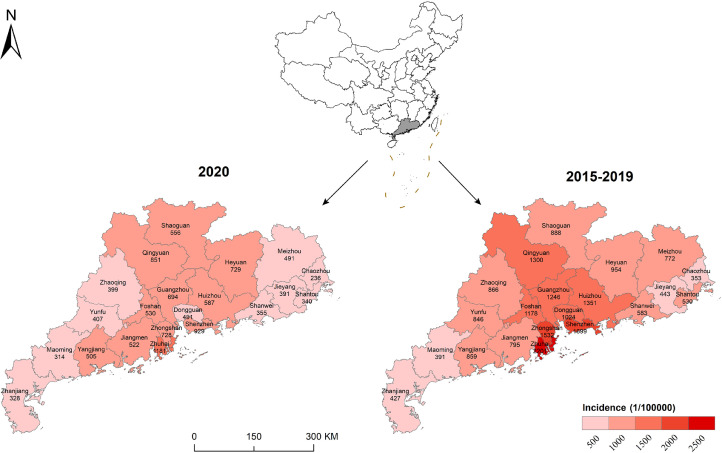
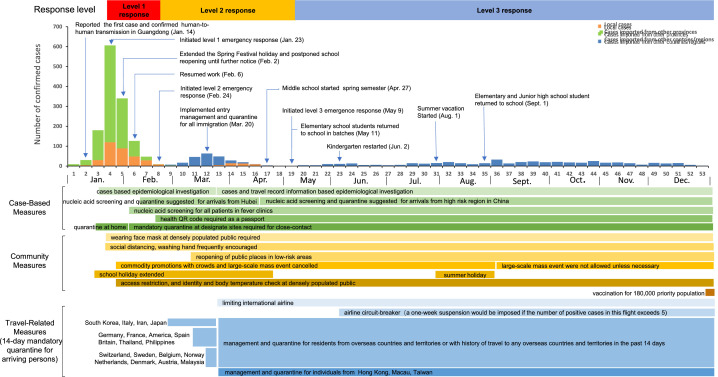
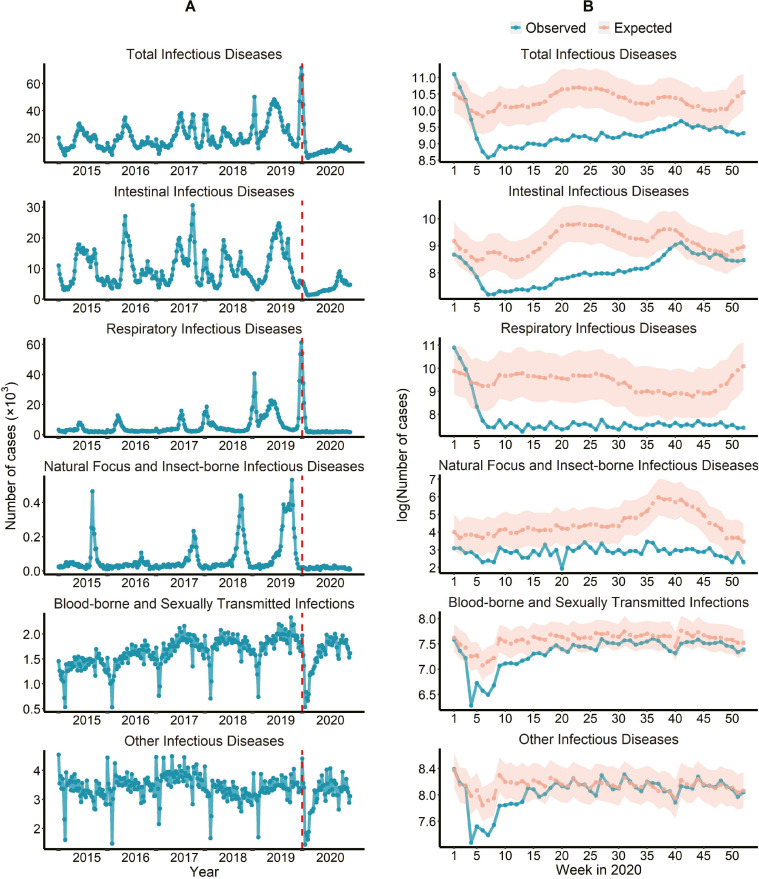
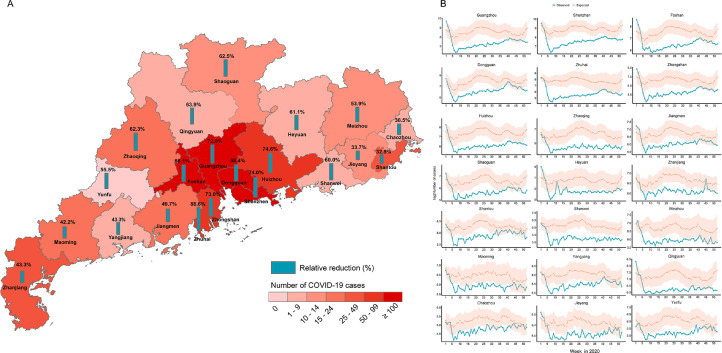
: Nonpharmaceutical interventions (NPIs) are public health measures that aim to suppress the transmission of infectious diseases, including border restrictions, quarantine and isolation, community management, social distancing, face mask usage, and personal hygiene. This research aimed to assess the co-benefits of NPIs against COVID-19 on notifiable infectious diseases (NIDs) in Guangdong Province, China. Based on NID data from the Notifiable Infectious Diseases Surveillance System in Guangdong, we first compared the incidence of NIDs during the emergency response period (weeks 4-53 of 2020) with those in the same period of 2015-2019 and then compared that with the expected incidence during the synchronous period of 2020 for each city by using a Bayesian structural time series model. A total of 514,341 cases of 39 types of NIDs were reported in Guangdong during the emergency response period in 2020, which decreased by 50·7% compared with the synchronous period during 2015-2019. It was estimated that the number of 39 NIDs during the emergency response in 2020 was 65·6% (95% credible interval [CI]: 64·0% - 68·2%) lower than expected, which means that 982,356 (95% CI: 913,443 - 1,105,170) cases were averted. The largest reduction (82·1%) was found for children aged 0-14 years. For different categories of NIDs, natural focal diseases and insect-borne infectious diseases had the greatest reduction (89·4%), followed by respiratory infectious diseases (87·4%), intestinal infectious diseases (59·4%), and blood-borne and sexually transmitted infections (18·2%). Dengue, influenza, and hand-foot-and-mouth disease were reduced by 99·3%, 95·1%, and 76·2%, respectively. Larger reductions were found in the regions with developed economies and a higher number of COVID-19 cases. NPIs against COVID-19 may have a large co-benefit on the prevention of other infectious diseases in Guangdong, China, and the effects have heterogeneity in populations, diseases, time and space. Key-Area Research and Development Program of Guangdong Province.
非药物干预措施(NPIs)是旨在抑制传染病传播的公共卫生措施,包括边境限制、检疫与隔离、社区管理、社交距离、佩戴口罩以及个人卫生。本研究旨在评估中国广东省针对新冠疫情采取的非药物干预措施对法定传染病(NIDs)的协同效益。基于广东省法定传染病监测系统的法定传染病数据,我们首先将应急响应期间(2020年第4 - 53周)法定传染病的发病率与2015 - 2019年同期的发病率进行比较,然后通过贝叶斯结构时间序列模型,将其与2020年同期各城市的预期发病率进行比较。2020年应急响应期间,广东省共报告了39种法定传染病病例514,341例,与2015 - 2019年同期相比下降了50.7%。据估计,2020年应急响应期间39种法定传染病的发病数比预期低65.6%(95%可信区间[CI]:64.0% - 68.2%),这意味着避免了982,356例(95%CI:913,443 - 1,105,170)发病。0 - 14岁儿童的发病数下降幅度最大(82.1%)。对于不同类别的法定传染病,自然疫源性疾病和虫媒传染病的下降幅度最大(89.4%),其次是呼吸道传染病(87.4%)、肠道传染病(59.4%)以及血源及性传播感染(18.2%)。登革热、流感和手足口病的发病数分别下降了99.3%、95.1%和76.2%。经济发达且新冠病例数较多的地区下降幅度更大。针对新冠疫情的非药物干预措施可能对中国广东省预防其他传染病具有较大的协同效益,且其效果在人群、疾病、时间和空间上存在异质性。广东省重点领域研发计划。