Gong Xun, You Lili, Li Feng, Chen Qingyu, Chen Chaogang, Zhang Xiaoyun, Zhang Xiuwei, Xuan Wenting, Sun Kan, Lao Guojuan, Wang Chuan, Li Yan, Xu Mingtong, Ren Meng, Yan Li
Department of Endocrinology, Sun Yat-sen Memorial Hospital, Sun Yat-sen University, Guangzhou, People's Republic of China.
Department of Medical Examination Center, Sun Yat-sen Memorial Hospital, Sun Yat-sen University, Guangzhou, People's Republic of China.
Endocr Connect. 2021 Nov 3;10(11):1410-1419. doi: 10.1530/EC-21-0235.
Adiponectin is an adipocyte-derived hormone with an important role in glucose metabolism. The present study explored the effect of adiponectin in diverse population groups on pre-diabetes and newly diagnosed diabetes.
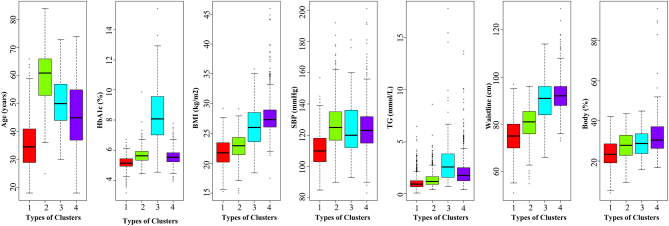
A total of 3300 individuals were enrolled and their data were collected in the analyses dataset from December 2018 to October 2019. Cluster analysis was conducted based on age, BMI, waistline, body fat, systolic blood pressure, triglycerides, and glycosylated hemoglobin 1c. Cluster analysis divided the participants into four groups: a young-healthy group, an elderly-hypertension group, a high glucose-lipid group, and an obese group. Odds ratio (OR) and 95% CIs were calculated using multivariate logistic regression analysis.
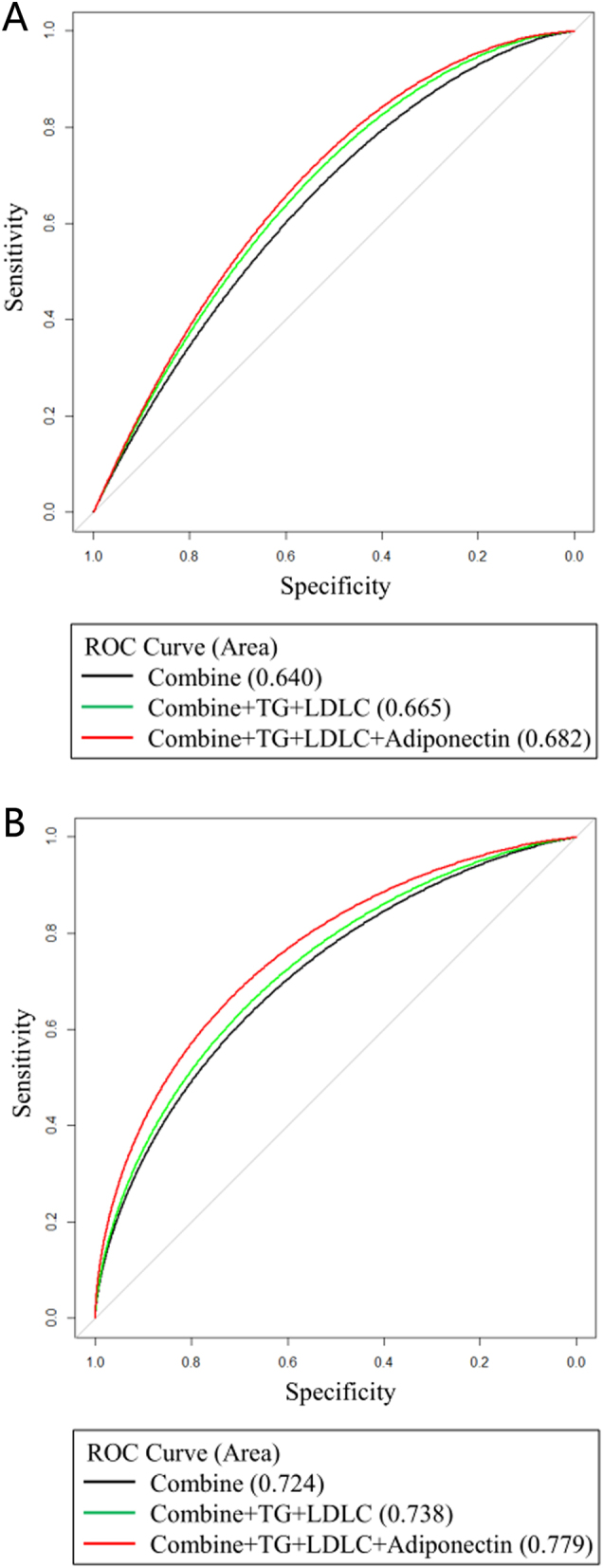
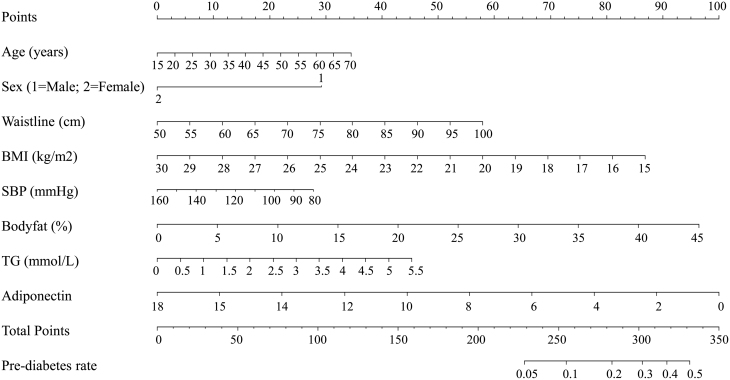
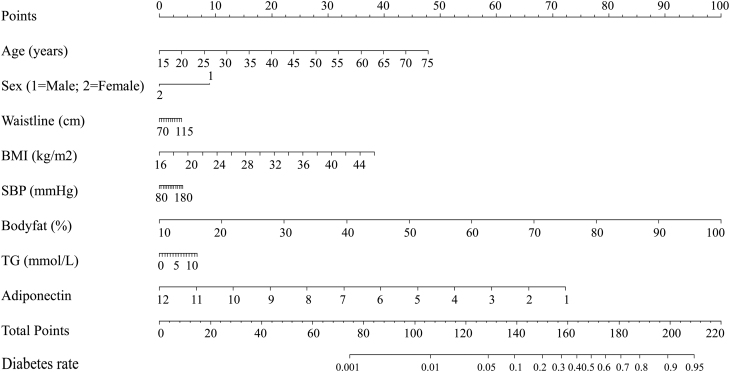
Compared with the first quartile of adiponectin, the risk of pre-diabetes of fourth quartile was decreased 61% (aOR = 0.39, 95% CI (0.20-0.73)) in the young-healthy group; and the risk of diabetes of fourth quartile was decreased 85% (aOR = 0.15, 95% CI (0.02-0.67)) in the obese group. There were no significant correlations between the adiponectin level and diabetes/pre-diabetes in the other two groups. Additionally, receiver operating characteristic curve analysis indicated that adiponectin could significantly improve the diagnosis based on models in the young-healthy group (from 0.640 to 0.675) and the obese group (from 0.714 to 0.761).
Increased adiponectin levels were associated with decreased risk of pre-diabetes in the young-healthy population, and with a decreased the risk of diabetes in the obese population. An increased adiponectin level is an independent protective factor for pre-diabetes and diabetes in a specific population in south China.
脂联素是一种由脂肪细胞分泌的激素,在葡萄糖代谢中起重要作用。本研究探讨了脂联素在不同人群中对糖尿病前期和新诊断糖尿病的影响。
共纳入3300名个体,其数据于2018年12月至2019年10月收集至分析数据集。基于年龄、体重指数、腰围、体脂、收缩压、甘油三酯和糖化血红蛋白1c进行聚类分析。聚类分析将参与者分为四组:年轻健康组、老年高血压组、高糖脂组和肥胖组。采用多因素logistic回归分析计算比值比(OR)和95%置信区间(CI)。
与脂联素第一四分位数相比,年轻健康组中脂联素第四四分位数的糖尿病前期风险降低了61%(校正OR = 0.39,95%CI(0.20 - 0.73));肥胖组中脂联素第四四分位数的糖尿病风险降低了85%(校正OR = 0.15,95%CI(0.02 - 0.67))。其他两组中脂联素水平与糖尿病/糖尿病前期之间无显著相关性。此外,受试者工作特征曲线分析表明,脂联素可显著改善年轻健康组(从0.640提高到0.675)和肥胖组(从0.714提高到0.761)基于模型的诊断。
脂联素水平升高与年轻健康人群中糖尿病前期风险降低以及肥胖人群中糖尿病风险降低相关。脂联素水平升高是中国南方特定人群中糖尿病前期和糖尿病的独立保护因素。