Kadonaga J T, Tjian R
Proc Natl Acad Sci U S A. 1986 Aug;83(16):5889-93. doi: 10.1073/pnas.83.16.5889.
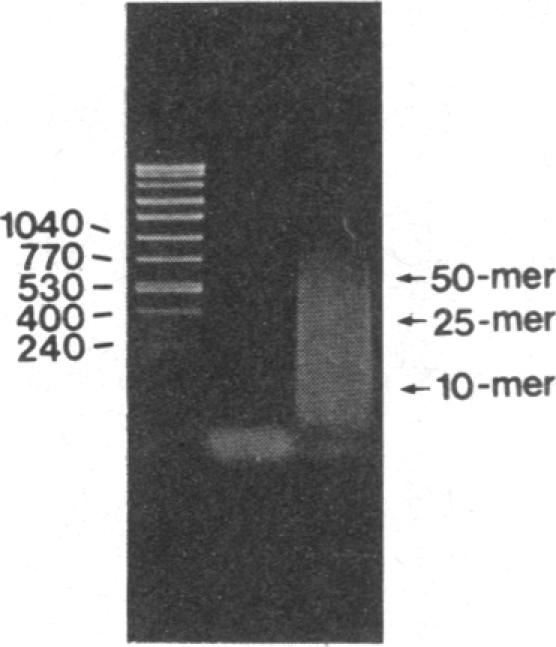
We describe a method for affinity purification of sequence-specific DNA binding proteins that is fast and effective. Complementary chemically synthesized oligodeoxynucleotides that contain a recognition site for a sequence-specific DNA binding protein are annealed and ligated to give oligomers. This DNA is then covalently coupled to Sepharose CL-2B with cyanogen bromide to yield the affinity resin. A partially purified protein fraction is combined with competitor DNA and subsequently passed through the DNA-Sepharose resin. The desired sequence-specific DNA binding protein is purified because it preferentially binds to the recognition sites in the affinity resin rather than to the nonspecific competitor DNA in solution. For example, a protein fraction that is enriched for transcription factor Sp1 can be further purified 500- to 1000-fold by two sequential affinity chromatography steps to give Sp1 of an estimated 90% homogeneity with 30% yield. In addition, the use of tandem affinity columns containing different protein binding sites allows the simultaneous purification of multiple DNA binding proteins from the same extract. This method provides a means for the purification of rare sequence-specific DNA binding proteins, such as Sp1 and CAAT-binding transcription factor.
我们描述了一种快速有效的序列特异性DNA结合蛋白亲和纯化方法。将含有序列特异性DNA结合蛋白识别位点的互补化学合成寡脱氧核苷酸退火并连接以形成寡聚物。然后将该DNA用溴化氰共价偶联到琼脂糖凝胶CL-2B上,得到亲和树脂。将部分纯化的蛋白组分与竞争DNA混合,随后通过DNA-琼脂糖树脂。所需的序列特异性DNA结合蛋白得以纯化,因为它优先结合亲和树脂中的识别位点,而不是溶液中的非特异性竞争DNA。例如,富含转录因子Sp1的蛋白组分可通过两个连续的亲和色谱步骤进一步纯化500至1000倍,得到估计纯度为90%、产率为30%的Sp1。此外,使用含有不同蛋白结合位点的串联亲和柱可从同一提取物中同时纯化多种DNA结合蛋白。该方法为纯化稀有序列特异性DNA结合蛋白(如Sp1和CAAT结合转录因子)提供了一种手段。