Han Siqi, Li Guangchao, Jia Meng, Zhao Yulu, He Chenglong, Huang Mengxi, Jiang Longwei, Wu Meijuan, Yang Jiahe, Ji Xiaoqin, Liu Xiaobei, Chen Cheng, Chu Xiaoyuan
Department of Medical Oncology, Jinling Hospital, Nanjing, The First School of Clinical Medicine, Southern Medical University, Guangzhou, China.
Department of Medical Oncology, Jinling Hospital, School of Medicine, Nanjing University, Nanjing, China.
Front Mol Biosci. 2021 Sep 20;8:743013. doi: 10.3389/fmolb.2021.743013. eCollection 2021.
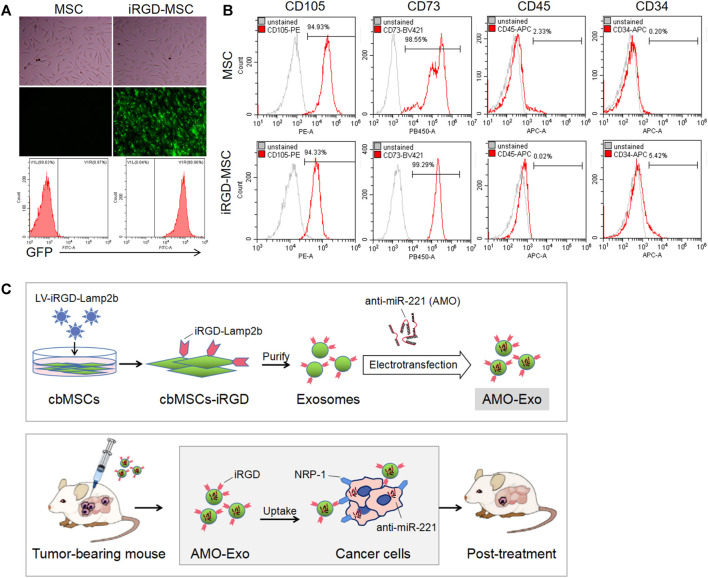
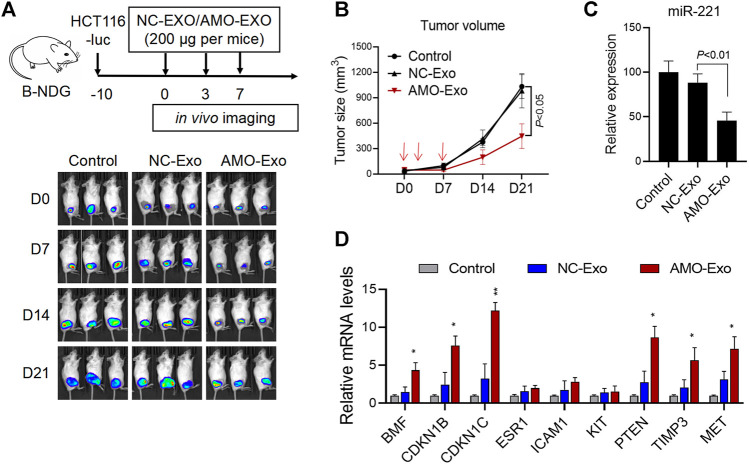
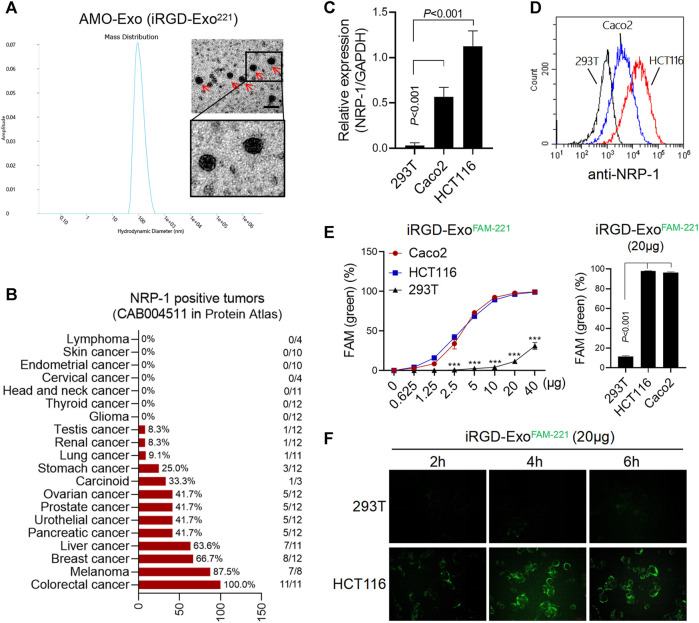
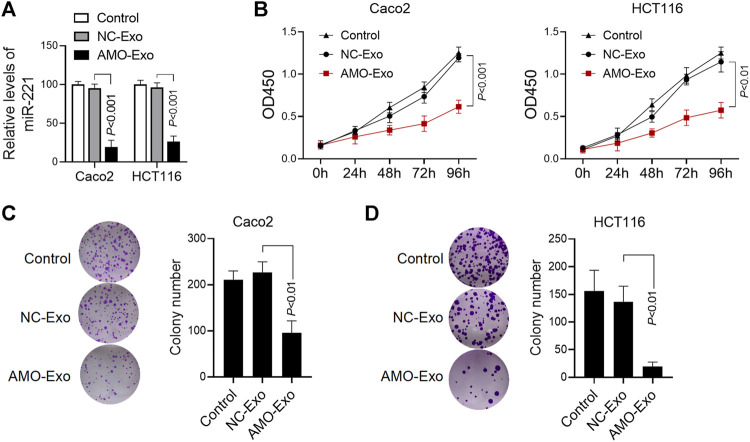
Exosomes, as natural intercellular information carriers, have great potential in the field of drug delivery. Many studies have focused on modifying exosome surface proteins to allow drugs to specifically target cancer cells. In this study, human cord blood mesenchymal stromal cell-derived exosomes were used in the delivery of anti-miRNA oligonucleotides so as to be specifically ingested by tumor cells to perform anti-tumor functions. Mesenchymal stem cells modified by the fusion gene iRGD-Lamp2b were constructed to separate and purify exosomes, and the anti-miRNA-221 oligonucleotide (AMO) was loaded into the exosomes by electroporation. The AMO-loaded exosomes (AMO-Exos) effectively inhibited the proliferation and clonal formation of colon cancer cells , and it was further found that AMO-Exos was taken up by tumor cells through interaction with the NRP-1 protein. The results of a xenograft tumor model also showed that iRGD-modified exosomes were obviously enriched in tumor sites, exerting excellent anti-tumor efficacy. imaging showed that exosomes were mainly distributed in liver, spleen, and lung tissues. Our results suggest that genetically modified exosomes could be an ideal natural nanostructure for anti-miRNA oligonucleotide delivery.
外泌体作为天然的细胞间信息载体,在药物递送领域具有巨大潜力。许多研究聚焦于修饰外泌体表面蛋白,以使药物能够特异性靶向癌细胞。在本研究中,人脐带血间充质基质细胞衍生的外泌体被用于递送抗 miRNA 寡核苷酸,从而被肿瘤细胞特异性摄取以发挥抗肿瘤功能。构建了由融合基因 iRGD-Lamp2b 修饰的间充质干细胞以分离和纯化外泌体,并通过电穿孔将抗 miRNA-221 寡核苷酸(AMO)载入外泌体。载入 AMO 的外泌体(AMO-Exos)有效抑制了结肠癌细胞的增殖和克隆形成,并且进一步发现 AMO-Exos 通过与 NRP-1 蛋白相互作用被肿瘤细胞摄取。异种移植肿瘤模型的结果还表明,iRGD 修饰的外泌体在肿瘤部位明显富集,发挥了优异的抗肿瘤功效。成像显示外泌体主要分布在肝、脾和肺组织中。我们的结果表明,基因修饰的外泌体可能是用于抗 miRNA 寡核苷酸递送的理想天然纳米结构。