Department of Family Medicine and Community Health, Duke University, Durham, NC, USA.
Department of Population Health Sciences, University of Utah, Salt Lake City, UT, USA.
Med Decis Making. 2022 Apr;42(3):364-374. doi: 10.1177/0272989X211028563. Epub 2021 Oct 7.
Rates of shared decision making (SDM) are relatively low in early stage prostate cancer decisions, as patients' values are not well integrated into a preference-sensitive treatment decision. The study objectives were to develop a SDM training video, measure usability and satisfaction, and determine the effect of the intervention on preparing patients to participate in clinical appointments.
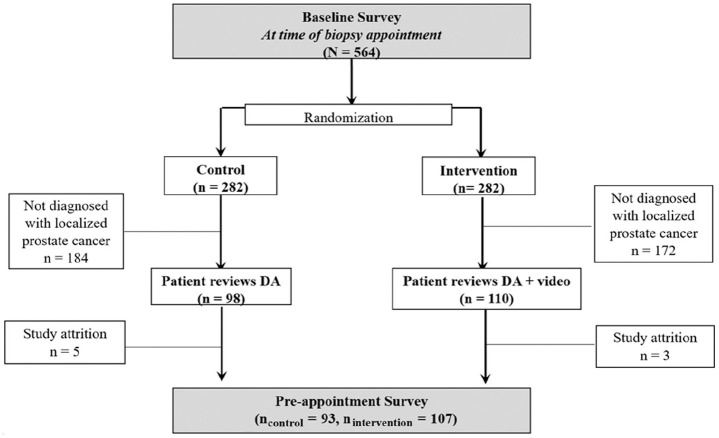
A randomized controlled trial was conducted to compare a plain-language decision aid (DA) to the DA plus a patient SDM training video. Patients with early stage prostate cancer completed survey measures at baseline and after reviewing the intervention materials. Survey items assessed patients' knowledge, beliefs related to SDM, and perceived readiness/intention to participate in their upcoming clinical appointment.
Of those randomized to the DA + SDM video group, most participants (91%) watched the video and 93% would recommend the video to others. Participants in the DA + SDM video group, compared to the DA-only group, reported an increased desire to participate in the decision (mean = 3.65 v. 3.39, < 0.001), less decision urgency (mean = 2.82 v. 3.39, < 0.001), and improved self-efficacy for communicating with physicians (mean = 4.69 v. 4.50, = 0.05). These participants also reported increased intentions to seek a referral from a radiation oncologist (73% v. 51%, = 0.004), to take notes (mean = 3.23 v. 2.86, = 0.004), and to record their upcoming appointments (mean = 1.79 v. 1.43, = 0.008).
A novel SDM training video was accepted by patients and changed several measures associated with SDM. This may be a scalable, cost-effective way to prepare patients with early stage prostate cancer to participate in their clinical appointments.[Box: see text].
在早期前列腺癌决策中,共享决策(SDM)的比率相对较低,因为患者的价值观尚未很好地融入到偏好敏感的治疗决策中。本研究的目的是开发一种 SDM 培训视频,测量其可用性和满意度,并确定干预对患者准备参加临床预约的影响。
进行了一项随机对照试验,比较了通俗易懂的决策辅助工具(DA)与 DA 加患者 SDM 培训视频。早期前列腺癌患者在基线和查看干预材料后完成了调查测量。调查项目评估了患者的知识、与 SDM 相关的信念以及对参与即将到来的临床预约的准备程度/意向。
在随机分配到 DA+SDM 视频组的患者中,大多数(91%)观看了视频,93%的患者会向他人推荐该视频。与仅接受 DA 的组相比,观看了 DA+SDM 视频的患者表示更希望参与决策(平均=3.65 比 3.39,<0.001),决策紧迫性降低(平均=2.82 比 3.39,<0.001),与医生沟通的自我效能感提高(平均=4.69 比 4.50,=0.05)。这些患者还报告说,他们更有可能寻求放射肿瘤学家的转诊(73%比 51%,=0.004),记录笔记(平均=3.23 比 2.86,=0.004),并记录即将到来的预约(平均=1.79 比 1.43,=0.008)。
一种新颖的 SDM 培训视频受到了患者的欢迎,并改变了与 SDM 相关的几个措施。这可能是一种可扩展、具有成本效益的方法,可以让早期前列腺癌患者为参与临床预约做好准备。