Division of Gastroenterology, Bezmialem Vakif University, Istanbul, Turkey.
Management Information Systems Department, School of Business and Management Science, Istanbul Medipol University, Istanbul, Turkey.
Dig Dis. 2022;40(4):427-435. doi: 10.1159/000520032. Epub 2021 Oct 7.
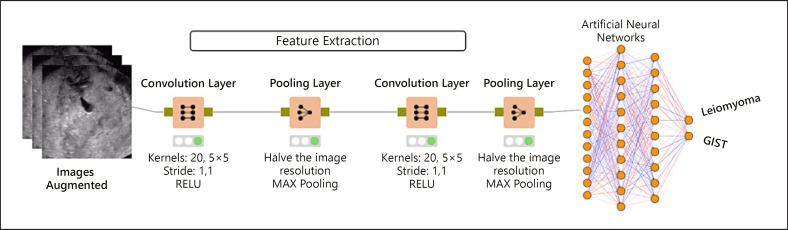
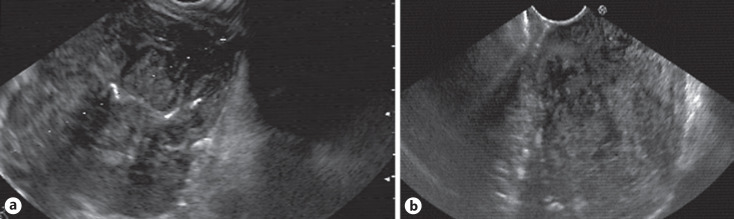
Endoscopic ultrasonography (EUS) is crucial to diagnose and evaluate gastrointestinal mesenchymal tumors (GIMTs). However, EUS-guided biopsy does not always differentiate gastrointestinal stromal tumors (GISTs) from leiomyomas. We evaluated the ability of a convolutional neural network (CNN) to differentiate GISTs from leiomyomas using EUS images. The conventional EUS features of GISTs were also compared with leiomyomas.
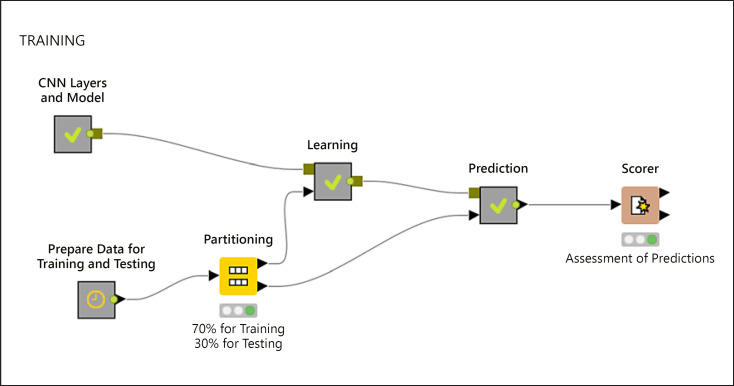
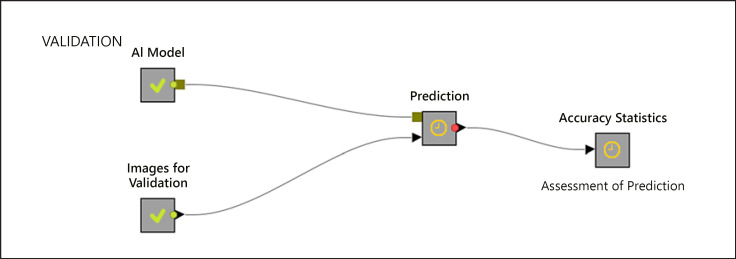
Patients who underwent EUS for evaluation of upper GIMTs between 2010 and 2020 were retrospectively reviewed, and 145 patients (73 women and 72 men; mean age 54.8 ± 13.5 years) with GISTs (n = 109) or leiomyomas (n = 36), confirmed by immunohistochemistry, were included. A total of 978 images collected from 100 patients were used to train and test the CNN system, and 384 images from 45 patients were used for validation. EUS images were also evaluated by an EUS expert for comparison with the CNN system.
The sensitivity, specificity, and accuracy of the CNN system for diagnosis of GIST were 92.0%, 64.3%, and 86.98% for the validation dataset, respectively. In contrast, the sensitivity, specificity, and accuracy of the EUS expert interpretations were 60.5%, 74.3%, and 63.0%, respectively. Concerning EUS features, only higher echogenicity was an independent and significant factor for differentiating GISTs from leiomyomas (p < 0.05).
The CNN system could diagnose GIMTs with higher accuracy than an EUS expert and could be helpful in differentiating GISTs from leiomyomas. A higher echogenicity may also aid in differentiation.
内镜超声检查(EUS)对于诊断和评估胃肠道间质肿瘤(GIMTs)至关重要。然而,EUS 引导下的活检并不总能区分胃肠道间质瘤(GISTs)和平滑肌瘤。我们评估了卷积神经网络(CNN)使用 EUS 图像区分 GISTs 和平滑肌瘤的能力。还比较了 GISTs 的传统 EUS 特征与平滑肌瘤。
回顾性分析 2010 年至 2020 年间因上 GIMTs 而行 EUS 评估的患者,纳入 145 例(73 名女性和 72 名男性;平均年龄 54.8 ± 13.5 岁),经免疫组织化学证实为 GIST(n = 109)或平滑肌瘤(n = 36)。从 100 名患者中采集了 978 张图像用于训练和测试 CNN 系统,从 45 名患者中采集了 384 张图像用于验证。EUS 图像也由 EUS 专家进行评估,以便与 CNN 系统进行比较。
CNN 系统对验证数据集 GIST 的诊断的敏感性、特异性和准确性分别为 92.0%、64.3%和 86.98%。相比之下,EUS 专家解释的敏感性、特异性和准确性分别为 60.5%、74.3%和 63.0%。关于 EUS 特征,只有更高的回声强度是区分 GISTs 和平滑肌瘤的独立且重要的因素(p < 0.05)。
CNN 系统可以比 EUS 专家更准确地诊断 GIMTs,并且有助于区分 GISTs 和平滑肌瘤。回声强度较高也可能有助于区分。