Sharaf Kariem, Felicio-Briegel Axelle, Widmann Magdalena, Huber Johanna, Eggersmann Tanja Kristina, Stadlberger Ursula, Schrötzlmair Florian, Canis Martin, Lechner Axel
Klinik und Poliklinik für Hals‑, Nasen- und Ohrenheilkunde, LMU Klinikum, Marchioninistraße 15, 81377, München, Deutschland.
Institut für Didaktik und Ausbildungsforschung in der Medizin, LMU Klinikum, Pettenkoferstraße 8a, 80336, München, Deutschland.
HNO. 2022 Apr;70(4):295-303. doi: 10.1007/s00106-021-01097-y. Epub 2021 Oct 7.
A central goal of medical school is acquisition of theoretical and practical competences. However, evidence on how capacity acquisition can be measured for special examination techniques is scarce. ToSkORL (Teaching of Skills in Otorhinolaryngology) is a project aimed at scientifically and didactically investigating students' self-evaluation skills in otorhinolaryngologic and head and neck examination techniques.
During the examination techniques course, a standardized oral and practical exam for nine different techniques was conducted. Using Likert scales, self-evaluation was based on questionnaires before the clinical skills exam and objective evaluation was performed by the examiners during the examination using a checklist. Self- and objective evaluation were correlated. Nine different examination skills were assessed 42 times each by a total of 91 students.
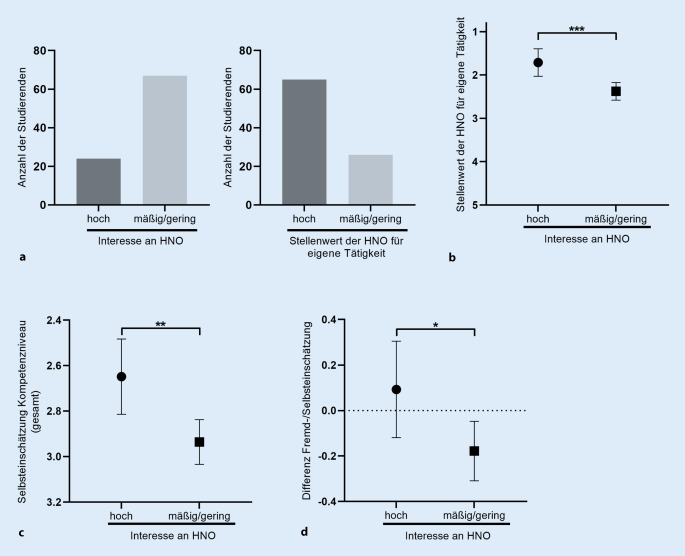
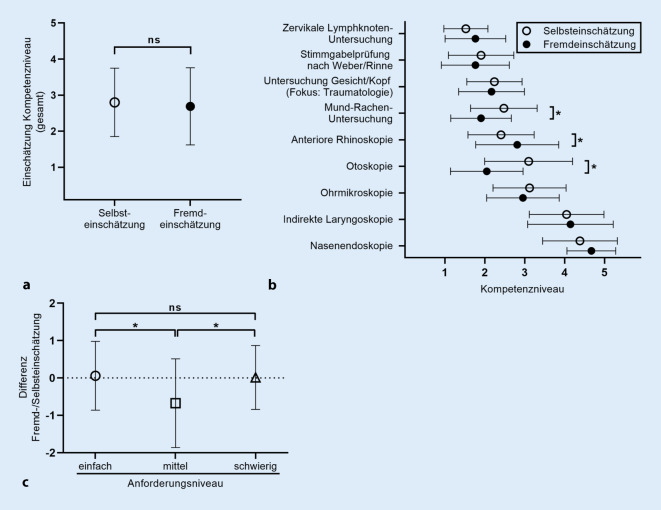
Self-evaluation of competence in the different examination skills varied widely. Nevertheless, self- and objective evaluation correlated well overall, independent of age and gender. Students highly interested in otorhinolaryngology rated their own skills higher but tended toward overestimation. For examination items with intermediate difficulty, the highest divergences between self- and objective evaluation were found.
Student self-evaluations are an appropriate instrument for measuring competences in otorhinolaryngologic examinations. Instructors should focus on items with allegedly intermediate difficulty, which are most often over- and underestimated.
医学院校的一个核心目标是培养理论和实践能力。然而,关于如何衡量特殊检查技术能力获取情况的证据却很少。ToSkORL(耳鼻咽喉科技能教学)项目旨在从科学和教学角度研究学生在耳鼻咽喉科及头颈检查技术方面的自我评估能力。
在检查技术课程期间,针对九种不同技术进行了标准化的口试和实践考试。使用李克特量表,自我评估基于临床技能考试前的问卷,客观评估由考官在考试期间使用检查表进行。对自我评估和客观评估进行相关性分析。共有91名学生对九种不同的检查技能各进行了42次评估。
对不同检查技能能力的自我评估差异很大。然而,总体而言,自我评估和客观评估相关性良好,且与年龄和性别无关。对耳鼻咽喉科高度感兴趣的学生对自己技能的评价更高,但往往存在高估。在中等难度的检查项目中,自我评估和客观评估之间的差异最大。
学生自我评估是衡量耳鼻咽喉科检查能力的一种合适工具。教师应关注那些据称中等难度的项目,这些项目最常被高估和低估。