Department of Biomedical Engineering, The University of Texas, Austin, Texas, United States of America.
Institute for Neuroscience, The University of Texas, Austin, Texas, United States of America.
PLoS Comput Biol. 2021 Oct 8;17(10):e1009451. doi: 10.1371/journal.pcbi.1009451. eCollection 2021 Oct.
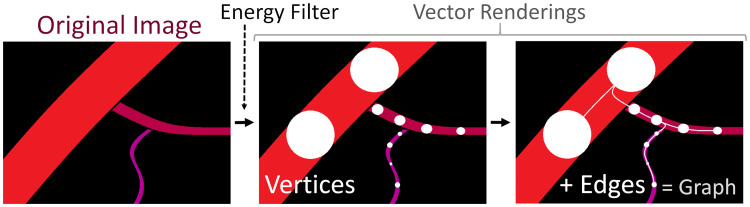
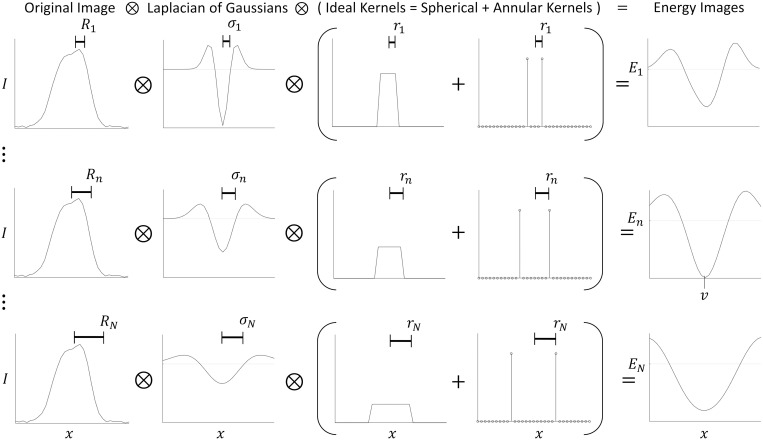
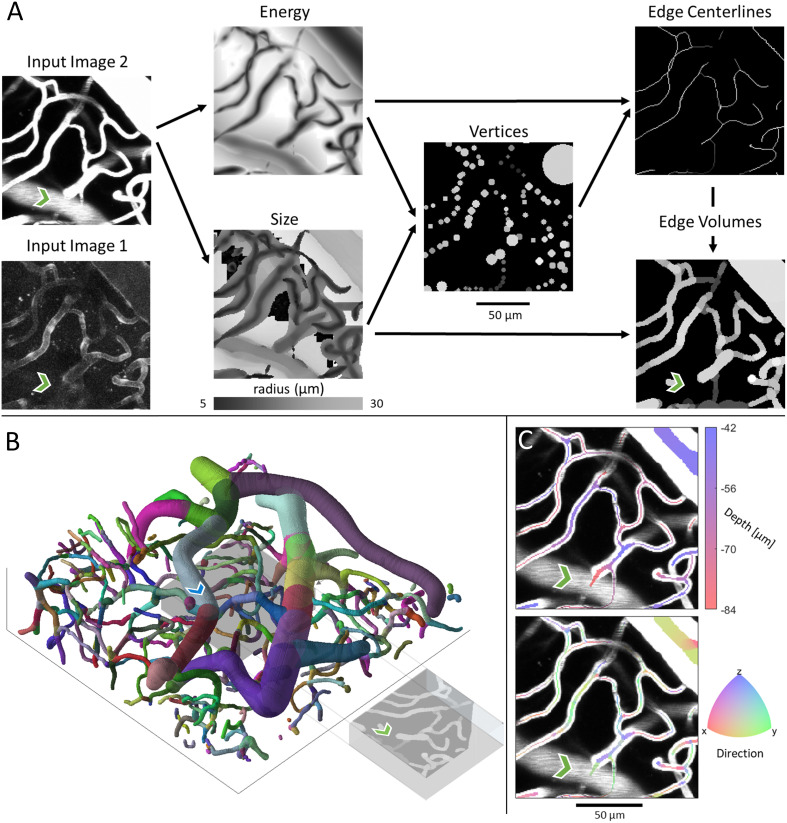
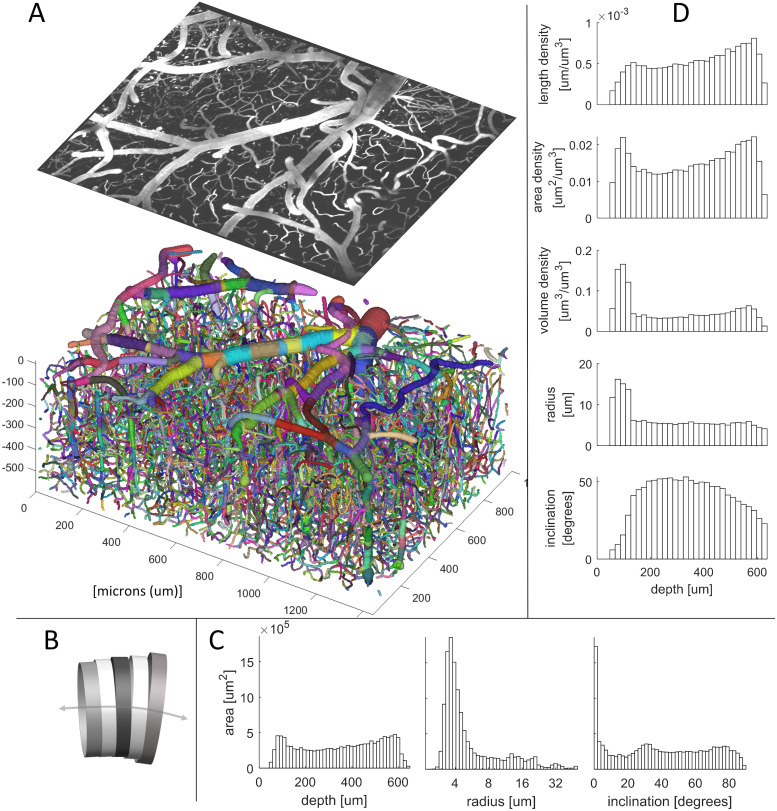
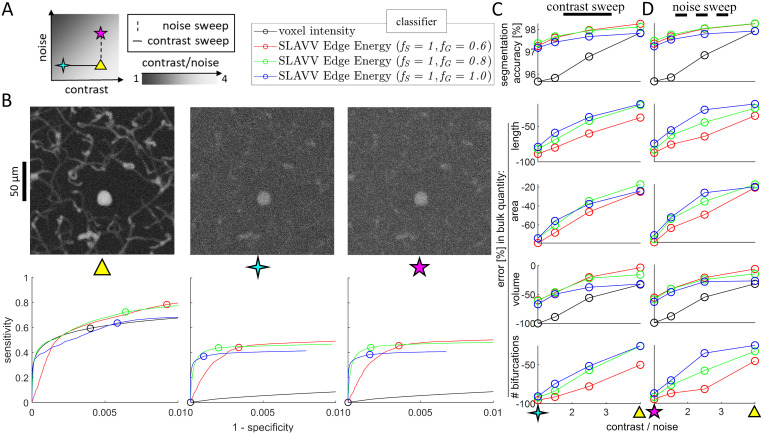
Recent advances in two-photon fluorescence microscopy (2PM) have allowed large scale imaging and analysis of blood vessel networks in living mice. However, extracting network graphs and vector representations for the dense capillary bed remains a bottleneck in many applications. Vascular vectorization is algorithmically difficult because blood vessels have many shapes and sizes, the samples are often unevenly illuminated, and large image volumes are required to achieve good statistical power. State-of-the-art, three-dimensional, vascular vectorization approaches often require a segmented (binary) image, relying on manual or supervised-machine annotation. Therefore, voxel-by-voxel image segmentation is biased by the human annotator or trainer. Furthermore, segmented images oftentimes require remedial morphological filtering before skeletonization or vectorization. To address these limitations, we present a vectorization method to extract vascular objects directly from unsegmented images without the need for machine learning or training. The Segmentation-Less, Automated, Vascular Vectorization (SLAVV) source code in MATLAB is openly available on GitHub. This novel method uses simple models of vascular anatomy, efficient linear filtering, and vector extraction algorithms to remove the image segmentation requirement, replacing it with manual or automated vector classification. Semi-automated SLAVV is demonstrated on three in vivo 2PM image volumes of microvascular networks (capillaries, arterioles and venules) in the mouse cortex. Vectorization performance is proven robust to the choice of plasma- or endothelial-labeled contrast, and processing costs are shown to scale with input image volume. Fully-automated SLAVV performance is evaluated on simulated 2PM images of varying quality all based on the large (1.4×0.9×0.6 mm3 and 1.6×10⁸ voxel) input image. Vascular statistics of interest (e.g. volume fraction, surface area density) calculated from automatically vectorized images show greater robustness to image quality than those calculated from intensity-thresholded images.
双光子荧光显微镜(2PM)的最新进展使得对活体小鼠中血管网络的大规模成像和分析成为可能。然而,从密集的毛细血管床中提取网络图和向量表示仍然是许多应用中的一个瓶颈。血管矢量化在算法上具有挑战性,因为血管具有多种形状和大小,样本通常不均匀照明,并且需要大的图像体积才能达到良好的统计能力。最先进的三维血管矢量化方法通常需要分割(二进制)图像,依赖于手动或监督机器注释。因此,体素逐个图像分割受到人类注释者或训练者的偏见。此外,在进行骨架化或矢量化之前,分割后的图像通常需要进行补救形态滤波。为了解决这些限制,我们提出了一种从未经分割的图像中直接提取血管对象的矢量化方法,而无需机器学习或训练。MATLAB 中的无分割、自动、血管矢量化(SLAVV)源代码可在 GitHub 上公开获取。这种新方法使用血管解剖的简单模型、高效的线性滤波和向量提取算法来去除图像分割要求,取而代之的是手动或自动的向量分类。半自动化的 SLAVV 在三个活体 2PM 微血管网络(毛细血管、小动脉和小静脉)的图像体积上进行了演示。向量化性能被证明对血浆或内皮标记对比度的选择具有鲁棒性,并且处理成本与输入图像体积成比例。完全自动化的 SLAVV 性能在基于大(1.4×0.9×0.6 mm3 和 1.6×10⁸ 体素)输入图像的不同质量的模拟 2PM 图像上进行了评估。从自动矢量化图像计算的感兴趣的血管统计信息(例如体积分数、表面积密度)比从强度阈值图像计算的信息更能抵抗图像质量的影响。