Morecraft Robert J, Stilwell-Morecraft Kimberly S, Ge Jizhi, Kraskov Alexander, Lemon Roger N
1Division of Basic Biomedical Sciences, Laboratory of Neurological Sciences, The University of South Dakota, Sanford School of Medicine, Vermillion, South Dakota.
2Biosciences Institute, Faculty of Medical Sciences, Newcastle University, Newcastle upon Tyne, United Kingdom; and.
J Neurosurg. 2021 Oct 8;136(5):1395-1409. doi: 10.3171/2021.4.JNS202464. Print 2022 May 1.
In some cases of incomplete cervical spinal cord injury (iSCI) there is marked paresis and dysfunction of upper-extremity movement but not lower-extremity movement. A continued explanation of such symptoms is a somatotopic organization of corticospinal tract (CST) fibers passing through the decussation at the craniovertebral junction (CVJ) and lateral CST (LCST). In central cord syndrome, it has been suggested that injury to the core of the cervical cord may include selective damage to medially located arm/hand LCST fibers, without compromising laterally located leg fibers. Because such somatotopic organization in the primate CST might contribute to the disproportionate motor deficits after some forms of iSCI, the authors made a systematic investigation of CST organization in the CVJ and LCST using modern neuroanatomical techniques.
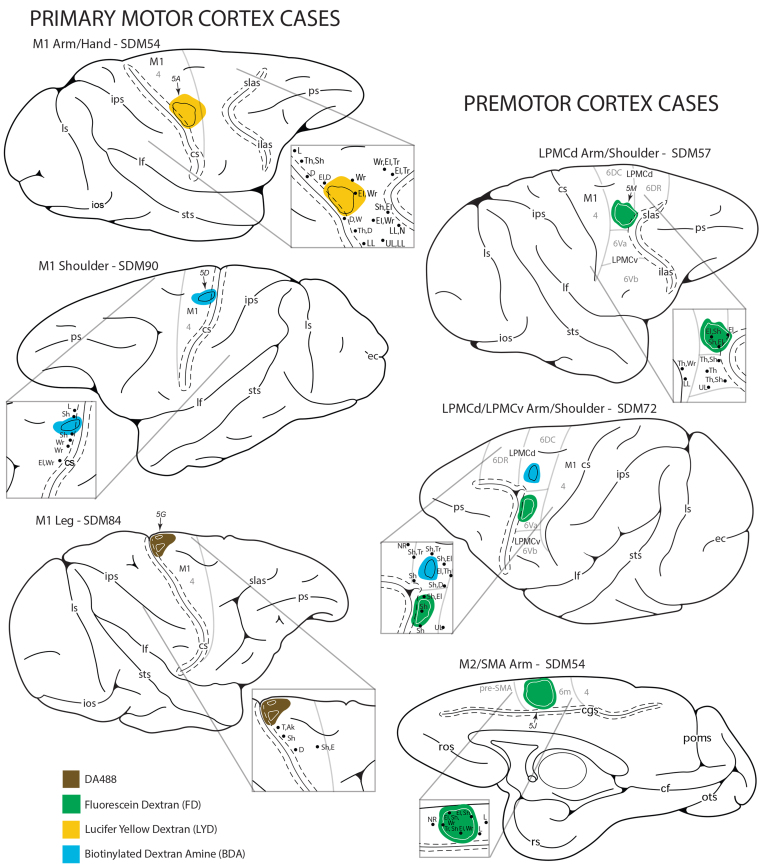
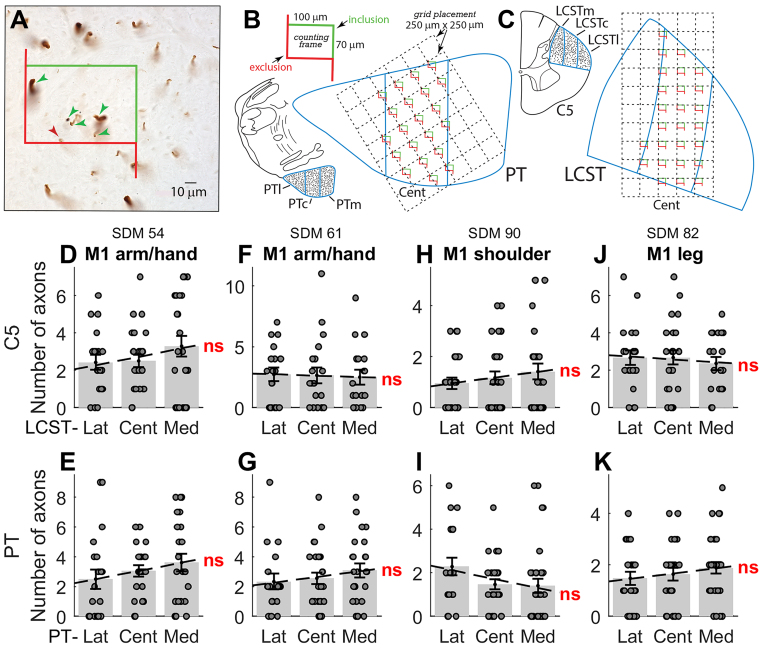
High-resolution anterograde tracers were used in 11 rhesus macaque monkeys to define the course of the corticospinal projection (CSP) through the CVJ and LCST from the arm/hand, shoulder, and leg areas of the primary motor cortex (M1). This approach labels CST fibers of all sizes, large and small, arising in these areas. The CSP from the dorsolateral and ventrolateral premotor cortex and supplementary motor area were also studied. A stereological approach was adapted to quantify labeled fiber distribution in 8 cases.
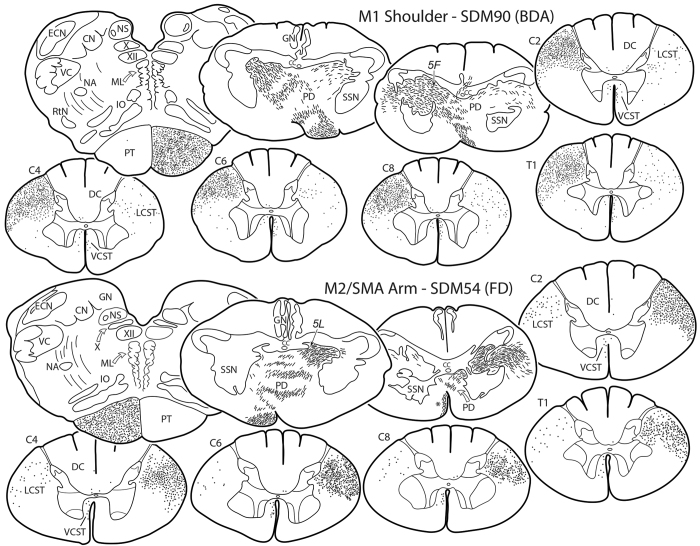
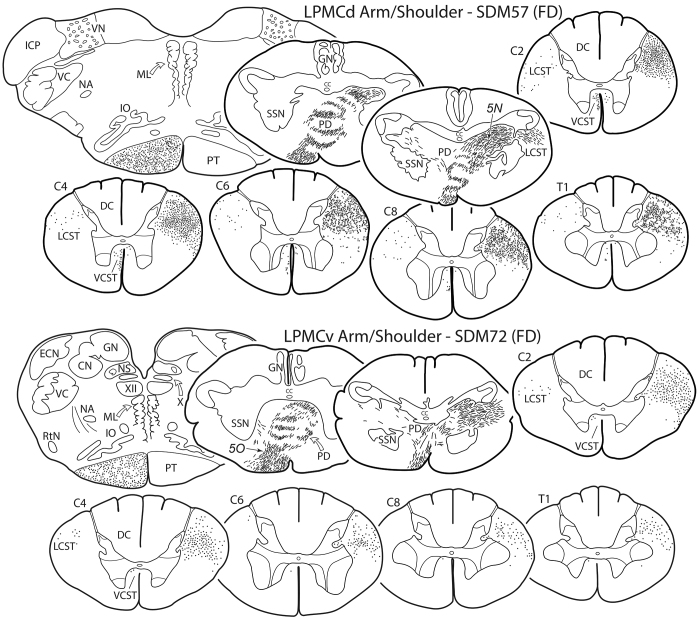
There was no evidence for somatotopic organization of CST fibers passing through the CVJ or contralateral LCST. Fiber labeling from each cortical representation was widespread throughout the CST at the CVJ and LCST and overlapped extensively with fibers from other representations. This study demonstrated no significant difference between medial versus lateral subsectors of the LCST in terms of number of fibers labeled from the M1 arm/hand area.
This investigation firmly rejects the concept of somatotopy among CST fibers passing through the CVJ and LCST, in contrast with the somatotopy in the cortex, corona radiata, and internal capsule. All CST fibers in the CVJ and LCST would thus appear to be equally susceptible to focal or diffuse injury, regardless of their cortical origin. The disproportionate impairment of arm/hand movement after iSCI must therefore be due to other factors, including greater dependence of hand/arm movements on the CST compared with the lower limb. The dispersed and intermingled nature of frontomotor fibers may be important in motor recovery after cervical iSCI.
在某些不完全性颈脊髓损伤(iSCI)病例中,上肢运动存在明显的轻瘫和功能障碍,而下肢运动则无此情况。对于此类症状的一种持续解释是,皮质脊髓束(CST)纤维在颅颈交界处(CVJ)交叉处及外侧皮质脊髓束(LCST)存在躯体定位组织。在中央脊髓综合征中,有人提出颈髓核心部位的损伤可能包括对内侧的臂/手LCST纤维的选择性损伤,而不影响外侧的腿部纤维。由于灵长类动物CST中的这种躯体定位组织可能导致某些形式的iSCI后出现不成比例的运动功能障碍,作者使用现代神经解剖学技术对CVJ和LCST中的CST组织进行了系统研究。
在11只恒河猴中使用高分辨率顺行示踪剂来确定从初级运动皮层(M1)的臂/手、肩部和腿部区域发出的皮质脊髓投射(CSP)通过CVJ和LCST的路径。这种方法标记了这些区域产生的所有大小的CST纤维。还研究了背外侧和腹外侧运动前皮层及辅助运动区的CSP。采用体视学方法对8例中的标记纤维分布进行量化。
没有证据表明通过CVJ或对侧LCST的CST纤维存在躯体定位组织。每个皮质代表区的纤维标记在CVJ和LCST的整个CST中广泛分布,并与来自其他代表区的纤维广泛重叠。这项研究表明,就从M1臂/手区域标记的纤维数量而言,LCST的内侧与外侧子区域之间没有显著差异。
与皮质、放射冠和内囊中的躯体定位不同,这项研究坚决否定了通过CVJ和LCST的CST纤维之间存在躯体定位的概念。因此,CVJ和LCST中的所有CST纤维似乎同样容易受到局灶性或弥漫性损伤,无论其皮质起源如何。iSCI后臂/手运动的不成比例损伤因此必定归因于其他因素,包括与下肢相比,手/臂运动对CST的更大依赖性。额运动纤维的分散和交织性质可能在颈段iSCI后的运动恢复中起重要作用。