
挪威普通医疗实践环境中游走性红斑患者的蜱传合并感染:一项临床和实验室随访研究。
Tick-transmitted co-infections among erythema migrans patients in a general practice setting in Norway: a clinical and laboratory follow-up study.
机构信息
Department of Global Public Health and Primary Care, University of Bergen, PO Box 7804, 5020, Bergen, Norway.
Department of Virus and Microbiological Special Diagnostics, Statens Serum Institut, Artillerivej 5, 2100, Copenhagen, Denmark.
出版信息
BMC Infect Dis. 2021 Oct 8;21(1):1044. doi: 10.1186/s12879-021-06755-8.
BACKGROUND
Erythema migrans (EM) is the most common manifestation of Lyme borreliosis. Here, we examined EM patients in Norwegian general practice to find the proportion exposed to tick-transmitted microorganisms other than Borrelia, and the impact of co-infection on the clinical manifestations and disease duration.
METHODS
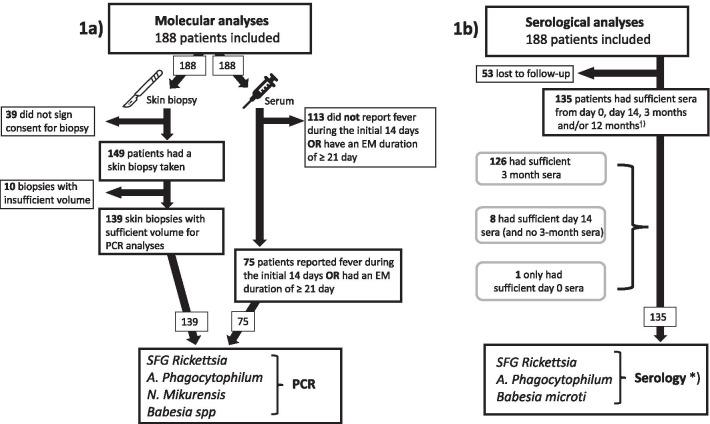
Skin biopsies from 139/188 EM patients were analyzed using PCR for Neoehrlichia mikurensis, Rickettsia spp., Anaplasma phagocytophilum and Babesia spp. Follow-up sera from 135/188 patients were analyzed for spotted fever group (SFG) Rickettsia, A. phagocytophilum and Babesia microti antibodies, and tested with PCR if positive. Day 0 sera from patients with fever (8/188) or EM duration of ≥ 21 days (69/188) were analyzed, using PCR, for A. phagocytophilum, Rickettsia spp., Babesia spp. and N. mikurensis. Day 14 sera were tested for TBEV IgG.
RESULTS
We detected no microorganisms in the skin biopsies nor in the sera of patients with fever or prolonged EM duration. Serological signs of exposure against SFG Rickettsia and A. phagocytophilum were detected in 11/135 and 8/135, respectively. Three patients exhibited both SFG Rickettsia and A. phagocytophilum antibodies, albeit negative PCR. No antibodies were detected against B. microti. 2/187 had TBEV antibodies without prior immunization. There was no significant increase in clinical symptoms or disease duration in patients with possible co-infection.
CONCLUSIONS
Co-infection with N. mikurensis, A. phagocytophilum, SFG Rickettsia, Babesia spp. and TBEV is uncommon in Norwegian EM patients. Despite detecting antibodies against SFG Rickettsia and A. phagocytophilum in some patients, no clinical implications could be demonstrated.
背景
游走性红斑(EM)是莱姆病最常见的表现。在这里,我们检查了挪威普通诊所的 EM 患者,以确定接触蜱传播的微生物(除伯氏疏螺旋体外)的比例,以及合并感染对临床表现和疾病持续时间的影响。
方法
对 188 例 EM 患者中的 139 例进行皮肤活检,采用 PCR 分析检测 Neoehrlichia mikurensis、立克次体、嗜吞噬细胞无形体和巴贝虫。对 135 例 EM 患者中的 135 例进行随访血清分析,检测斑疹热群(SFG)立克次体、嗜吞噬细胞无形体和巴贝虫微孢子抗体,并在阳性时进行 PCR 检测。对发热(188 例中的 8 例)或 EM 持续时间≥21 天(188 例中的 69 例)的患者的第 0 天血清进行分析,采用 PCR 检测嗜吞噬细胞无形体、立克次体、巴贝虫和 Neoehrlichia mikurensis。第 14 天血清检测 TBEV IgG。
结果
我们在皮肤活检和发热或 EM 持续时间延长患者的血清中均未检测到微生物。在 135 例患者中,分别有 11 例和 8 例检测到 SFG 立克次体和嗜吞噬细胞无形体的血清暴露迹象。3 例患者同时存在 SFG 立克次体和嗜吞噬细胞无形体抗体,但 PCR 为阴性。未检测到巴贝虫微孢子抗体。187 例中有 2 例在没有预先免疫的情况下有 TBEV 抗体。在可能合并感染的患者中,临床症状或疾病持续时间没有明显增加。
结论
在挪威 EM 患者中,与 Neoehrlichia mikurensis、嗜吞噬细胞无形体、SFG 立克次体、巴贝虫和 TBEV 的合并感染并不常见。尽管一些患者检测到 SFG 立克次体和嗜吞噬细胞无形体抗体,但没有发现临床意义。
 Zotero 插件