Garivalis Alekos Ioannis, Manfredini Giacomo, Saccone Giacomo, Di Marco Paolo, Kossolapov Artyom, Bucci Matteo
DESTEC, University of Pisa, 56122, Pisa, Italy.
Department of Nuclear Science and Engineering, Massachusetts Institute of Technology, Cambridge, MA, 02139, USA.
NPJ Microgravity. 2021 Oct 8;7(1):37. doi: 10.1038/s41526-021-00167-3.
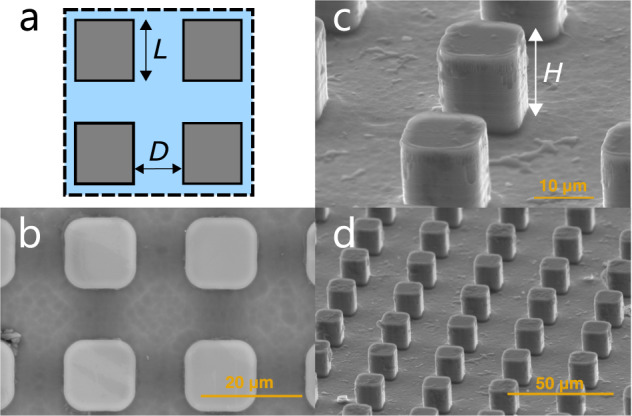
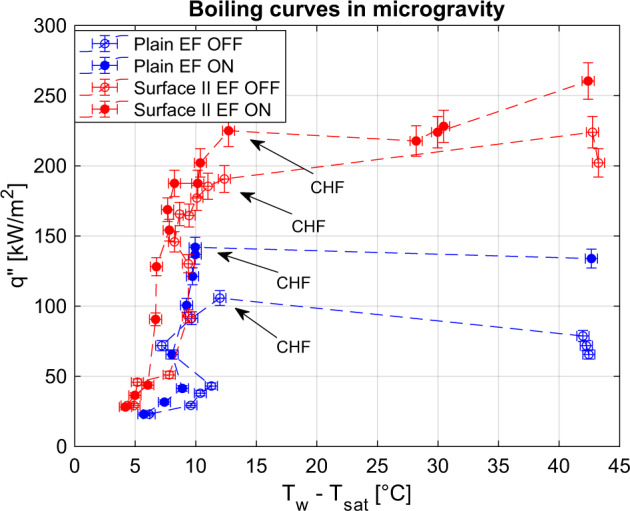
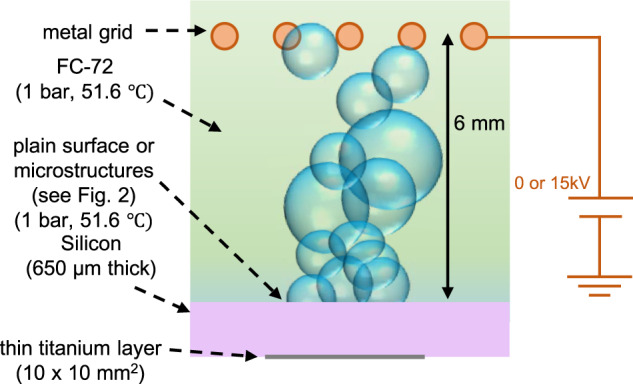
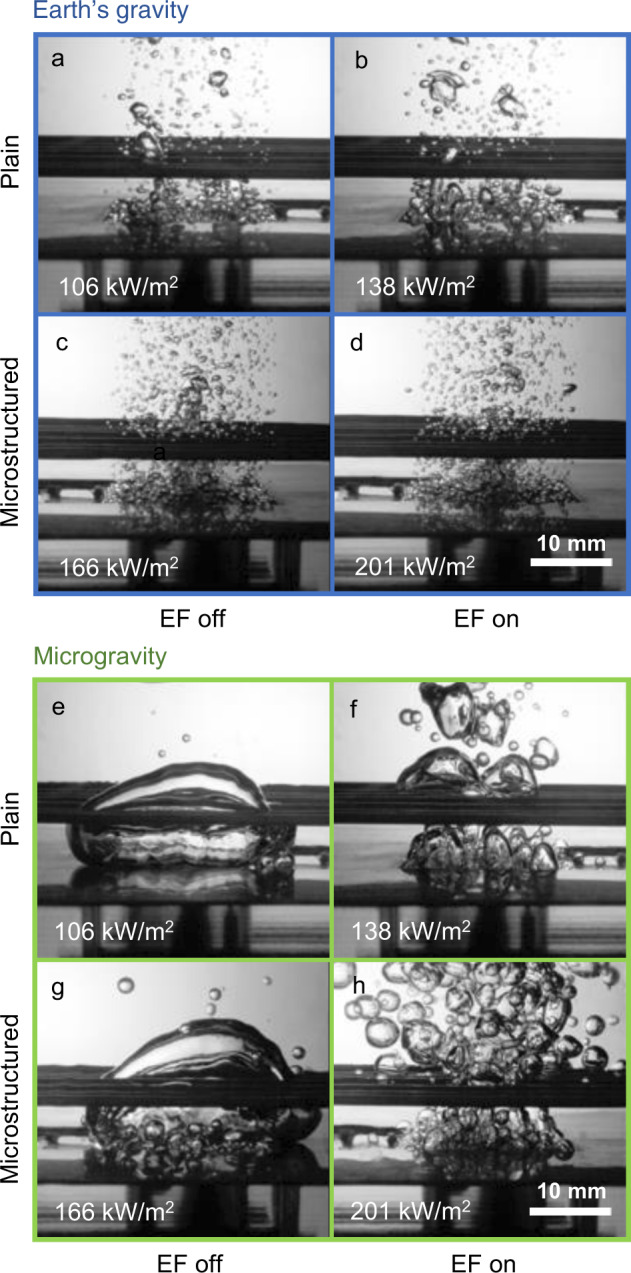
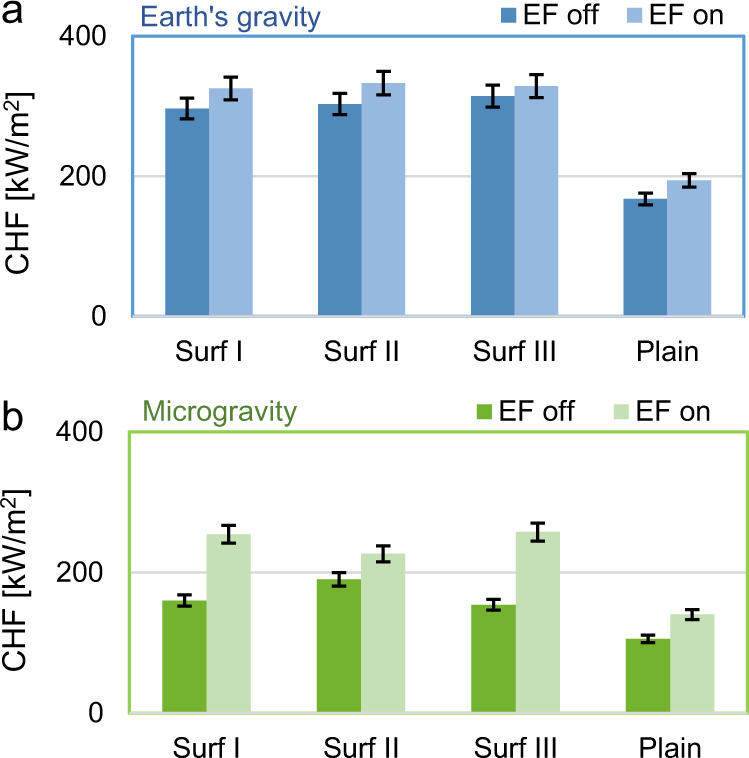
We run pool boiling experiments with a dielectric fluid (FC-72) on Earth and on board an ESA parabolic flight aircraft able to cancel the effects of gravity, testing both highly wetting microstructured surfaces and plain surfaces and applying an external electric field that creates gravity-mimicking body forces. Our results reveal that microstructured surfaces, known to enhance the critical heat flux on Earth, are also useful in microgravity. An enhancement of the microgravity critical heat flux on a plain surface can also be obtained using the electric field. However, the best boiling performance is achieved when these techniques are used together. The effects created by microstructured surfaces and electric fields are synergistic. They enhance the critical heat flux in microgravity conditions up to 257 kW/m, which is even higher than the value measured on Earth on a plain surface (i.e., 168 kW/m). These results demonstrate the potential of this synergistic approach toward very compact and efficient two-phase heat transfer systems for microgravity applications.
我们在地球上以及一架能够消除重力影响的欧洲航天局抛物线飞行飞机上,使用介电流体(FC - 72)进行池沸腾实验,测试了高润湿性微结构表面和平板表面,并施加了一个产生模拟重力体力的外部电场。我们的结果表明,在地球上已知能提高临界热流密度的微结构表面,在微重力环境中同样有用。使用电场也可以提高平板表面在微重力环境下的临界热流密度。然而,当这些技术一起使用时,能实现最佳的沸腾性能。微结构表面和电场产生的效果是协同的。它们在微重力条件下将临界热流密度提高到257kW/m,甚至高于在地球上平板表面测得的值(即168kW/m)。这些结果证明了这种协同方法对于用于微重力应用的非常紧凑且高效的两相传热系统的潜力。