Department of Physiology-HeartOtago, School of Biomedical Sciences, University of Otago, Dunedin, 9010, New Zealand.
Department of Medicine, Otago Medical School, University of Otago, Dunedin, 9010, New Zealand.
Int J Obes (Lond). 2022 Jan;46(1):238-241. doi: 10.1038/s41366-021-00984-2. Epub 2021 Oct 8.
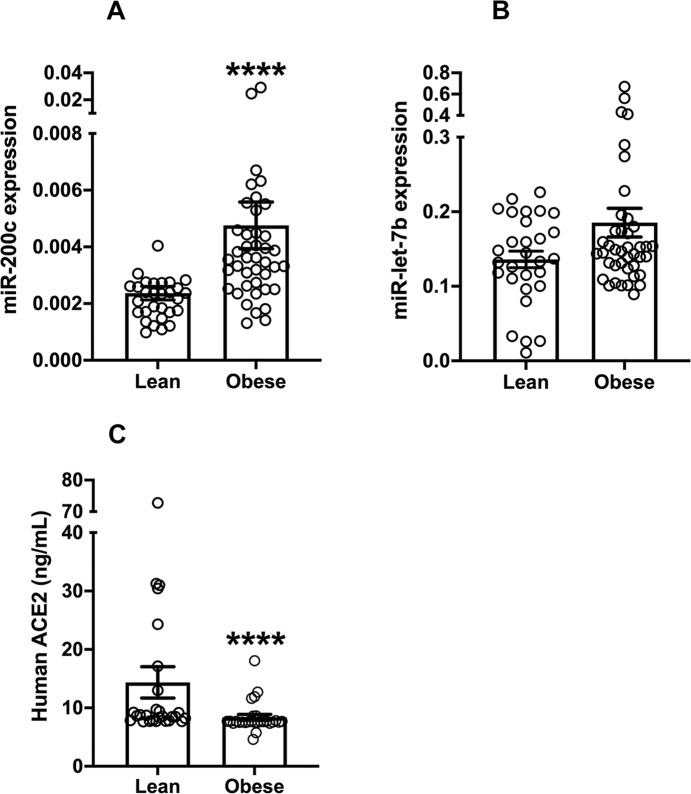
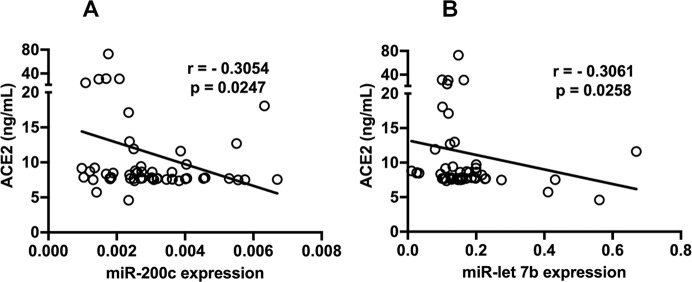
Obesity is a risk factor for coronavirus disease 2019 (COVID-19) infection, with studies demonstrating the prevalence of individuals with obesity admitted with COVID-19 ranging between 30 and 60%. We determined whether early changes in microRNAs (miRNAs) are associated with dysregulation of angiotensin-converting enzyme 2 (ACE2), the specific functional receptor for severe acute respiratory syndrome coronavirus 2. ACE2 is a membrane-bound enzyme that catalyzes the conversion of angiotensin II to angiotensin 1-7 the latter having cardioprotective and vasorelaxation effects. Quantitative real-time PCR analysis of plasma samples for circulating miRNAs showed upregulation of miR-200c and miR-let-7b in otherwise healthy individuals with obesity. This was associated with significant downregulation of ACE2, a direct target for both miRNAs, in individuals with obesity. Correlation analysis confirmed a significant negative correlation between ACE2 and both the miRNAs. Studies showed that despite being the functional receptor, inhibition/downregulation of ACE2 did not reduce the severity of COVID-19 infection. In contrast, increased angiotensin II following inhibition of ACE2 may increase the severity of the disease. Taken together, our novel results identify that upregulation of miR-200c may increase the susceptibility of individuals with obesity to COVID-19. Considering miRNA are the earliest molecular regulators, the level of circulating miR-200c could be a potential biomarker in the early identification of those at the risk of severe COVID-19.
肥胖是 2019 年冠状病毒病(COVID-19)感染的一个危险因素,研究表明,肥胖患者中 COVID-19 的患病率在 30%至 60%之间。我们确定了早期 microRNAs (miRNAs) 的变化是否与血管紧张素转换酶 2 (ACE2) 的失调有关,ACE2 是严重急性呼吸综合征冠状病毒 2 的特定功能受体。ACE2 是一种膜结合酶,可催化血管紧张素 II 转化为血管紧张素 1-7,后者具有心脏保护和血管舒张作用。对肥胖人群的血浆样本进行循环 miRNAs 的定量实时 PCR 分析显示,miR-200c 和 miR-let-7b 上调。这与肥胖个体中 ACE2 的显著下调有关,ACE2 是这两种 miRNA 的直接靶标。相关性分析证实了 ACE2 与这两种 miRNA 之间存在显著的负相关。研究表明,尽管 ACE2 是功能性受体,但抑制/下调 ACE2 并不能降低 COVID-19 感染的严重程度。相反,ACE2 抑制后血管紧张素 II 的增加可能会增加疾病的严重程度。总之,我们的新结果表明,miR-200c 的上调可能会增加肥胖个体感染 COVID-19 的易感性。鉴于 miRNA 是最早的分子调节剂,循环 miR-200c 的水平可能是识别 COVID-19 高危人群的潜在生物标志物。