Li Aoyong, Zhao Pengxiang, Haitao He, Mansourian Ali, Axhausen Kay W
Institute for Transport Planning and Systems (IVT), ETH Zürich, Zürich, Switzerland.
GIS Center, Department of Physical Geography and Ecosystem Science, Lund University, Lund, Sweden.
Comput Environ Urban Syst. 2021 Nov;90:101703. doi: 10.1016/j.compenvurbsys.2021.101703. Epub 2021 Aug 19.
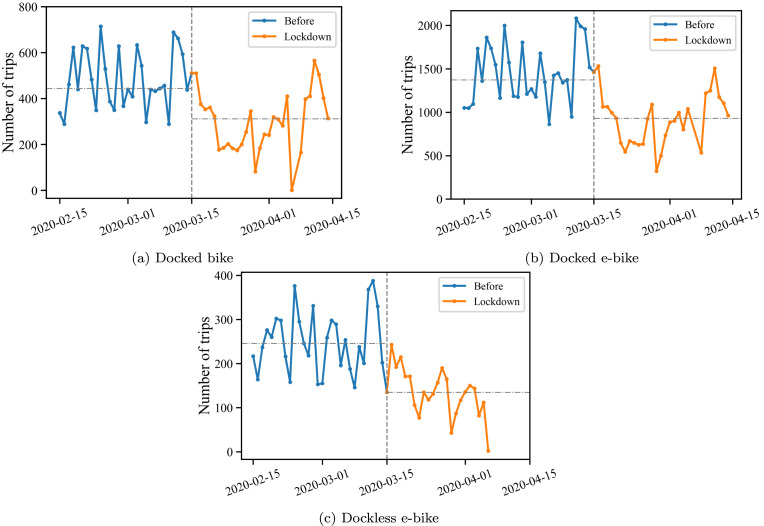
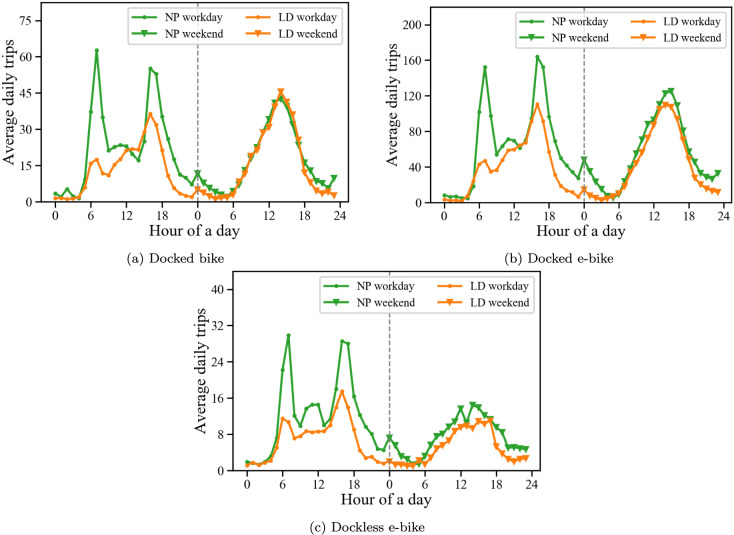
Cities worldwide adopted lockdown policies in response to the outbreak of coronavirus disease 2019 (COVID-19), significantly influencing people's travel behavior. In particular, micro-mobility, an emerging mode of urban transport, is profoundly shaped by this crisis. However, there is limited research devoted to understanding the rapidly evolving trip patterns of micro-mobility in response to COVID-19. To fill this gap, we analyze the changes in micro-mobility usage before and during the lockdown period exploiting high-resolution micro-mobility trip data collected in Zurich, Switzerland. Specifically, docked bike, docked e-bike, and dockless e-bike are evaluated and compared from the perspective of space, time and semantics. First, the spatial and temporal analysis results uncover that the number of trips decreased remarkably during the lockdown period. The striking difference between the normal and lockdown period is the decline in the peak hours of workdays. Second, the origin-destination flows are used to construct spatially embedded networks. The results suggest that the origin-destination pairs remain similar during the lockdown period, while the numbers of trips between each origin-destination pair is reduced due to COVID-19 pandemic. Finally, the semantic analysis is conducted to uncover the changes in trip purpose. It is revealed that the proportions of Home, Park, and Grocery activities increase, while the proportions of Leisure and Shopping activities decrease during the lockdown period. The above results can help planners and policymakers better make evidence-based policies regarding micro-mobility in the post-pandemic society.
全球各城市为应对2019冠状病毒病(COVID-19)疫情而采取了封锁政策,这对人们的出行行为产生了重大影响。特别是,微出行作为一种新兴的城市交通方式,受到了这场危机的深刻影响。然而,致力于理解微出行在应对COVID-19时迅速演变的出行模式的研究却很有限。为了填补这一空白,我们利用在瑞士苏黎世收集的高分辨率微出行行程数据,分析了封锁期前后微出行使用情况的变化。具体而言,从空间、时间和语义的角度对有桩自行车、有桩电动自行车和无桩电动自行车进行了评估和比较。首先,空间和时间分析结果表明,封锁期间出行次数显著减少。正常时期和封锁时期的显著差异在于工作日高峰时段出行次数的下降。其次,利用起讫点流量构建空间嵌入网络。结果表明,在封锁期间,起讫点对保持相似,但由于COVID-19大流行,每个起讫点对之间的出行次数减少。最后,进行语义分析以揭示出行目的的变化。结果显示,在封锁期间,回家、公园和杂货店活动的比例增加,而休闲和购物活动的比例下降。上述结果有助于规划者和政策制定者在疫情后社会更好地制定基于证据的微出行政策。