Gfrerer Eva, Laina Danae, Gibernau Marc, Fuchs Roman, Happ Martin, Tolasch Till, Trutschnig Wolfgang, Hörger Anja C, Comes Hans Peter, Dötterl Stefan
Department of Biosciences, Paris Lodron University of Salzburg, Salzburg, Austria.
Laboratory of Sciences for the Environment, CNRS - University of Corsica, Ajaccio, France.
Front Plant Sci. 2021 Sep 24;12:719092. doi: 10.3389/fpls.2021.719092. eCollection 2021.
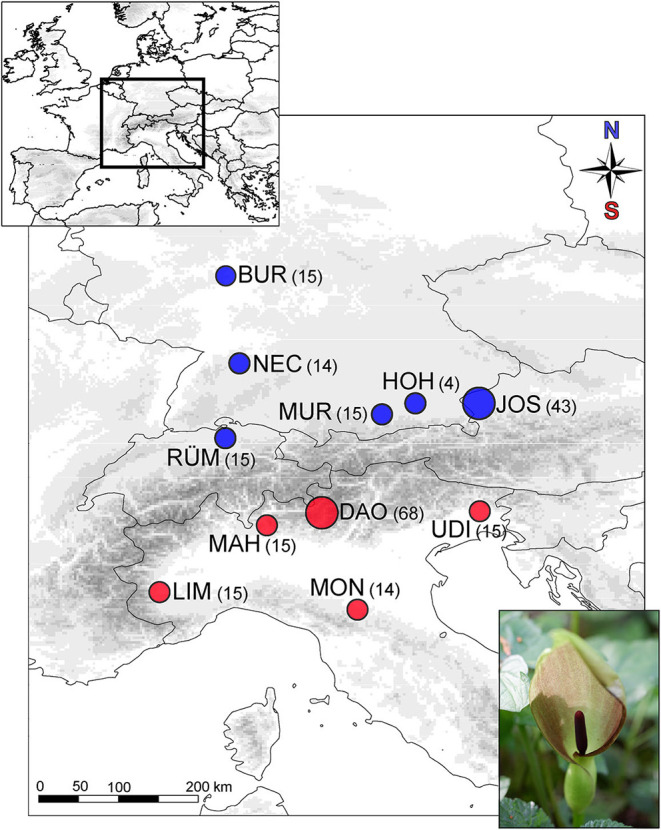
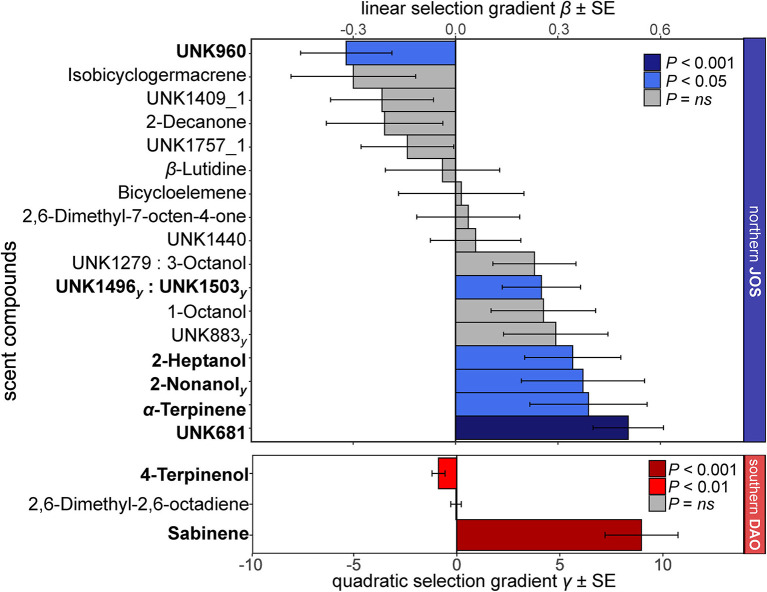
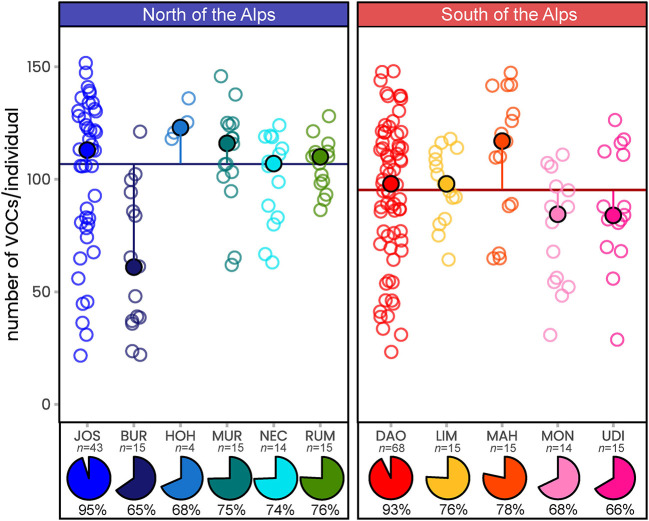
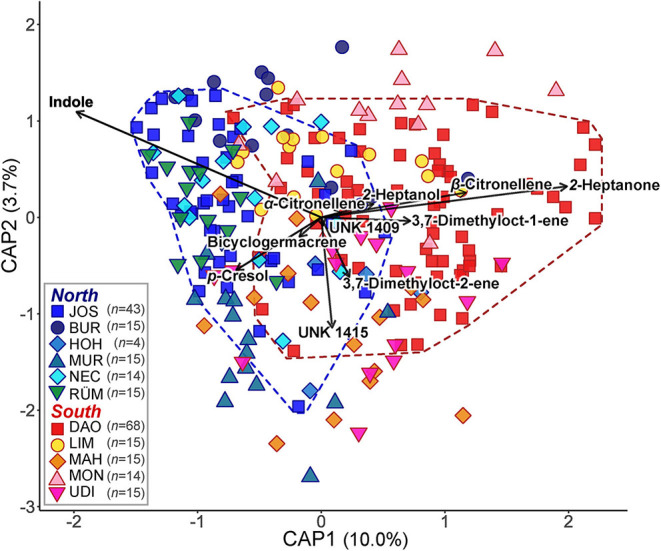
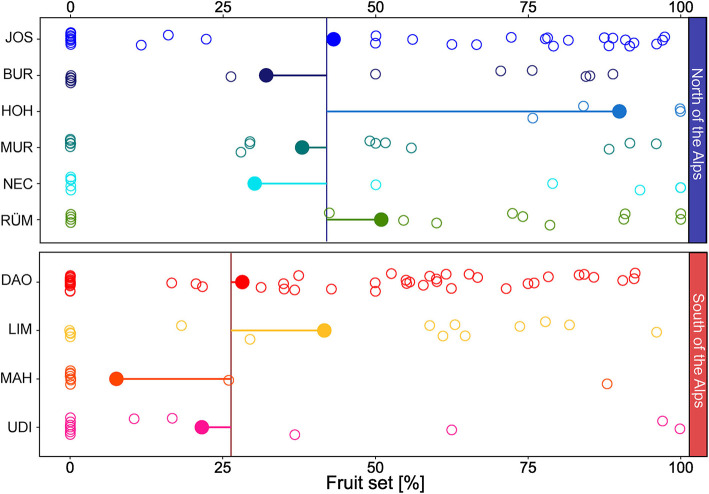
Floral scent is a key mediator in plant-pollinator interactions. However, little is known to what extent intraspecific scent variation is shaped by phenotypic selection, with no information yet in deceptive plants. In this study, we collected inflorescence scent and fruit set of the deceptive moth fly-pollinated L. (Araceae) from six populations north vs. five populations south of the Alps, accumulating to 233 samples in total, and tested for differences in scent, fruit set, and phenotypic selection on scent across this geographic barrier. We recorded 289 scent compounds, the highest number so far reported in a single plant species. Most of the compounds occurred both north and south of the Alps; however, plants of the different regions emitted different absolute and relative amounts of scent. Fruit set was higher north than south of the Alps, and some, but not all differences in scent could be explained by differential phenotypic selection in northern vs. southern populations. This study is the first to provide evidence that floral scents of a deceptive plant are under phenotypic selection and that phenotypic selection is involved in shaping geographic patterns of floral scent in such plants. The hyperdiverse scent of might result from the imitation of various brood substrates of its pollinators.
花香是植物与传粉者相互作用的关键媒介。然而,关于种内气味变异在多大程度上受表型选择影响,我们所知甚少,对于欺骗性植物更是尚无相关信息。在本研究中,我们收集了来自阿尔卑斯山以北六个种群和以南五个种群的、由欺骗性的蛾蠓传粉的天南星科犁头尖属植物的花序气味和坐果情况,总共积累了233个样本,并测试了跨越这一地理屏障的气味、坐果以及气味的表型选择方面的差异。我们记录了289种气味化合物,这是迄今为止在单一植物物种中报道的最高数量。大多数化合物在阿尔卑斯山以北和以南地区均有出现;然而,不同地区的植物释放出不同绝对量和相对量的气味。阿尔卑斯山以北的坐果率高于以南地区,并且气味的一些(但并非全部)差异可以通过南北种群不同的表型选择来解释。本研究首次提供证据表明,一种欺骗性植物的花香受到表型选择,且表型选择参与塑造此类植物花香的地理格局。犁头尖属植物极度多样的气味可能源于对其传粉者各种繁殖基质的模仿。