Gonzalez-Rivas Juan P, Mechanick Jeffrey I, Hernandez José Pantaleón, Infante-Garcia María M, Pavlovska Iuliia, Medina-Inojosa José R, Kunzova Sarka, Nieto-Martinez Ramfis, Brož Jan, Busetto Luca, Maranhao Neto Geraldo A, Lopez-Jimenez Francisco, Urbanová Jana, Stokin Gorazd B
International Clinical Research Center (ICRC) St Anne's University Hospital (FNUSA) Brno Brno Czech Republic.
Department of Global Health and Population Harvard TH Chan School of Public Health Harvard University Boston Massachusetts USA.
Obes Sci Pract. 2021 May 5;7(5):535-544. doi: 10.1002/osp4.496. eCollection 2021 Oct.
AIMS/HYPOTHESIS: The need for understanding obesity as a chronic disease, its stigmatization, and the lack of actionability related to it demands a new approach. The adiposity-based chronic disease (ABCD) model is based on adiposity amount, distribution, and function, with a three stage complication-centric rather than a body mass index (BMI)-centric approach. The prevalence rates and associated risk factors are presented.
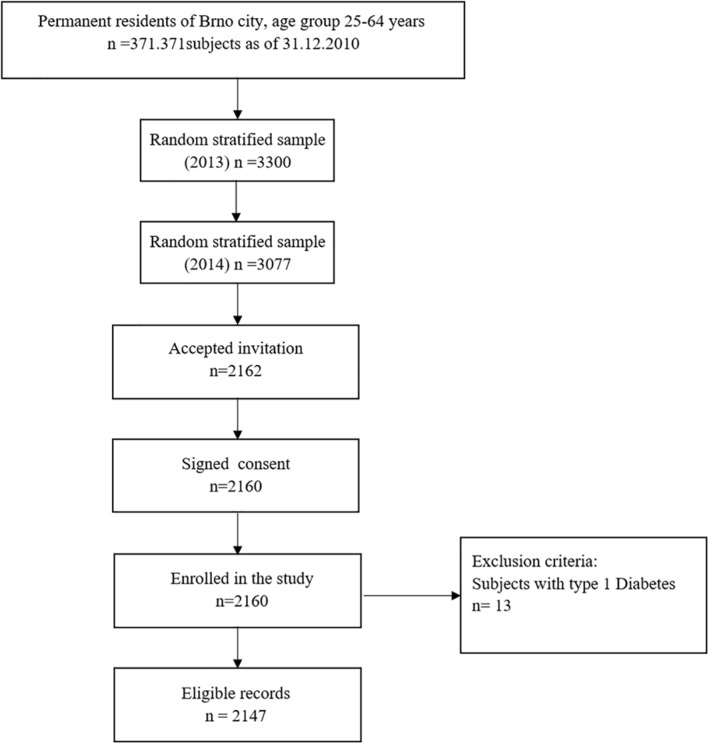
In total, 2159 participants were randomly selected from Czechia. ABCD was established as BMI ≥ 25 kg/m or high body fat percent, or abdominal obesity and then categorized by their adiposity-based complications: Stage 0: none; Stage 1: mild/moderate; Stage 2: severe.
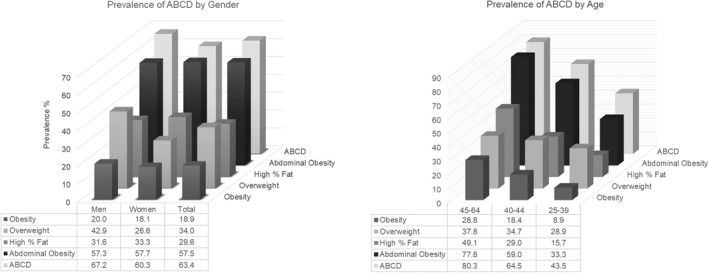
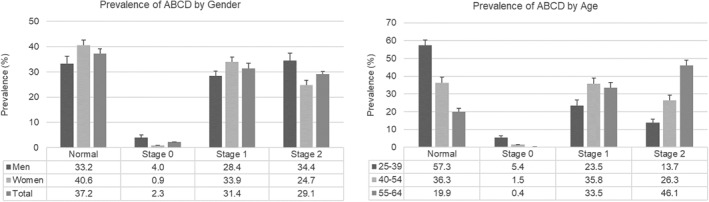
ABCD prevalence was 62.8%. Stage 0 was 2.3%; Stage 1 was 31.4%; Stage 2 was 29.1%. Comparing with other classifiers, participants in Stage 2 were more likely to have diabetes, hypertension, and metabolic syndrome than those with overweight, obesity, abdominal obesity, and increased fat mass. ABCD showed the highest sensitivity and specificity to detect participants with peripheral artery disease, increased intima media, and vascular disease.
CONCLUSION/INTERPRETATION: The ABCD model provides a more sensitive approach that facilitates the early detection and stratification of participants at risk compared to traditional classifiers.
目的/假设:鉴于需要将肥胖理解为一种慢性疾病,认识到其污名化现象以及与之相关的缺乏可操作性的问题,需要一种新的方法。基于肥胖的慢性疾病(ABCD)模型基于肥胖程度、分布和功能,采用以并发症为中心的三阶段方法,而非以体重指数(BMI)为中心的方法。文中呈现了患病率及相关风险因素。
总共从捷克随机选取了2159名参与者。将ABCD定义为BMI≥25kg/m²或体脂百分比高,或存在腹型肥胖,然后根据基于肥胖的并发症进行分类:0期:无并发症;1期:轻度/中度;2期:重度。
ABCD患病率为62.8%。0期为2.3%;1期为31.4%;2期为29.1%。与其他分类方法相比,2期参与者患糖尿病、高血压和代谢综合征的可能性高于超重、肥胖、腹型肥胖和脂肪量增加的参与者。ABCD在检测外周动脉疾病、内膜中层增厚和血管疾病参与者方面显示出最高的敏感性和特异性。
结论/解读:与传统分类方法相比,ABCD模型提供了一种更敏感的方法,有助于对有风险的参与者进行早期检测和分层。