Spencer Trina D
Department of Child and Family Studies, Rightpath Research & Innovation Center, University of South Florida, 13301 Bruce B. Downs Blvd. MHC 1719, Tampa, FL 33612 USA.
Behav Anal Pract. 2021 Sep 7;14(3):816-830. doi: 10.1007/s40617-021-00640-1. eCollection 2021 Sep.
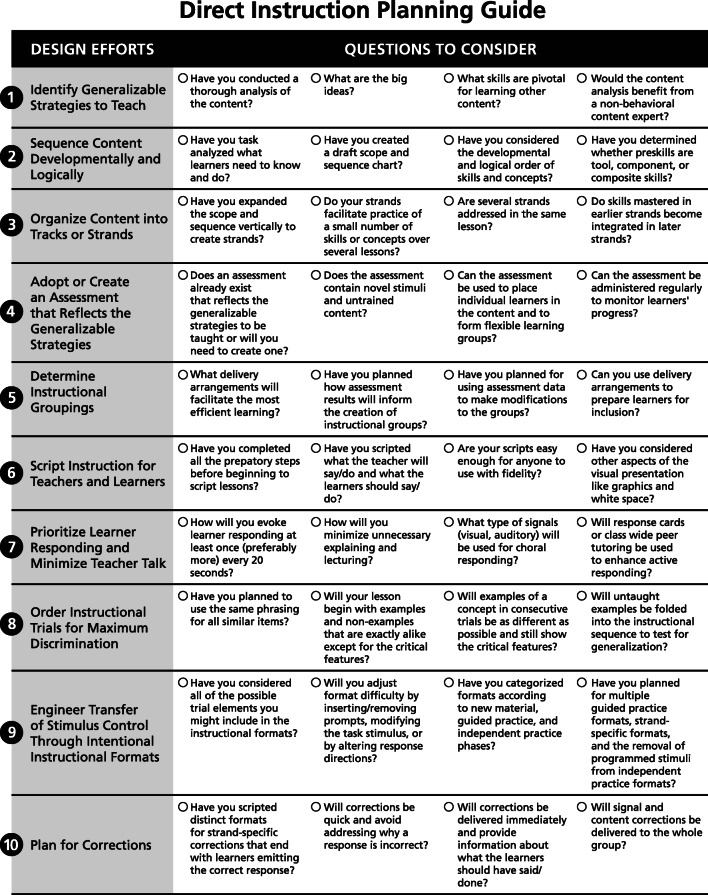
Although behavior analysts are trained in discrete trial instruction, other instructional approaches like Direct Instruction are underutilized in behavior analytic practice. Direct Instruction is a specialized technology that capitalizes on sophisticated instructional design and highly effective delivery strategies. What makes Direct Instruction so powerful is that it emphasizes the development of generative repertoires and establishes them efficiently. The purpose of this article is to introduce 10 critical instructional design efforts that behavior analysts can use in their practice, regardless of the population they serve and repertoires they build. The 10 instructional design efforts are summarized in a Direct Instruction Planning Guide. Behavior analysts can follow this sequence of design efforts and refer to the guiding questions as they develop efficient instruction for their learners. In doing so, behavior analysts can take up the torch of Direct Instruction, extend this remarkable instructional approach into their research and practice, and strengthen the behavioral technology available to behavior analytic practitioners.
尽管行为分析师接受过离散式单元教学的培训,但在行为分析实践中,诸如直接教学法等其他教学方法并未得到充分利用。直接教学法是一种专门技术,它利用了复杂的教学设计和高效的教学策略。直接教学法如此强大的原因在于它强调生成性技能组合的发展并能高效地建立这些技能组合。本文的目的是介绍行为分析师在其实践中可以使用的10项关键教学设计工作,无论他们所服务的人群和所建立的技能组合如何。这10项教学设计工作总结在一份直接教学法规划指南中。行为分析师可以遵循这一设计工作顺序,并在为学习者制定高效教学时参考指导问题。这样做,行为分析师可以接过直接教学法的火炬,将这种卓越的教学方法扩展到他们的研究和实践中,并加强行为分析从业者可用的行为技术。