Velmurugan Ganesan, Mohanraj Sundaresan, Christy Yacob Jenifer, Keppanan Sundaravadivu, Rekha Balakrishnan, Krishnasamy Anbalagan, Shanmugarajan Suresh, Boopathi Seenivasan, Ayyapparaja Anitha, Ayyapparaja Prabhu Chandhran, Rs Tamilselvan, Gopalakrishnan Manigandan, Veerappan Jayaramanathan, Dharmaraj Vithya, Vaithilingam Subramaniyan, Purushothaman Priyadharshini, Chelladurai Sumathi, Pandiyan Jeevan, Selvarajan Vijaya Samoondeeswari, Annathurai Kalidoss, Vengatachalam Sukumaran, Arivuruvone Gorky, Kaliyaperumal Saravanan, G Velsamy, S Kannan, Ramasamy Subbiah, Swaminathan Krishnan
Chemomicrobiomics Laboratory, Department of Biochemistry & Molecular Biology, KMCH Research Foundation, Coimbatore, India.
Department of Molecular Biology, School of Biological Sciences, Madurai Kamaraj University, Madurai, India.
Front Cardiovasc Med. 2021 Sep 24;8:737505. doi: 10.3389/fcvm.2021.737505. eCollection 2021.
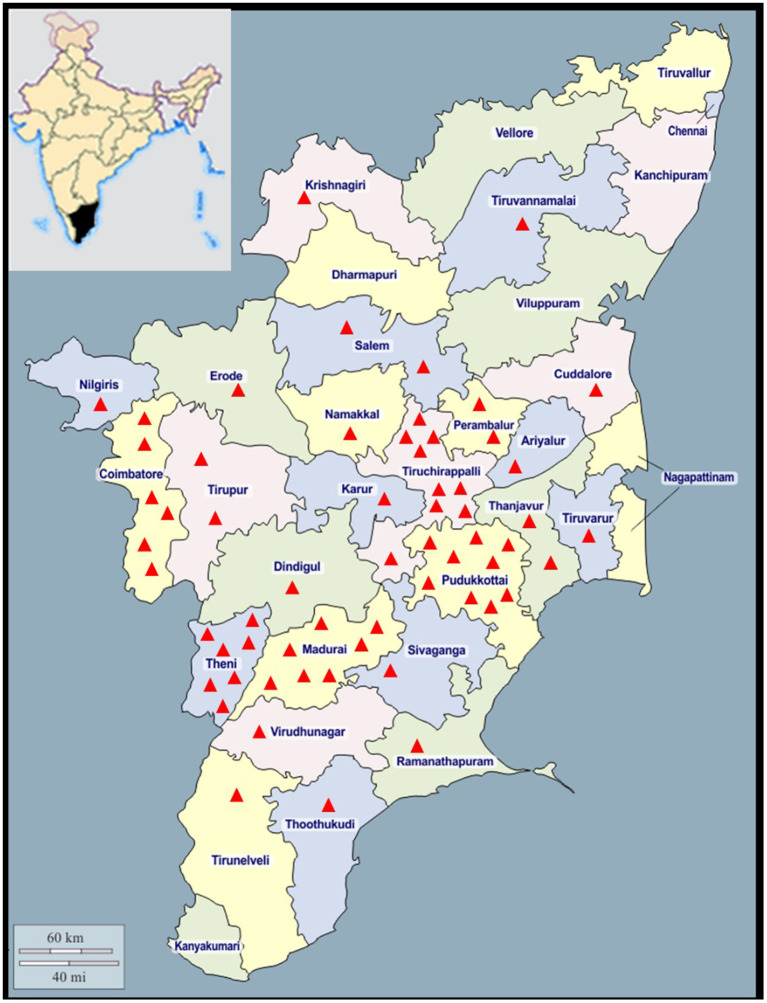
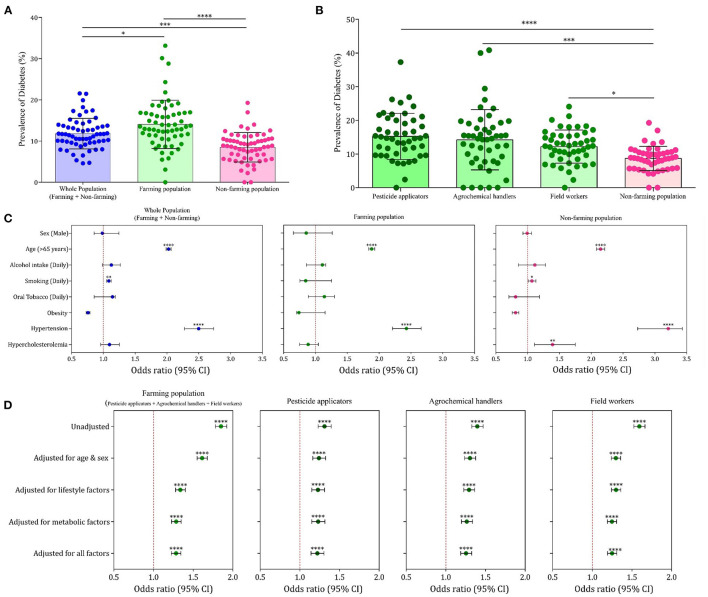
There has been a huge increase in diabetes and its associated cardiovascular complications over the last decade, predominantly in the middle- and low-income countries. In these countries, the majority live in rural areas. The Rural Epidemiology of Diabetes in South India (REDSI) study was aimed to analyze the prevalence of diabetes, cardiovascular risk factors, and its complications in rural farming and non-farming villages in Tamil Nadu, South India. A research survey on the prevalence of self-reported diabetes, cardiovascular risk factors (age, sex, obesity, hypertension, hypercholesterolemia, alcohol and tobacco use) and agricultural occupational exposure was executed among 106,111 people from 61 villages in the state of Tamil Nadu, South India, during 2015-2018. Overall, we observed a diabetes prevalence of 11.9% in rural South India. A nearly two-fold higher prevalence of diabetes was observed among the farming community (15.0%) compared to that among the non-farming population (8.7%). Logistic regression analyses revealed a strong association with agrochemical exposure ( < 0.0001) and diabetes prevalence among rural farming people. Our survey indicates a high prevalence of diabetes in rural South India particularly among the farming community. This survey in conjunction with other epidemiological and experimental studies raises the need for understanding the etiology of diabetes and other cardiovascular risk factors in rural communities.
在过去十年中,糖尿病及其相关心血管并发症大幅增加,主要集中在中低收入国家。在这些国家,大多数人生活在农村地区。印度南部农村糖尿病流行病学(REDSI)研究旨在分析印度南部泰米尔纳德邦农村农业和非农业村庄中糖尿病、心血管危险因素及其并发症的患病率。2015年至2018年期间,对印度南部泰米尔纳德邦61个村庄的106111人进行了一项关于自我报告的糖尿病患病率、心血管危险因素(年龄、性别、肥胖、高血压、高胆固醇血症、饮酒和吸烟)以及农业职业暴露的研究调查。总体而言,我们观察到印度南部农村地区的糖尿病患病率为11.9%。与非农业人口(8.7%)相比,农业社区的糖尿病患病率高出近两倍(15.0%)。逻辑回归分析显示,农业化学品暴露与印度南部农村农业人口的糖尿病患病率之间存在密切关联(<0.0001)。我们的调查表明,印度南部农村地区糖尿病患病率很高,尤其是在农业社区。这项调查与其他流行病学和实验研究一起,凸显了了解农村社区糖尿病及其他心血管危险因素病因的必要性。