Jiangsu Key Laboratory of Phylogenomics and Comparative Genomics, School of Life Sciences, Jiangsu Normal University, Xuzhou, China.
Institute of Food Crops, Provincial Key Laboratory of Agrobiology, Jiangsu Academy of Agricultural Sciences, Nanjing, China.
Mol Plant Pathol. 2022 Jan;23(1):104-117. doi: 10.1111/mpp.13146. Epub 2021 Oct 11.
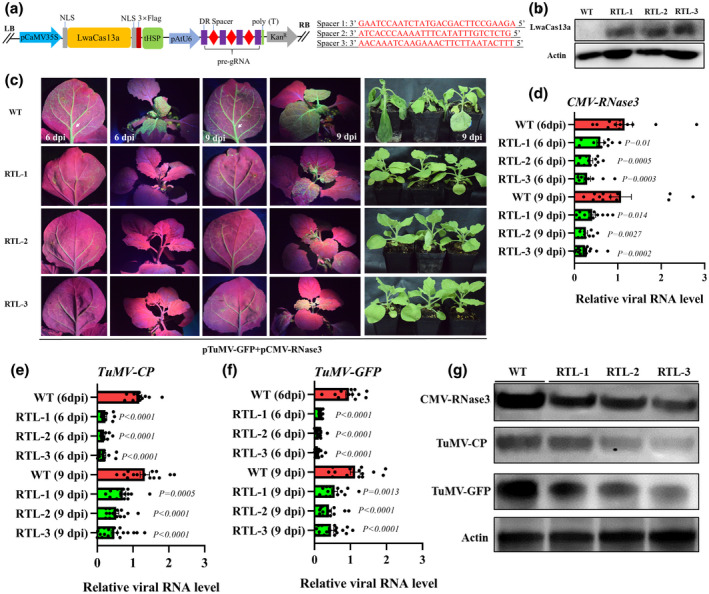
Sweet potato (Ipomoea batatas) is one of the most important crops in the world, and its production rate is mainly decreased by the sweet potato virus disease (SPVD) caused by the co-infection of sweet potato chlorotic stunt virus (SPCSV) and sweet potato feathery mottle virus. However, methods for improving SPVD resistance have not been established. Thus, this study aimed to enhance SPVD resistance by targeting one of its important pathogenesis-related factors (i.e., SPCSV-RNase3) by using the CRISPR-Cas13 technique. First, the RNA targeting activity of four CRISPR-Cas13 variants were compared using a transient expression system in Nicotiana benthamiana. LwaCas13a and RfxCas13d had more efficient RNA and RNA virus targeting activity than PspCas13b and LshCas13a. Driven by the pCmYLCV promoter for the expression of gRNAs, RfxCas13d exhibited higher RNA targeting activity than that driven by the pAtU6 promoter. Furthermore, the targeting of SPCSV-RNase3 using the LwaCas13a system inhibited its RNA silencing suppressor activity and recovered the RNA silencing activity in N. benthamiana leaf cells. Compared with the wild type, transgenic N. benthamiana plants carrying an RNase3-targeted LwaCas13a system exhibited enhanced resistance against turnip mosaic virus TuMV-GFP and cucumber mosaic virus CMV-RNase3 co-infection. Moreover, transgenic sweet potato plants carrying an RNase3-targeted RfxCas13d system exhibited substantially improved SPVD resistance. This method may contribute to the development of SPVD immune germplasm and the enhancement of sweet potato production in SPVD-prevalent regions.
甘薯(Ipomoea batatas)是世界上最重要的作物之一,其产量主要因甘薯褪绿矮化病毒(SPCSV)和甘薯羽状斑驳病毒的共同感染引起的甘薯病毒病(SPVD)而降低。然而,提高 SPVD 抗性的方法尚未建立。因此,本研究旨在利用 CRISPR-Cas13 技术靶向 SPCSV-RNase3 等重要的发病相关因子之一来提高 SPVD 抗性。首先,在本氏烟的瞬时表达系统中比较了四种 CRISPR-Cas13 变体的 RNA 靶向活性。LwaCas13a 和 RfxCas13d 比 PspCas13b 和 LshCas13a 具有更高的 RNA 和 RNA 病毒靶向活性。在 pCmYLCV 启动子驱动下表达 gRNA 的 RfxCas13d 比在 pAtU6 启动子驱动下表达的具有更高的 RNA 靶向活性。此外,LwaCas13a 系统靶向 SPCSV-RNase3 抑制了其 RNA 沉默抑制活性并恢复了 N. benthamiana 叶片细胞中的 RNA 沉默活性。与野生型相比,携带靶向 RNase3 的 LwaCas13a 系统的转基因 N. benthamiana 植物对芜菁花叶病毒 TuMV-GFP 和黄瓜花叶病毒 CMV-RNase3 共感染表现出增强的抗性。此外,携带靶向 RNase3 的 RfxCas13d 系统的转基因甘薯植物表现出显著提高的 SPVD 抗性。该方法可能有助于开发 SPVD 免疫种质资源并提高 SPVD 流行地区的甘薯产量。