Center for Population Biology, University of California, Davis, California, United States of America.
Department of Evolution and Ecology, University of California, Davis, California, United States of America.
PLoS Genet. 2021 Oct 11;17(10):e1009810. doi: 10.1371/journal.pgen.1009810. eCollection 2021 Oct.
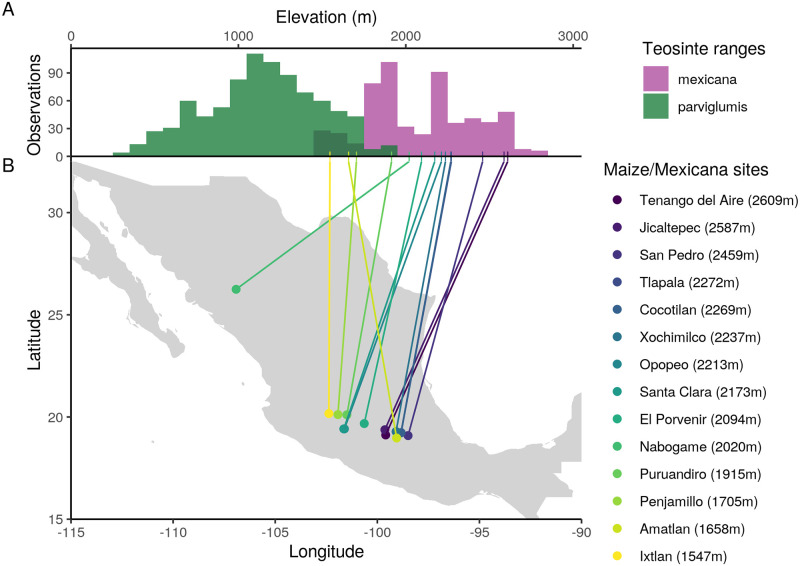
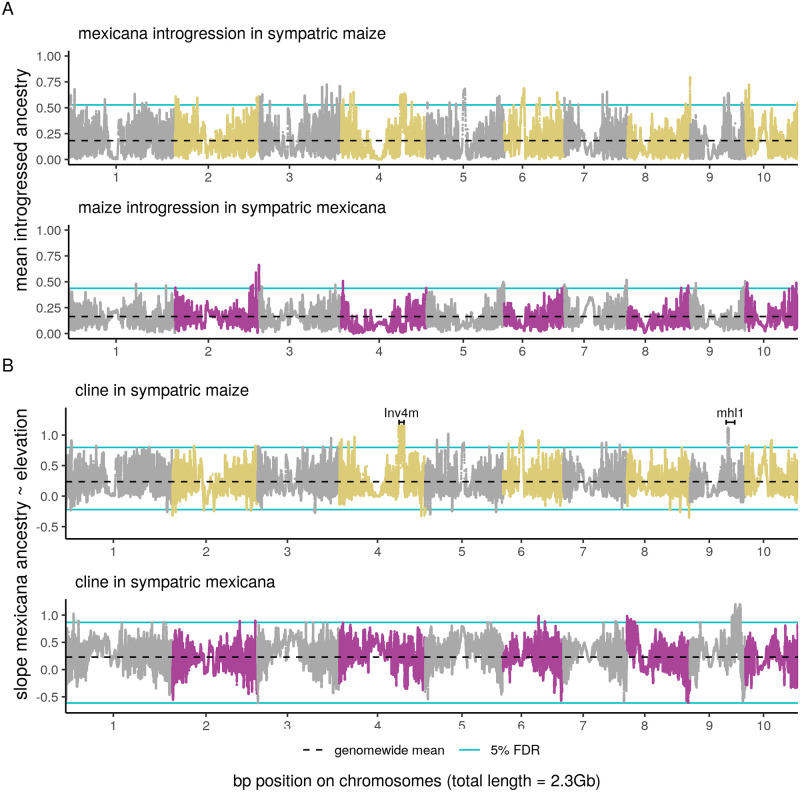
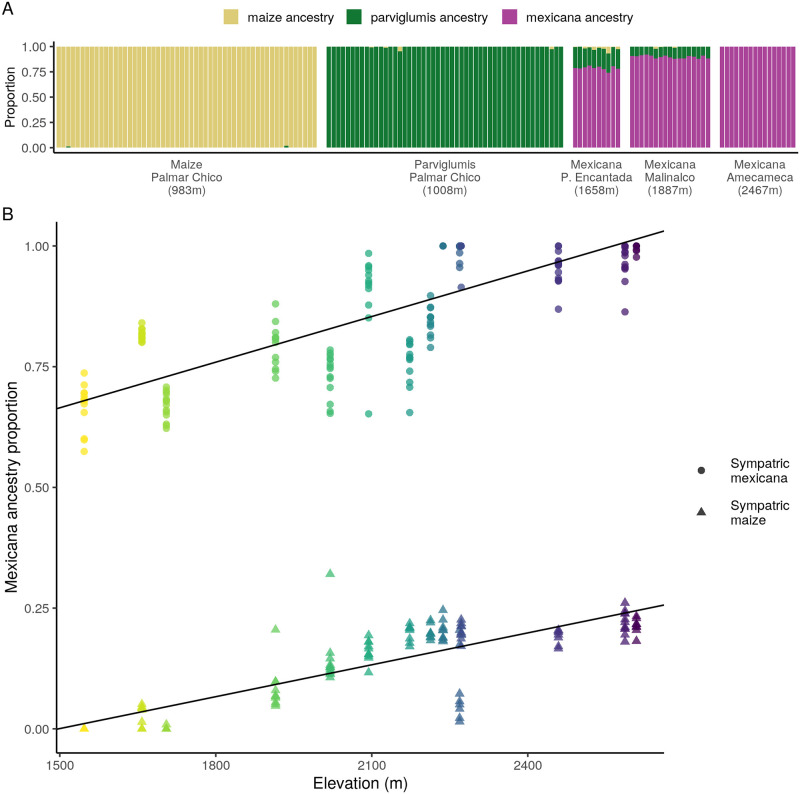
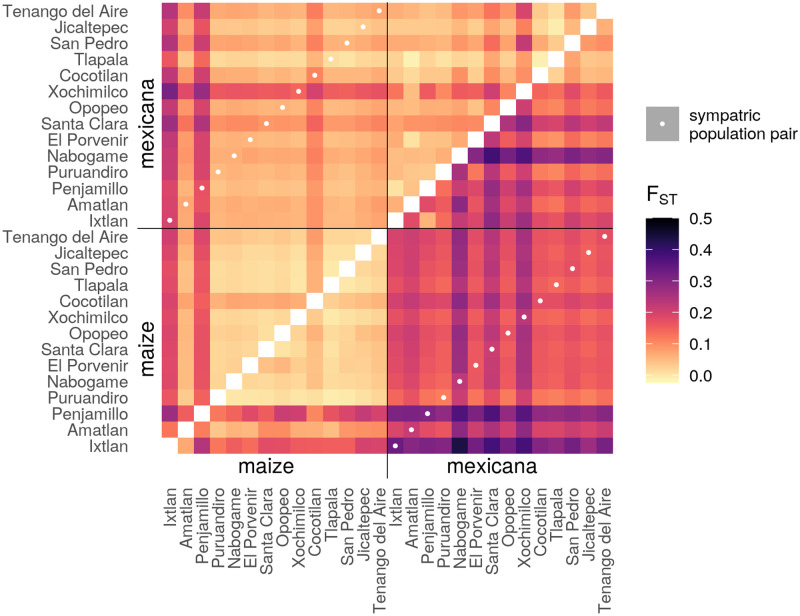
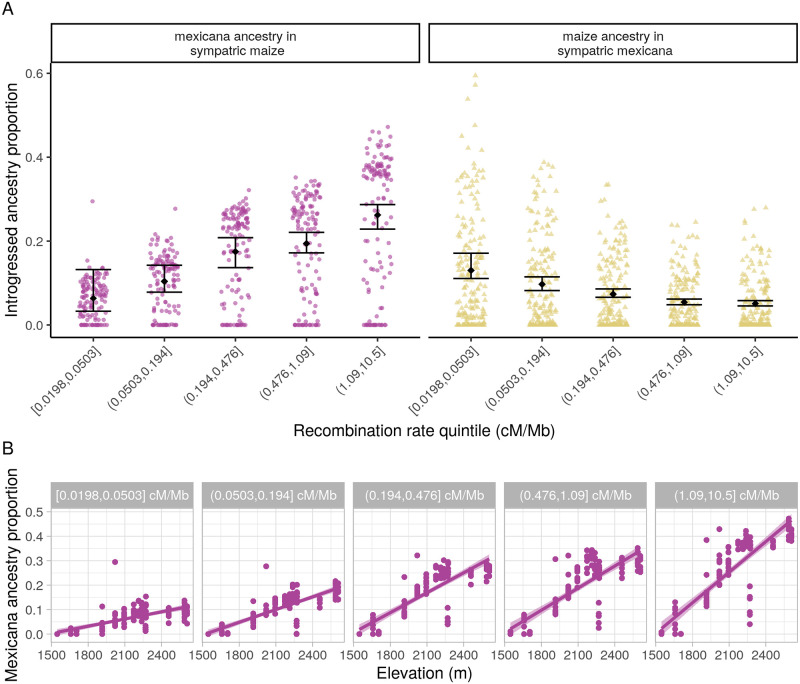
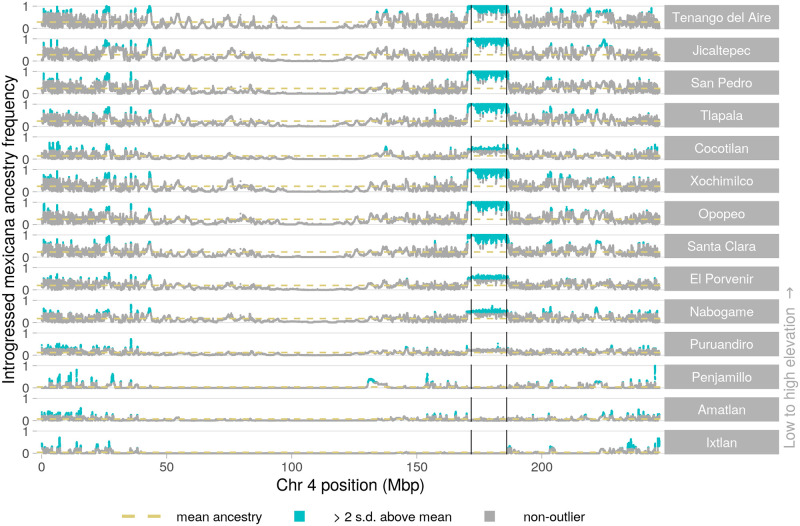
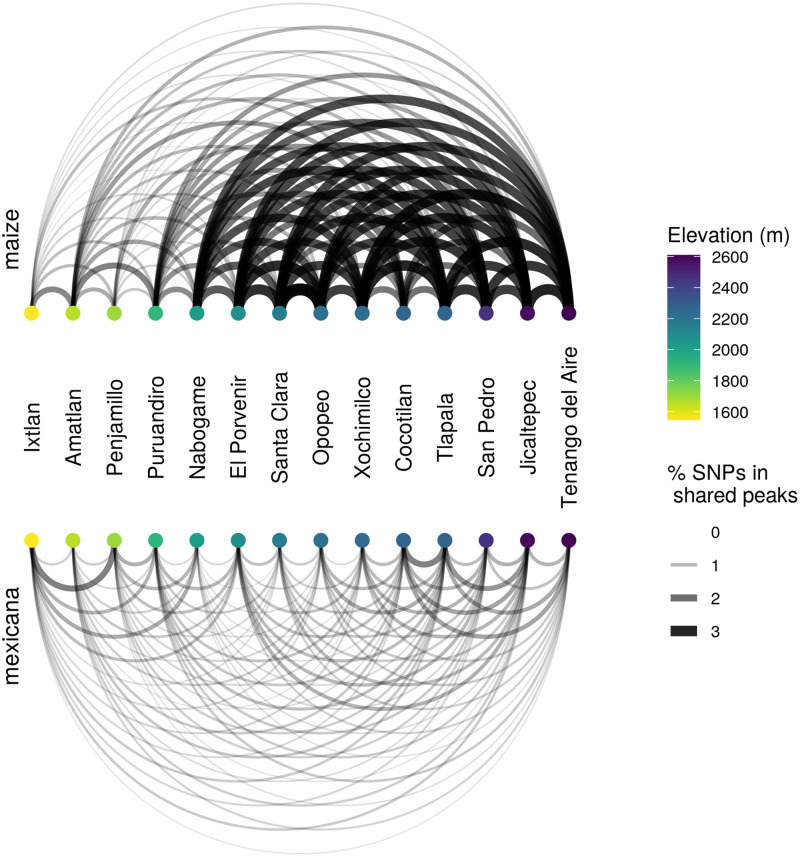
While often deleterious, hybridization can also be a key source of genetic variation and pre-adapted haplotypes, enabling rapid evolution and niche expansion. Here we evaluate these opposing selection forces on introgressed ancestry between maize (Zea mays ssp. mays) and its wild teosinte relative, mexicana (Zea mays ssp. mexicana). Introgression from ecologically diverse teosinte may have facilitated maize's global range expansion, in particular to challenging high elevation regions (> 1500 m). We generated low-coverage genome sequencing data for 348 maize and mexicana individuals to evaluate patterns of introgression in 14 sympatric population pairs, spanning the elevational range of mexicana, a teosinte endemic to the mountains of Mexico. While recent hybrids are commonly observed in sympatric populations and mexicana demonstrates fine-scale local adaptation, we find that the majority of mexicana ancestry tracts introgressed into maize over 1000 generations ago. This mexicana ancestry seems to have maintained much of its diversity and likely came from a common ancestral source, rather than contemporary sympatric populations, resulting in relatively low FST between mexicana ancestry tracts sampled from geographically distant maize populations. Introgressed mexicana ancestry in maize is reduced in lower-recombination rate quintiles of the genome and around domestication genes, consistent with pervasive selection against introgression. However, we also find mexicana ancestry increases across the sampled elevational gradient and that high introgression peaks are most commonly shared among high-elevation maize populations, consistent with introgression from mexicana facilitating adaptation to the highland environment. In the other direction, we find patterns consistent with adaptive and clinal introgression of maize ancestry into sympatric mexicana at many loci across the genome, suggesting that maize also contributes to adaptation in mexicana, especially at the lower end of its elevational range. In sympatric maize, in addition to high introgression regions we find many genomic regions where selection for local adaptation maintains steep gradients in introgressed mexicana ancestry across elevation, including at least two inversions: the well-characterized 14 Mb Inv4m on chromosome 4 and a novel 3 Mb inversion Inv9f surrounding the macrohairless1 locus on chromosome 9. Most outlier loci with high mexicana introgression show no signals of sweeps or local sourcing from sympatric populations and so likely represent ancestral introgression sorted by selection, resulting in correlated but distinct outcomes of introgression in different contemporary maize populations.
尽管杂交通常是有害的,但它也可以成为遗传变异和预先适应的单倍型的关键来源,从而实现快速进化和生态位扩张。在这里,我们评估了这些相反的选择力量在玉米(Zea mays ssp. mays)与其野生亲缘种墨西哥玉米草(Zea mays ssp. mexicana)之间的渐渗遗传背景上的作用。来自生态多样的玉米草的渐渗可能促进了玉米的全球范围扩张,特别是在具有挑战性的高海拔地区(>1500 米)。我们为 348 个玉米和墨西哥玉米草个体生成了低覆盖基因组测序数据,以评估 14 个同域种群对之间渐渗模式,这些种群跨越了墨西哥玉米草的海拔范围,墨西哥玉米草是墨西哥山区特有的玉米草。虽然在同域种群中经常观察到最近的杂种,但墨西哥玉米草表现出精细的局部适应,我们发现大多数墨西哥玉米草遗传背景在 1000 多代前就已渐渗到玉米中。这些墨西哥玉米草遗传背景似乎保持了其大部分多样性,并且可能来自共同的祖先来源,而不是当代同域种群,这导致了从地理上遥远的玉米种群中采样的墨西哥玉米草遗传背景之间相对较低的 FST。玉米中的渐渗墨西哥玉米草遗传背景在基因组的低重组率五分位数和驯化基因周围减少,这与对渐渗的普遍选择一致。然而,我们也发现,在整个采样的海拔梯度上,墨西哥玉米草遗传背景增加,并且在高海拔玉米种群中最常见的是高渐渗峰值,这与墨西哥玉米草的渐渗有助于适应高地环境一致。在另一个方向上,我们发现了在整个基因组的许多基因座上,玉米遗传背景向同域墨西哥玉米草适应性和渐渗的模式一致,这表明玉米也有助于墨西哥玉米草的适应,特别是在其海拔范围的低端。在同域玉米中,除了高渐渗区域外,我们还发现了许多基因组区域,在这些区域中,对局部适应的选择维持了沿海拔高度渐渗的墨西哥玉米草遗传背景的陡峭梯度,其中包括至少两个倒位:染色体 4 上特征明显的 14 Mb Inv4m 和染色体 9 上围绕 macrohairless1 基因座的新型 3 Mb Inv9f。具有高墨西哥玉米草渐渗的大多数外显子位点没有来自同域种群的扫荡或局部来源的信号,因此可能代表由选择排序的祖先渐渗,导致不同当代玉米种群中渐渗的相关但不同的结果。