Biology Department, Queens College, City University of New York (CUNY), New York City, New York, United States of America.
Ph.D. Program in Biology, The Graduate Center, City University of New York (CUNY), New York City, New York, United States of America.
PLoS Genet. 2021 Oct 11;17(10):e1009836. doi: 10.1371/journal.pgen.1009836. eCollection 2021 Oct.
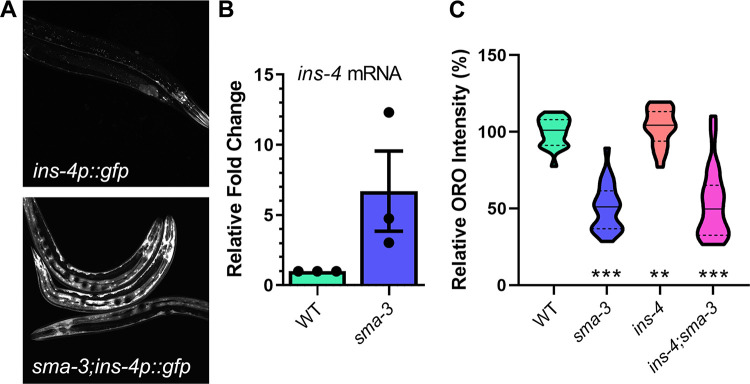
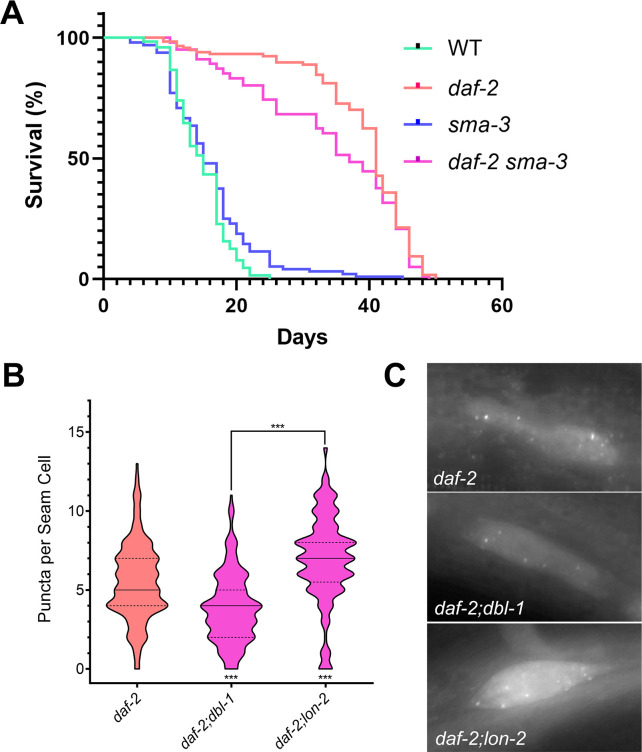
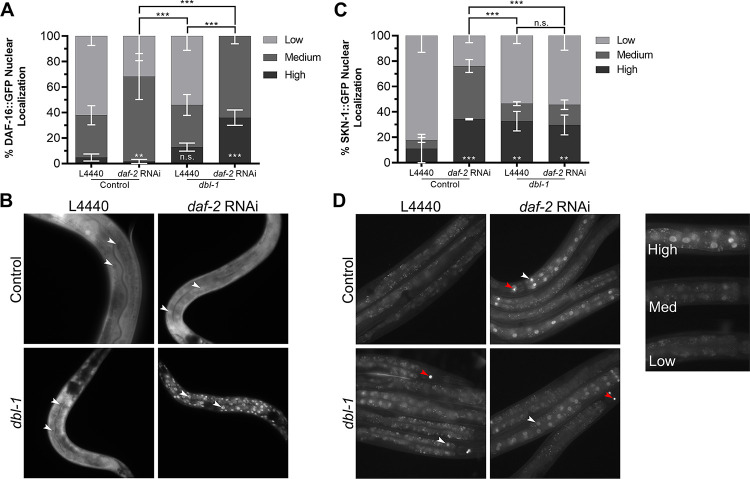
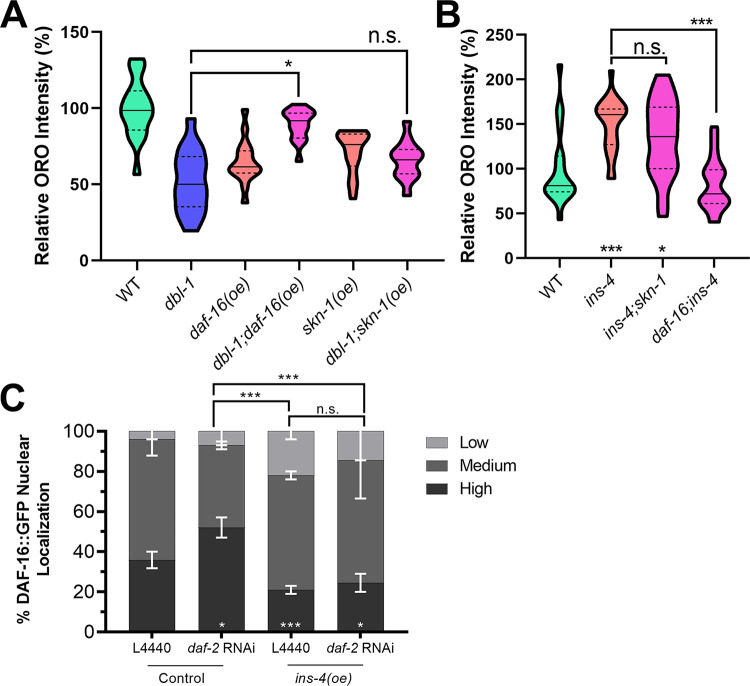
A small number of peptide growth factor ligands are used repeatedly in development and homeostasis to drive programs of cell differentiation and function. Cells and tissues must integrate inputs from these diverse signals correctly, while failure to do so leads to pathology, reduced fitness, or death. Previous work using the nematode C. elegans identified an interaction between the bone morphogenetic protein (BMP) and insulin/IGF-1-like signaling (IIS) pathways in the regulation of lipid homeostasis. The molecular components required for this interaction, however, were not fully understood. Here we report that INS-4, one of 40 insulin-like peptides (ILPs), is regulated by BMP signaling to modulate fat accumulation. Furthermore, we find that the IIS transcription factor DAF-16/FoxO, but not SKN-1/Nrf, acts downstream of BMP signaling in lipid homeostasis. Interestingly, BMP activity alters sensitivity of these two transcription factors to IIS-promoted cytoplasmic retention in opposite ways. Finally, we probe the extent of BMP and IIS interactions by testing additional IIS functions including dauer formation, aging, and autophagy induction. Coupled with our previous work and that of other groups, we conclude that BMP and IIS pathways have at least three modes of interaction: independent, epistatic, and antagonistic. The molecular interactions we identify provide new insight into mechanisms of signaling crosstalk and potential therapeutic targets for IIS-related pathologies such as diabetes and metabolic syndrome.
少量的肽生长因子配体在发育和体内平衡中被反复使用,以驱动细胞分化和功能的程序。细胞和组织必须正确整合来自这些不同信号的输入,而未能正确整合则会导致病理学、适应性降低或死亡。先前使用线虫 C. elegans 的研究确定了骨形态发生蛋白 (BMP) 和胰岛素/IGF-1 样信号 (IIS) 通路在脂质体内平衡调节中的相互作用。然而,对于这种相互作用所需的分子成分还不完全清楚。在这里,我们报告说,40 种胰岛素样肽 (ILP) 之一的 INS-4 受 BMP 信号调节,以调节脂肪积累。此外,我们发现 IIS 转录因子 DAF-16/FoxO,但不是 SKN-1/Nrf,在脂质体内平衡中作为 BMP 信号的下游发挥作用。有趣的是,BMP 活性以相反的方式改变这两个转录因子对 IIS 促进的细胞质保留的敏感性。最后,我们通过测试其他 IIS 功能,包括 dauer 形成、衰老和自噬诱导,来探究 BMP 和 IIS 相互作用的程度。结合我们以前的工作和其他小组的工作,我们得出结论,BMP 和 IIS 途径至少有三种相互作用模式:独立、上位和拮抗。我们确定的分子相互作用为信号串扰的机制提供了新的见解,并为与 IIS 相关的病理学(如糖尿病和代谢综合征)提供了潜在的治疗靶点。