Morales Delphine, Vigneron Pascale, Ferreira Ines, Hamitou Warda, Magnano Mikael, Mahenthiran Laxsika, Lok Catherine, Vayssade Muriel
Université de Technologie de Compiègne, CNRS, Biomechanics and Bioengineering, Centre de Recherche Royallieu-CS 60 319, CEDEX, 60203 Compiègne, France.
Department of Dermatology, CHU Amiens Picardie-Site Nord, CEDEX 1, 80054 Amiens, France.
Cancers (Basel). 2021 Sep 23;13(19):4761. doi: 10.3390/cancers13194761.
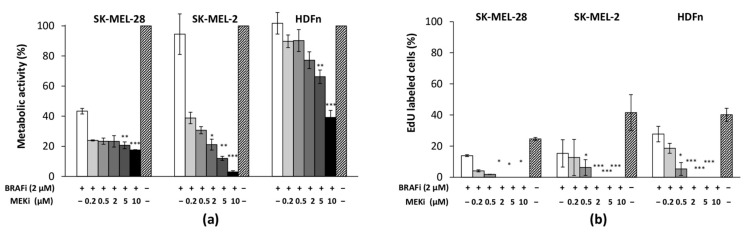
The sensitivity of melanoma cells to targeted therapy compounds depends on the tumor microenvironment. Three-dimensional (3D) in vitro coculture systems better reflect the native structural architecture of tissues and are ideal for investigating cellular interactions modulating cell sensitivity to drugs. Metastatic melanoma (MM) cells (SK-MEL-28 BRAF V600E mutant and SK-MEL-2 wt) were cultured as a monolayer (2D) or cocultured on 3D dermal equivalents (with fibroblasts) and treated with a BRAFi (vemurafenib) combined with a MEK inhibitor (MEKi, cobimetinib). The drug combination efficiently inhibited 2D and 3D MM cell proliferation and survival regardless of their BRAF status. Two-dimensional and three-dimensional cancer-associated fibroblasts (CAFs), isolated from a cutaneous MM biopsy, were also sensitive to the targeted therapy. Conditioned media obtained from healthy dermal fibroblasts or CAFs modulated the MM cell's response differently to the treatment: while supernatants from healthy fibroblasts potentialized the efficiency of drugs on MM, those from CAFs tended to increase cell survival. Our data indicate that the secretory profiles of fibroblasts influence MM sensitivity to the combined vemurafenib and cobimetinib treatment and highlight the need for 3D in vitro cocultures representing the complex crosstalk between melanoma and CAFs during preclinical studies of drugs.
黑色素瘤细胞对靶向治疗化合物的敏感性取决于肿瘤微环境。三维(3D)体外共培养系统能更好地反映组织的天然结构架构,是研究调节细胞对药物敏感性的细胞间相互作用的理想模型。转移性黑色素瘤(MM)细胞(SK-MEL-28 BRAF V600E突变型和SK-MEL-2野生型)以单层(2D)方式培养,或与成纤维细胞一起在3D真皮替代物上共培养,并用BRAF抑制剂(维莫非尼)联合MEK抑制剂(MEK抑制剂,考比替尼)处理。无论其BRAF状态如何,该药物组合均能有效抑制2D和3D MM细胞的增殖和存活。从皮肤MM活检中分离出的二维和三维癌症相关成纤维细胞(CAF)对靶向治疗也敏感。从健康真皮成纤维细胞或CAF获得的条件培养基对MM细胞对治疗的反应调节不同:健康成纤维细胞的上清液增强了药物对MM的作用效率,而CAF的上清液则倾向于增加细胞存活率。我们的数据表明,成纤维细胞的分泌谱影响MM对维莫非尼和考比替尼联合治疗的敏感性,并强调在药物临床前研究中需要3D体外共培养来代表黑色素瘤和CAF之间复杂的相互作用。