Romano Veronica, Belviso Immacolata, Venuta Alessandro, Ruocco Maria Rosaria, Masone Stefania, Aliotta Federica, Fiume Giuseppe, Montagnani Stefania, Avagliano Angelica, Arcucci Alessandro
Department of Public Health, University of Napoli "Federico II", 80131 Naples, Italy.
Department of Molecular Medicine and Medical Biotechnology, University of Naples Federico II, 80131 Naples, Italy.
Int J Mol Sci. 2021 May 17;22(10):5283. doi: 10.3390/ijms22105283.
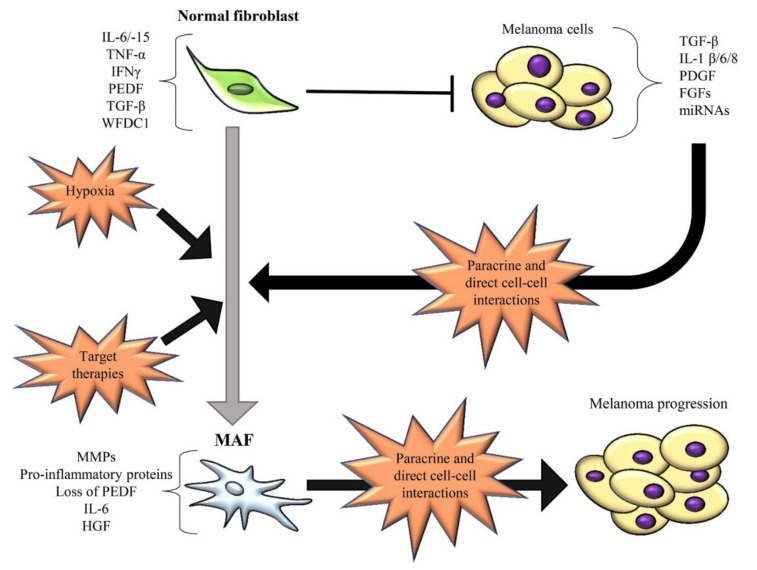
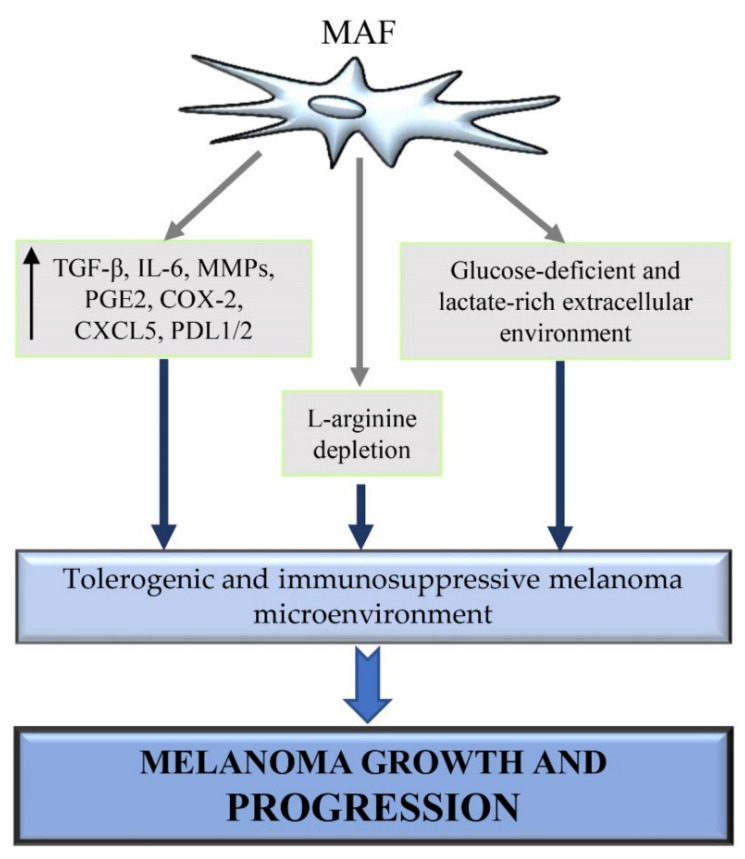
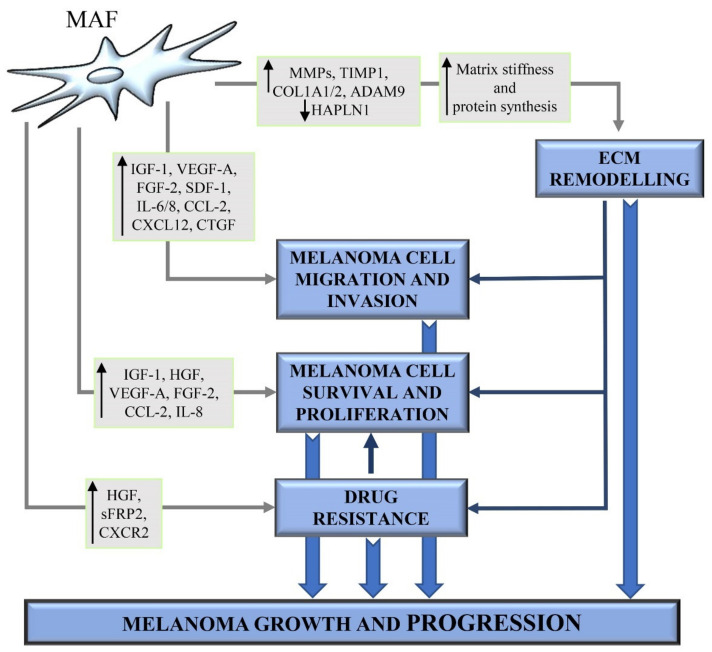
Cutaneous melanoma (CM) tissue represents a network constituted by cancer cells and tumor microenvironment (TME). A key feature of CM is the high structural and cellular plasticity of TME, allowing its evolution with disease and adaptation to cancer cell and environmental alterations. In particular, during melanoma development and progression each component of TME by interacting with each other and with cancer cells is subjected to dramatic structural and cellular modifications. These alterations affect extracellular matrix (ECM) remodelling, phenotypic profile of stromal cells, cancer growth and therapeutic response. The stromal fibroblast populations of the TME include normal fibroblasts and melanoma-associated fibroblasts (MAFs) that are highly abundant and flexible cell types interacting with melanoma and stromal cells and differently influencing CM outcomes. The shift from the normal microenvironment to TME and from normal fibroblasts to MAFs deeply sustains CM growth. Hence, in this article we review the features of the normal microenvironment and TME and describe the phenotypic plasticity of normal dermal fibroblasts and MAFs, highlighting their roles in normal skin homeostasis and TME regulation. Moreover, we discuss the influence of MAFs and their secretory profiles on TME remodelling, melanoma progression, targeted therapy resistance and immunosurveillance, highlighting the cellular interactions, the signalling pathways and molecules involved in these processes.
皮肤黑色素瘤(CM)组织是一个由癌细胞和肿瘤微环境(TME)构成的网络。CM的一个关键特征是TME具有高度的结构和细胞可塑性,使其能够随着疾病的发展而演变,并适应癌细胞和环境的变化。特别是,在黑色素瘤的发生和发展过程中,TME的每个组成部分通过相互作用以及与癌细胞相互作用,会经历显著的结构和细胞改变。这些改变影响细胞外基质(ECM)重塑、基质细胞的表型特征、癌症生长和治疗反应。TME的基质成纤维细胞群体包括正常成纤维细胞和黑色素瘤相关成纤维细胞(MAF),它们是高度丰富且灵活的细胞类型,与黑色素瘤和基质细胞相互作用,并对CM的结局产生不同影响。从正常微环境到TME以及从正常成纤维细胞到MAF的转变极大地促进了CM的生长。因此,在本文中,我们综述了正常微环境和TME的特征,并描述了正常真皮成纤维细胞和MAF的表型可塑性,强调了它们在正常皮肤稳态和TME调节中的作用。此外,我们讨论了MAF及其分泌谱对TME重塑、黑色素瘤进展、靶向治疗耐药性和免疫监视的影响,突出了这些过程中涉及的细胞相互作用、信号通路和分子。