Department of Biochemistry, School of Medicine, University of Patras, 26504 Patras, Greece.
Int J Mol Sci. 2021 Sep 24;22(19):10307. doi: 10.3390/ijms221910307.
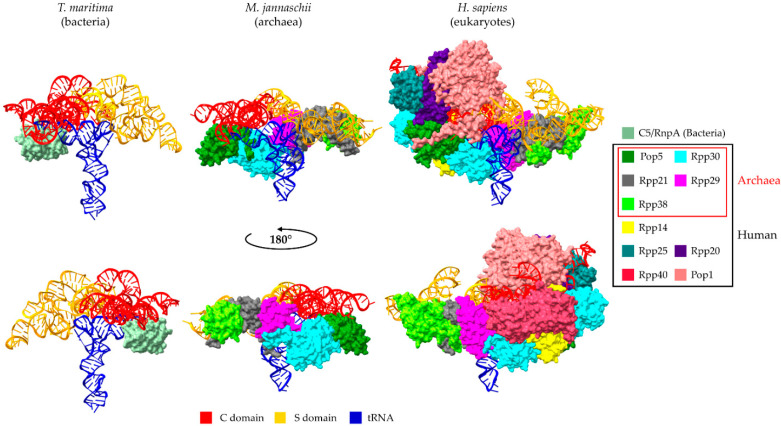
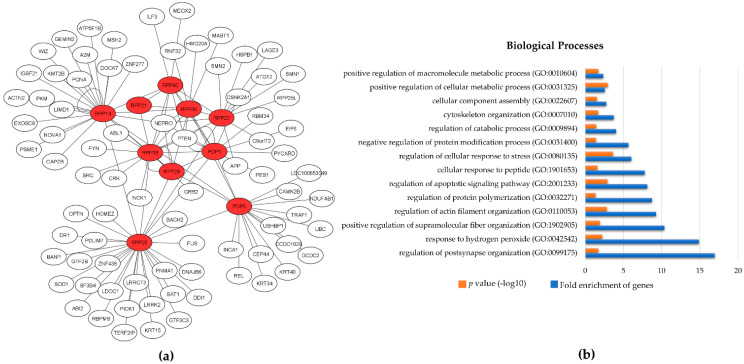
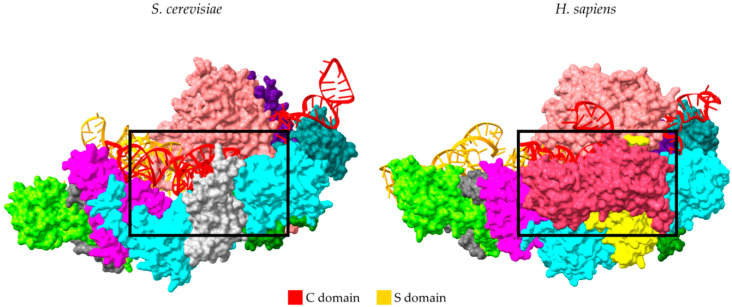
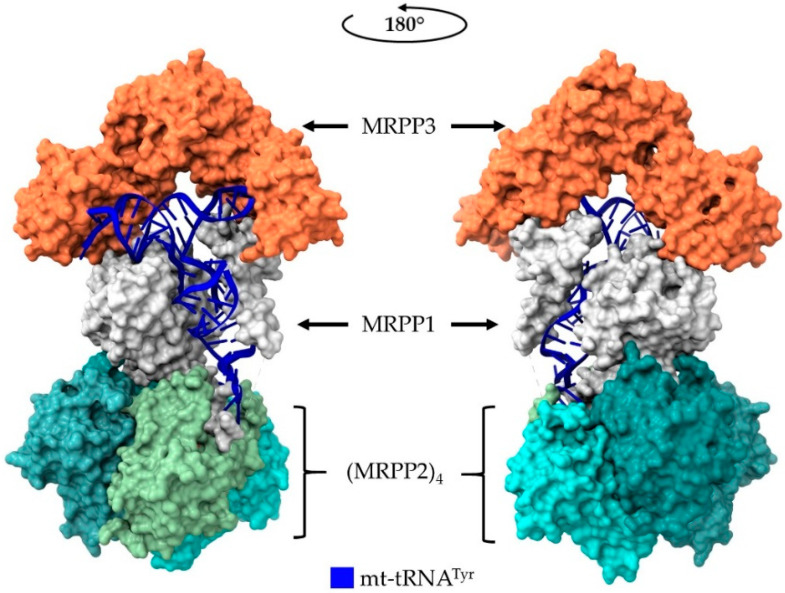
Ribonuclease P (RNase P) is an important ribonucleoprotein (RNP), responsible for the maturation of the 5' end of precursor tRNAs (pre-tRNAs). In all organisms, the cleavage activity of a single phosphodiester bond adjacent to the first nucleotide of the acceptor stem is indispensable for cell viability and lies within an essential catalytic RNA subunit. Although RNase P is a ribozyme, its kinetic efficiency in vivo, as well as its structural variability and complexity throughout evolution, requires the presence of one protein subunit in bacteria to several protein partners in archaea and eukaryotes. Moreover, the existence of protein-only RNase P (PRORP) enzymes in several organisms and organelles suggests a more complex evolutionary timeline than previously thought. Recent detailed structures of bacterial, archaeal, human and mitochondrial RNase P complexes suggest that, although apparently dissimilar enzymes, they all recognize pre-tRNAs through conserved interactions. Interestingly, individual protein subunits of the human nuclear and mitochondrial holoenzymes have additional functions and contribute to a dynamic network of elaborate interactions and cellular processes. Herein, we summarize the role of each RNase P subunit with a focus on the human nuclear RNP and its putative role in flawless gene expression in light of recent structural studies.
核糖核酸酶 P(RNase P)是一种重要的核糖核蛋白(RNP),负责前体 tRNA(pre-tRNA)5'端的成熟。在所有生物体中,临近接受茎第一个核苷酸的单个磷酸二酯键的切割活性对于细胞活力是必不可少的,并且位于必需的催化 RNA 亚基内。尽管 RNase P 是一种核酶,但它在体内的动力学效率以及在整个进化过程中的结构可变性和复杂性,需要在细菌中存在一个蛋白质亚基,在古菌和真核生物中存在几个蛋白质伴侣。此外,在几个生物体和细胞器中存在仅含蛋白质的 RNase P(PRORP)酶,表明其进化时间线比以前认为的更为复杂。最近对细菌、古菌、人类和线粒体 RNase P 复合物的详细结构研究表明,尽管这些酶显然不同,但它们都通过保守的相互作用识别 pre-tRNA。有趣的是,人核酶和线粒体全酶的单个蛋白质亚基具有额外的功能,并有助于复杂的相互作用和细胞过程的动态网络。本文总结了每个 RNase P 亚基的作用,重点介绍了人类核 RNP 及其在最近的结构研究中在完美基因表达中的潜在作用。