Department of Biochemistry, The Ohio State University, Columbus, OH 43210, USA.
Nucleic Acids Res. 2010 Dec;38(22):8316-27. doi: 10.1093/nar/gkq668. Epub 2010 Aug 12.
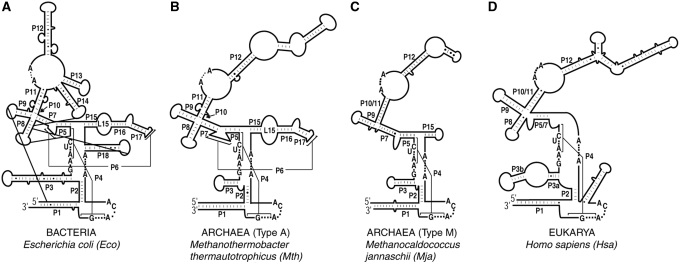
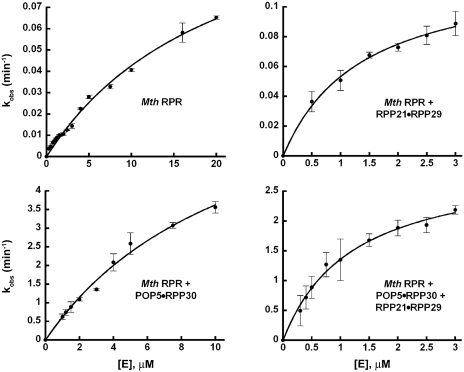
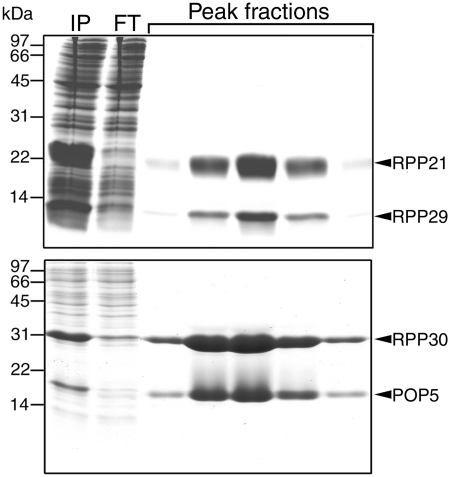
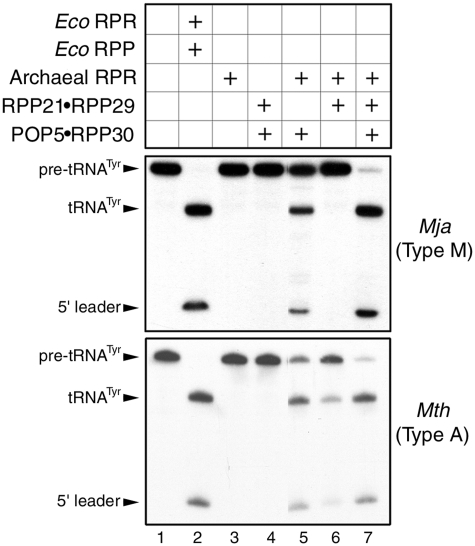
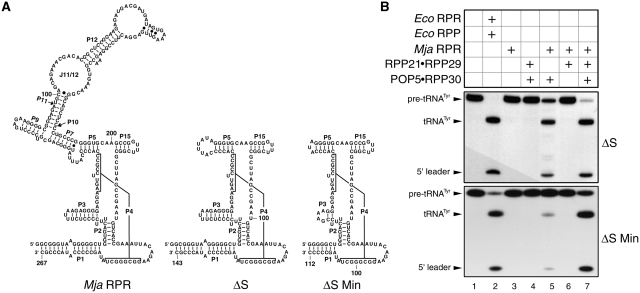
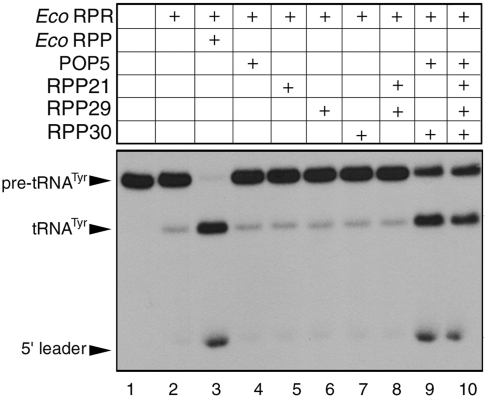
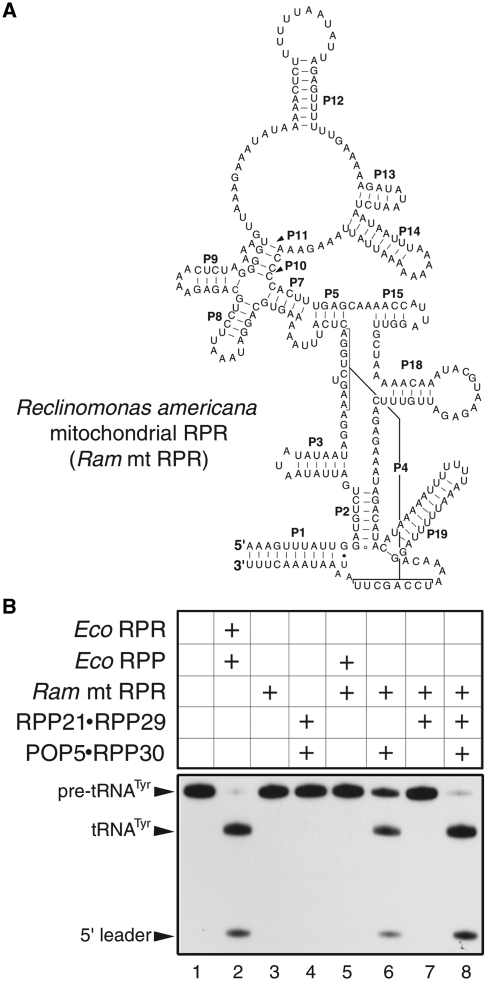
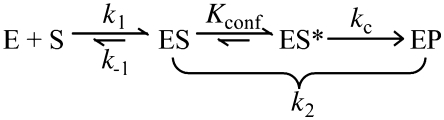
RNase P catalyzes the Mg(2)(+)-dependent 5'-maturation of precursor tRNAs. Biochemical studies on the bacterial holoenzyme, composed of one catalytic RNase P RNA (RPR) and one RNase P protein (RPP), have helped understand the pleiotropic roles (including substrate/Mg(2+) binding) by which a protein could facilitate RNA catalysis. As a model for uncovering the functional coordination among multiple proteins that aid an RNA catalyst, we use archaeal RNase P, which comprises one catalytic RPR and at least four RPPs. Exploiting our previous finding that these archaeal RPPs function as two binary RPP complexes (POP5•RPP30 and RPP21•RPP29), we prepared recombinant RPP pairs from three archaea and established interchangeability of subunits through homologous/heterologous assemblies. Our finding that archaeal POP5•RPP30 reconstituted with bacterial and organellar RPRs suggests functional overlap of this binary complex with the bacterial RPP and highlights their shared recognition of a phylogenetically-conserved RPR catalytic core, whose minimal attributes we further defined through deletion mutagenesis. Moreover, single-turnover kinetic studies revealed that while POP5•RPP30 is solely responsible for enhancing the RPR's rate of precursor tRNA cleavage (by 60-fold), RPP21•RPP29 contributes to increased substrate affinity (by 16-fold). Collectively, these studies provide new perspectives on the functioning and evolution of an ancient, catalytic ribonucleoprotein.
RNase P 催化 Mg(2)(+)依赖的前体 tRNA 的 5'-成熟。对由一个催化性 RNase P RNA (RPR) 和一个 RNase P 蛋白 (RPP) 组成的细菌全酶的生化研究有助于理解蛋白质促进 RNA 催化的多效性作用(包括底物/Mg(2+)结合)。作为揭示有助于 RNA 催化剂的多个蛋白质之间功能协调的模型,我们使用古菌 RNase P,它由一个催化性 RPR 和至少四个 RPP 组成。利用我们之前发现的这些古菌 RPP 作为两个二元 RPP 复合物(POP5•RPP30 和 RPP21•RPP29)的功能,我们从三种古菌中制备了重组 RPP 对,并通过同源/异源组装实现了亚基的可互换性。我们发现古菌 POP5•RPP30 与细菌和细胞器 RPR 重建表明该二元复合物与细菌 RPP 的功能重叠,并强调了它们对系统发育保守的 RPR 催化核心的共同识别,我们通过缺失突变进一步定义了其最小属性。此外,单轮动力学研究表明,虽然 POP5•RPP30 仅负责增强 RPR 对前体 tRNA 切割的速率(提高 60 倍),但 RPP21•RPP29 有助于提高底物亲和力(提高 16 倍)。总的来说,这些研究为古老的催化性核糖核蛋白的功能和进化提供了新的视角。