ATLANTES Research Group, Institute for Culture and Society, University of Navarra, 31009 Pamplona, Navarra, Spain.
Navarra Institute for Health Research (IdiSNA), Recinto de Complejo Hospitalario de Navarra C/Irunlarrea, 3, 31008 Pamplona, Navarra, Spain.
Int J Environ Res Public Health. 2021 Sep 30;18(19):10345. doi: 10.3390/ijerph181910345.
Palliative care is a priority for health systems worldwide, yet equity in access remains unknown. To shed light on this issue, this study compares populations' driving time to specialized palliative care services in three countries: Ireland, Spain, and Switzerland.
Network analysis of the population's driving time to services according to geolocated palliative care services using Geographical Information System (GIS). Percentage of the population living within a 30-min driving time, between 30 and 60 minutes, and over 60 min were calculated.
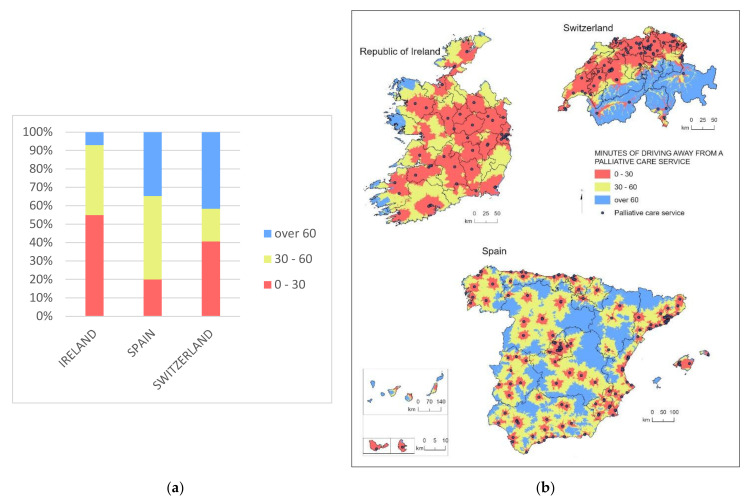
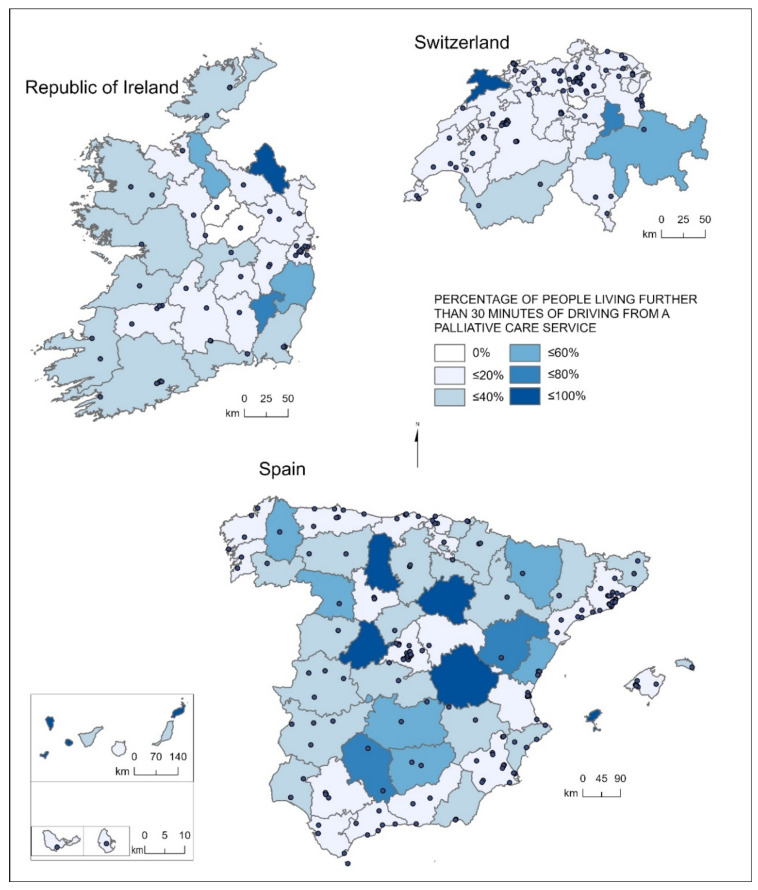
The percentage of the population living less than thirty minutes away from the nearest palliative care provider varies among Ireland (84%), Spain (79%), and Switzerland (95%). Percentages of the population over an hour away from services were 1.87% in Spain, 0.58% in Ireland, and 0.51% in Switzerland.
Inequities in access to specialized palliative care are noticeable amongst countries, with implications also at the sub-national level.
姑息治疗是全球卫生系统的重点,但获得服务的公平性仍不清楚。为了阐明这个问题,本研究比较了爱尔兰、西班牙和瑞士三个国家的人群到专门的姑息治疗服务的驾车时间。
使用地理信息系统(GIS)根据地理位置定位的姑息治疗服务,对人群到达服务的驾车时间进行网络分析。计算了居住在 30 分钟车程内、30-60 分钟车程内和超过 60 分钟车程内的人口比例。
距离最近的姑息治疗提供者不到 30 分钟车程的人口比例在爱尔兰为 84%,西班牙为 79%,瑞士为 95%。距离服务超过一小时的人口比例在西班牙为 1.87%,爱尔兰为 0.58%,瑞士为 0.51%。
国家之间在获得专门姑息治疗服务方面存在明显的不公平现象,在国家以下层面也存在影响。