Department of Epidemiology and Preventive Medicine, Sackler Faculty of Medicine and Sylvan Adams Sports Institute, School of Public Health, Tel Aviv University, P.O. Box 39040, Tel Aviv 6997801, Israel.
Department of Health Promotion, Sackler Faculty of Medicine, School of Public Health, Tel-Aviv University, Tel-Aviv 39040, Israel.
Int J Environ Res Public Health. 2021 Oct 3;18(19):10418. doi: 10.3390/ijerph181910418.
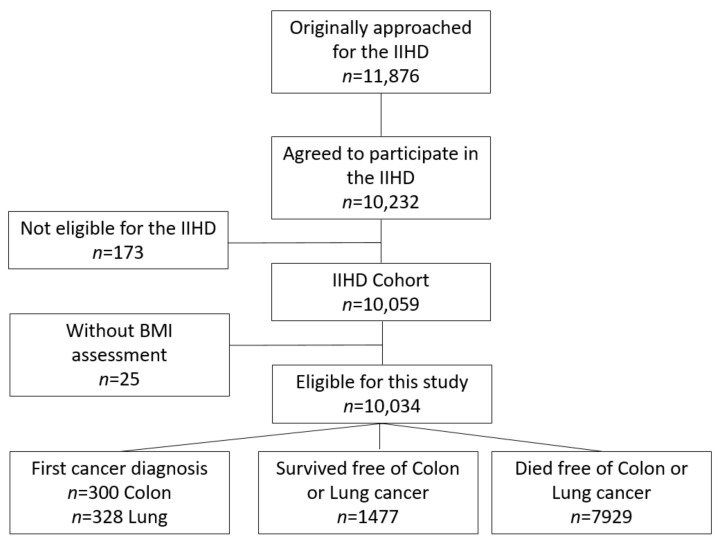
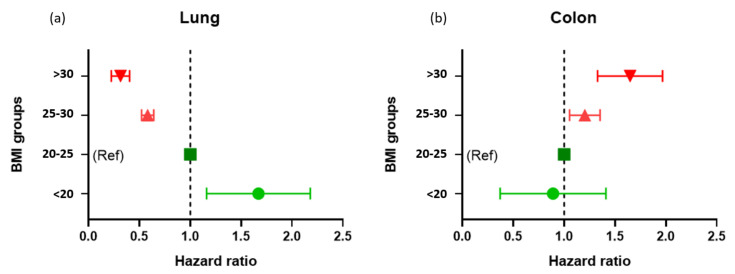
Most evidence for an association between excess body weight and cancer risk has been derived from studies of relatively short duration with little reference to the effect on tumor site. This study was designed to evaluate the association between categories of body mass index (BMI: <20, 20-25, 25-30, and >30 kg/m) and the incidence of colon and lung cancer over 43 years of follow-up (1963-2006), in 10,043 men from the Israeli Ischemic Heart Disease (IIHD) prospective cohort (mean age at baseline 49.3 years, mean BMI 25.7 kg/m). Data from the Israel National Cancer Registry was linked with the IIHD, and the Cox proportional hazards regression model was applied to analyze the relative risks for lung and colon cancer across BMI categories at baseline. Three hundred cases of lung cancer (2.9%) and 328 cases of colon cancer (3.3%) were diagnosed in the total population. Applying a multivariate model adjusted for age, smoking intensity, and total cholesterol, higher BMI category was associated with an increased risk of colon cancer [HR = 1.22 (95% CI 1.02-1.45)], and with a decreased risk for lung cancer [HR = 0.66 (95% CI 0.56-0.77)]. In this long-term follow-up study over four decades, we observed a consistent dose-response pattern between BMI and increased risk for colon cancer, but decreased risk for lung cancer. Specific associations between excess body weight and cancer risk may suggest different patterns of body fat and cancer incidence at a given site.
大多数关于超重与癌症风险之间关联的证据来自于短期研究,很少涉及对肿瘤部位的影响。本研究旨在评估体质量指数(BMI:<20、20-25、25-30 和>30kg/m2)类别与 43 年随访期间(1963-2006 年)结肠癌和肺癌发病率之间的关联,研究对象为来自以色列缺血性心脏病(IIHD)前瞻性队列的 10043 名男性(基线时平均年龄为 49.3 岁,平均 BMI 为 25.7kg/m2)。以色列国家癌症登记处的数据与 IIHD 相关联,应用 Cox 比例风险回归模型分析基线时 BMI 类别与肺癌和结肠癌的相对风险。在总人群中诊断出 300 例肺癌(2.9%)和 328 例结肠癌(3.3%)。应用调整年龄、吸烟强度和总胆固醇的多变量模型,较高的 BMI 类别与结肠癌风险增加相关[风险比(HR)=1.22(95%可信区间(CI)1.02-1.45)],与肺癌风险降低相关[HR=0.66(95%CI 0.56-0.77)]。在这项超过四十年的长期随访研究中,我们观察到 BMI 与结肠癌风险增加之间存在一致的剂量反应模式,但与肺癌风险降低相关。超重与癌症风险之间的特定关联可能提示特定部位的体脂肪和癌症发病率存在不同模式。