Graduate School of Public Health, Teikyo University, Tokyo 173-8605, Japan.
Department of Breast Surgery, Jyoban Hospital of Tokiwa Foundation, Iwaki 972-8322, Japan.
Int J Environ Res Public Health. 2021 Oct 6;18(19):10495. doi: 10.3390/ijerph181910495.
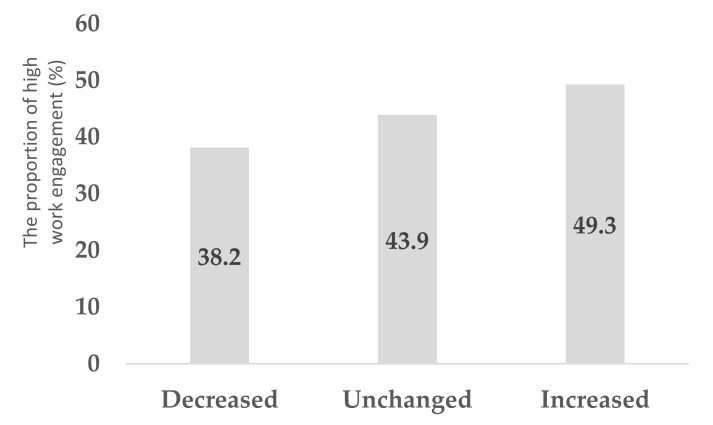
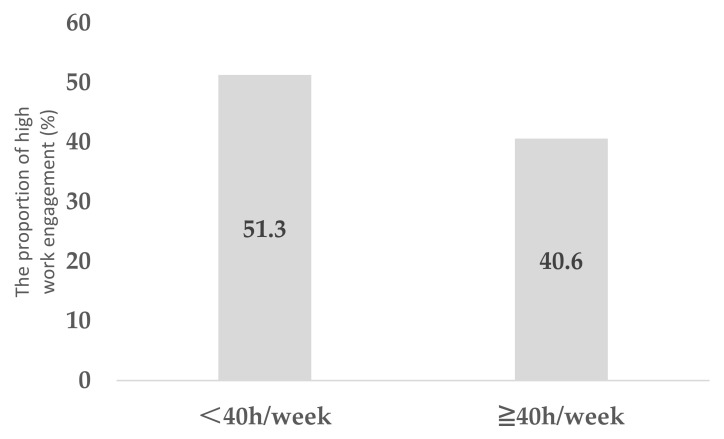
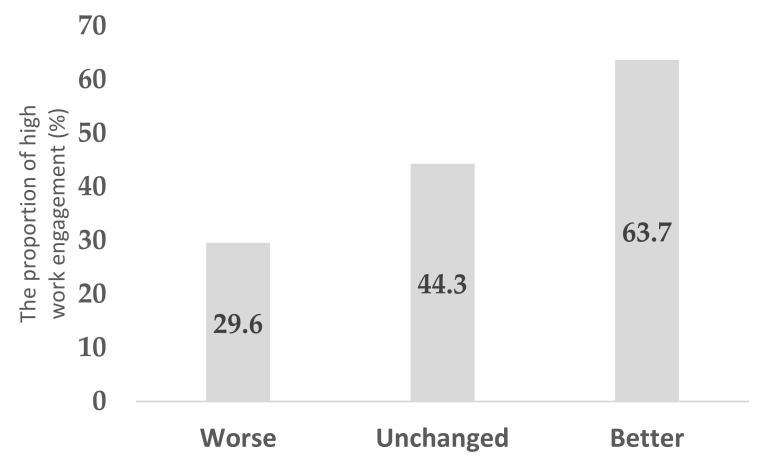
This study aimed to identify factors influencing the work engagement of employees working from home during the COVID-19 pandemic in Japan. Employees' work engagement was examined using the following survey questions: "Do you feel energized when you are at work? (yes or no)" and "Do you take pride in your work? (yes or no)" After adjusting for potential confounders, Poisson regression was used to examine prevalence ratio and 95% confidence intervals for employees' work engagement. We analyzed 15,670 individuals (11,894 of whom did not work from home and 3776 of whom worked from home). Their mean age was 45.6 ± 13.8 years, and 58.3% were men. Those who worked from home were younger than those who did not (43.9 ± 13.1 vs. 46.1 ± 13.9, < 0.001). About 44% of all employees reported high work engagement. Among the employees who worked from home, an increase in sleep hours, effective interactions with supervisors, and working hours of ≤40 h/week were associated with engagement. Sensitivity analysis showed similar results. Close communication with superiors, refraining from working long hours, and obtaining adequate sleep may boost the work engagement of employees working from home.
这项研究旨在确定在 COVID-19 大流行期间,在家工作的员工工作投入的影响因素。使用以下调查问题来检查员工的工作投入:“当你在工作时,你是否感到精力充沛?(是或否)”和“你是否为自己的工作感到自豪?(是或否)”。在调整潜在混杂因素后,使用泊松回归检查员工工作投入的患病率比和 95%置信区间。我们分析了 15670 个人(其中 11894 人不居家办公,3776 人居家办公)。他们的平均年龄为 45.6±13.8 岁,58.3%为男性。居家办公者比非居家办公者年轻(43.9±13.1 岁比 46.1±13.9 岁,<0.001)。大约 44%的员工报告工作投入度高。在居家办公的员工中,睡眠时间增加、与主管的有效互动以及每周工作时间≤40 小时与投入度相关。敏感性分析显示了类似的结果。与上级保持密切沟通、避免长时间工作和获得充足的睡眠可能会提高居家办公员工的工作投入度。