Ostrowska Lucyna, Wasiluk Diana, Lieners Camille F J, Gałęcka Mirosława, Bartnicka Anna, Tveiten Dag
Department of Dietetics and Clinical Nutrition, Medical University of Bialystok, ul. Mieszka I 4B, 15-054 Bialystok, Poland.
Institute of Microecology, ul. Sielska 10, 60-129 Poznan, Poland.
J Clin Med. 2021 Sep 23;10(19):4317. doi: 10.3390/jcm10194317.
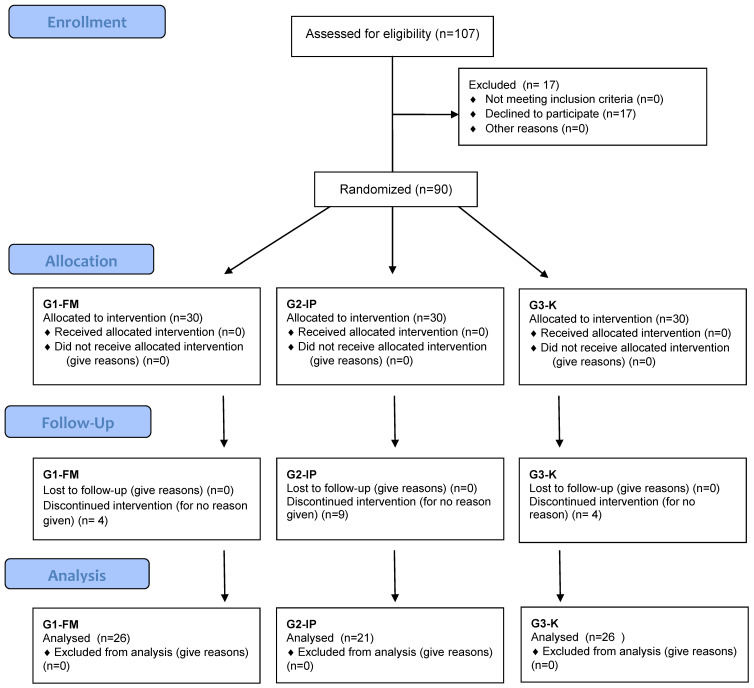
Irritable bowel syndrome (IBS) is a chronic disease with recurrent abdominal pain, disturbed bowel emptying, and changes in stool consistency. We compared the effectiveness of three different dietary treatment plans (G1-FM-low FODMAP diet, G2-IP IgG based elimination-rotation-diet, and as control group, the G3-K control diet recommended by an attending gastroenterologist) in treating patients diagnosed with mixed irritable bowel syndrome. A total of seventy-three female patients diagnosed with a mixed form of irritable bowel syndrome (IBS-M) were enrolled in the study. The diet of each patient in Group 1 (G1-FM) and 2 (G2-IP) was determined individually during a meeting with a dietitian. Patients from Group 3 (G3-K) received nutrition advice from a gastroenterologist. Significant differences in the reduction of IBS symptoms were found between the groups. IBS symptoms as well as comorbid symptoms significantly improved or disappeared completely in the G2-IP group (idiopathic abdominal pain, < 0.001; abdominal pain after a meal, < 0.001; abdominal pain during defecation, = 0.008), while in the G1-FM group, some of the IBS symptoms significantly improved (mucus in stool, = 0.031; bloating, < 0.001). In group G3-K no significant improvement was seen. Based on the results of this open-label study, it was concluded that various dietary interventions in the treatment of IBS-M patients do not uniformly affect the course and outcomes of disease management. Rotation diets based on IgG show significantly better results compared to other diets.
肠易激综合征(IBS)是一种慢性疾病,具有反复腹痛、排便紊乱和大便性状改变等症状。我们比较了三种不同饮食治疗方案(G1-FM——低发酵性寡糖、双糖、单糖和多元醇饮食,G2-IP——基于免疫球蛋白G的排除-轮换饮食,以及作为对照组的由主治胃肠病学家推荐的G3-K对照饮食)在治疗诊断为混合型肠易激综合征患者中的有效性。共有73例诊断为混合型肠易激综合征(IBS-M)的女性患者纳入该研究。第1组(G1-FM)和第2组(G2-IP)的每位患者饮食在与营养师会诊时单独确定。第3组(G3-K)的患者接受胃肠病学家的营养建议。各组之间在IBS症状减轻方面发现有显著差异。G2-IP组(特发性腹痛,<0.001;餐后腹痛,<0.001;排便时腹痛,=0.008)的IBS症状以及合并症状显著改善或完全消失,而在G1-FM组,一些IBS症状显著改善(大便中有黏液,=0.031;腹胀,<0.001)。G3-K组未见显著改善。基于这项开放标签研究的结果,得出结论:对IBS-M患者的各种饮食干预对疾病管理的过程和结果并非均有相同影响。与其他饮食相比,基于免疫球蛋白G的轮换饮食显示出明显更好的效果。