Jäckel Markus, Aicher Nico, Biever Paul Marc, Heine Laura, Bemtgen Xavier, Rilinger Jonathan, Zotzmann Viviane, Supady Alexander, Stachon Peter, Wengenmayer Tobias, Bode Christoph, Staudacher Dawid Leander
Department of Cardiology and Angiology I, Heart Center Freiburg University, Faculty of Medicine, University of Freiburg, 79106 Freiburg, Germany.
Department of Medicine III (Interdisciplinary Medical Intensive Care), Medical Center, Faculty of Medicine, University of Freiburg, 79106 Freiburg, Germany.
J Clin Med. 2021 Sep 26;10(19):4412. doi: 10.3390/jcm10194412.
Delirium complicating the course of Intensive care unit (ICU) therapy is a known driver of morbidity and mortality. It has been speculated that infection with the neurotrophic SARS-CoV-2 might promote delirium.
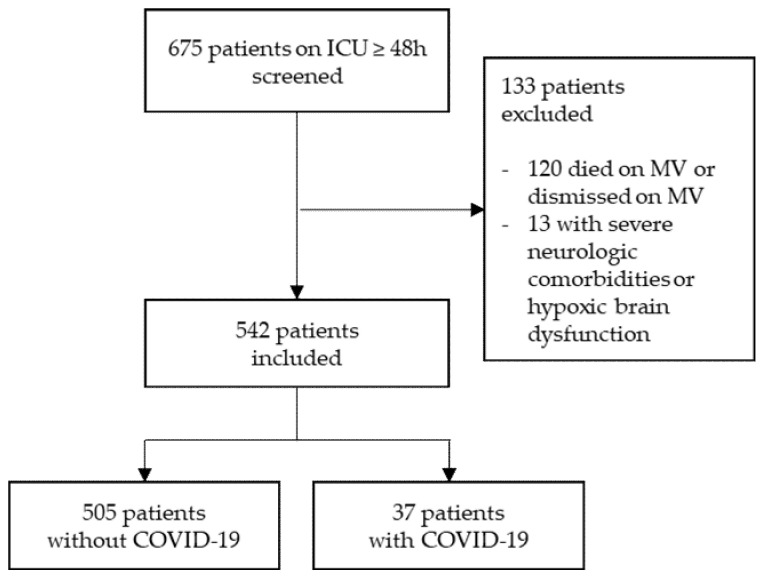
Retrospective registry analysis including all patients treated at least 48 h on a medical intensive care unit. The primary endpoint was development of delirium as diagnosed by Nursing Delirium screening scale ≥2. Results were confirmed by propensity score matching.
542 patients were included. The primary endpoint was reached in 352/542 (64.9%) patients, without significant differences between COVID-19 patients and non-COVID-19 patients (51.4% and 65.9%, respectively, = 0.07) and correlated with prolonged ICU stay in both groups. In a subgroup of patients with ICU stay >10 days delirium was significantly lower in COVID-19 patients ( ≤ 0.01). After adjustment for confounders, COVID-19 correlated independently with less ICU delirium ( ≤ 0.01). In the propensity score matched cohort, patients with COVID-19 had significantly lower delirium incidence compared to the matched control patients ( ≤ 0.01).
Delirium is frequent in critically ill patients with and without COVID-19 treated at an intensive care unit. Data suggests that COVID-19 itself is not a driver of delirium per se.
谵妄使重症监护病房(ICU)治疗过程复杂化,是已知的发病和死亡驱动因素。据推测,感染嗜神经的严重急性呼吸综合征冠状病毒2(SARS-CoV-2)可能会引发谵妄。
进行回顾性登记分析,纳入所有在医学重症监护病房接受至少48小时治疗的患者。主要终点是根据护理谵妄筛查量表≥2诊断出的谵妄发生情况。结果通过倾向评分匹配得到证实。
共纳入542例患者。352/542(64.9%)例患者达到主要终点,COVID-19患者和非COVID-19患者之间无显著差异(分别为51.4%和65.9%,P = 0.07),且两组谵妄均与ICU住院时间延长相关。在ICU住院时间>10天的患者亚组中,COVID-19患者的谵妄发生率显著较低(P≤0.01)。在对混杂因素进行调整后,COVID-19与较少发生ICU谵妄独立相关(P≤0.01)。在倾向评分匹配队列中,COVID-19患者的谵妄发生率显著低于匹配的对照患者(P≤0.01)。
在重症监护病房接受治疗的COVID-19患者和非COVID-19患者中,谵妄都很常见。数据表明,COVID-19本身并非谵妄的驱动因素。