Department of Social and Behavioral Sciences, Harvard T.H. Chan School of Public Health, Boston, Massachusetts, United States of America.
Department of Medicine, Massachusetts General Hospital, Boston, Massachusetts, United States of America.
PLoS One. 2021 Oct 13;16(10):e0257879. doi: 10.1371/journal.pone.0257879. eCollection 2021.
The dual burden of poor diet quality and food insecurity makes free food-food acquired at no cost-a very important part of the nutrition safety net for low-income families. The goal of this study was to determine the national prevalence and nutritional quality of free food acquired separately in two settings: 1) by children at school; and 2) by employees at work; both stratified by participation in the Supplemental Nutrition Assistance Program (SNAP).
Using National Household Food Acquisition and Purchase Survey data (2012; n = 4,826 U.S. households containing 5,382 employed adults and 3,338 school-aged children), we used survey-weighted proportions to describe free food acquisition and linear regression to compare the 2010 Healthy Eating Index (HEI-2010) for free/non-free food acquisition events (i.e., meals) by SNAP status. Analyses were conducted in 2019-2020.
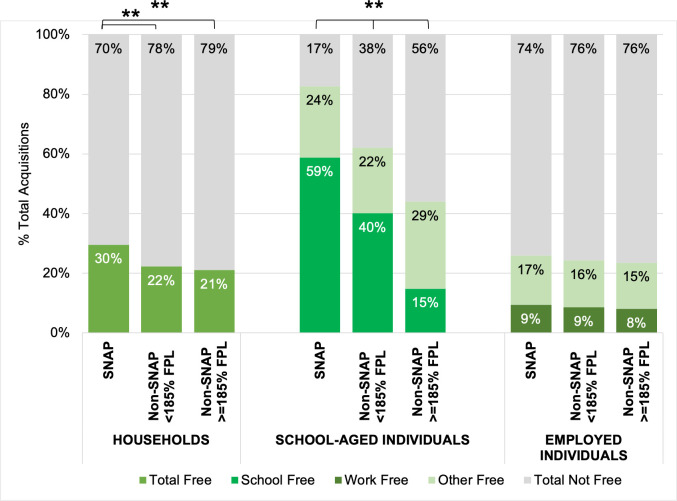
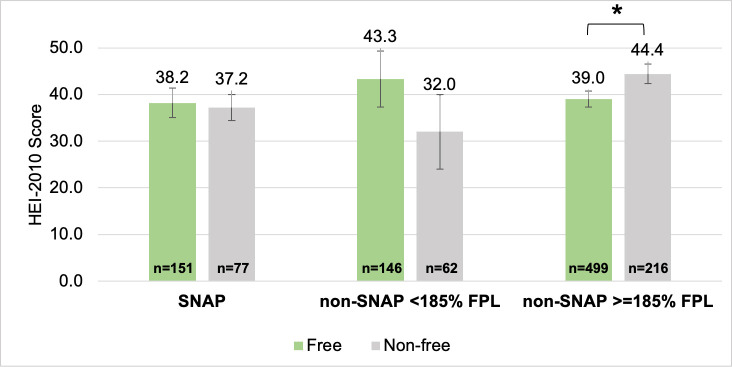
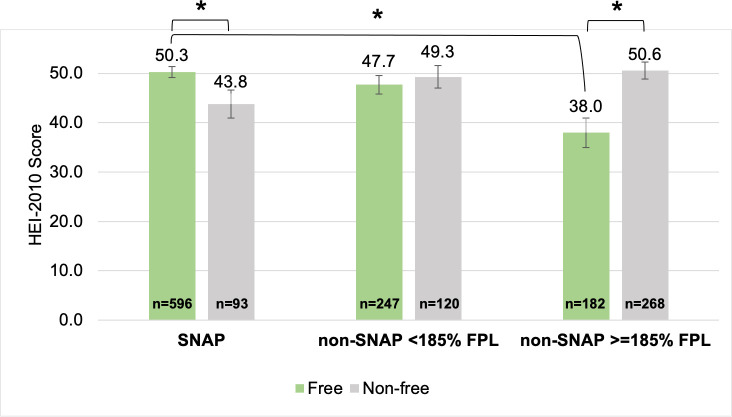
SNAP households had more free acquisition events (29.6%) compared to non-SNAP households (<185% federal poverty level (FPL) = 22.3%; ≥185%FPL = 21.0%, p's<0.001). For SNAP-participant children, free acquisition events at school had a higher mean HEI-2010 compared to non-free acquisition events at school (50.3 vs. 43.8, p = 0.033) and free acquisition events by SNAP-non-participant children ≥185%FPL at school (50.3 vs. 38.0, p = 0.001). Free and non-free acquisition events at work had relatively low HEI-2010s, with no differences by SNAP status.
Over one fifth of all food acquisition events were free, but free food acquisitions at school and work were relatively unhealthy. For children participating in SNAP, free food acquired at school had higher nutritional quality. Improving the dietary quality of free foods could improve the health of families, especially those participating in SNAP.
饮食质量差和粮食不安全的双重负担使得免费食品——无需付费获得的食品——成为低收入家庭营养安全网的重要组成部分。本研究的目的是确定在美国,分别通过儿童在学校和员工在工作时获得的免费食品的全国流行率和营养质量,并按参与补充营养援助计划(SNAP)的情况进行分层。
利用 2012 年全国家庭食品获取和购买调查数据(n=4826 户美国家庭,其中包含 5382 名在职成年人和 3338 名学龄儿童),我们使用调查加权比例来描述免费食品的获取情况,并通过 SNAP 状况比较免费/非免费食品获取事件(即膳食)的 2010 年健康饮食指数(HEI-2010)。分析于 2019-2020 年进行。
与非 SNAP 家庭(<185%联邦贫困线(FPL)=22.3%;≥185%FPL=21.0%,p 值均<0.001)相比,SNAP 家庭的免费获取事件更多(29.6%)。对于 SNAP 参与者的儿童,学校的免费获取事件的平均 HEI-2010 高于学校的非免费获取事件(50.3 比 43.8,p=0.033),以及 SNAP 非参与者≥185%FPL 的儿童在学校的免费获取事件(50.3 比 38.0,p=0.001)。工作时的免费和非免费获取事件的 HEI-2010 相对较低,且与 SNAP 状况无关。
超过五分之一的所有食品获取事件都是免费的,但学校和工作场所的免费食品获取相对不健康。对于参与 SNAP 的儿童,在学校获得的免费食品的营养质量更高。提高免费食品的饮食质量可以改善家庭的健康状况,特别是那些参与 SNAP 的家庭。