Universidade de São Paulo, Hospital Universitário de São Paulo - Centro de Pesquisa Clínica e Epidemiológica, São Paulo, SP - Brasil.
Arq Bras Cardiol. 2021 Nov;117(5):978-985. doi: 10.36660/abc.20200399.
Long-term prognosis post-acute coronary syndrome (ACS) in secondary care is not well-known. The severity of coronary artery disease (CAD) as a predictor of long-term mortality was evaluated in a community hospital in Brazil.
We aimed to compare short and long-term prognosis after an ACS event according to severity of obstructive disease in patients attended in a secondary community hospital from prospective CAD cohort in Brazil (the Strategy of Registry of Acute Coronary Syndrome, ERICO study).
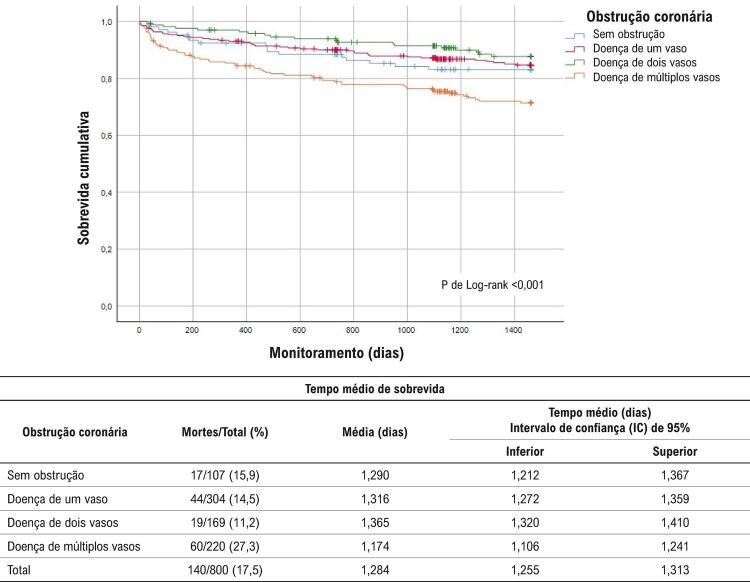
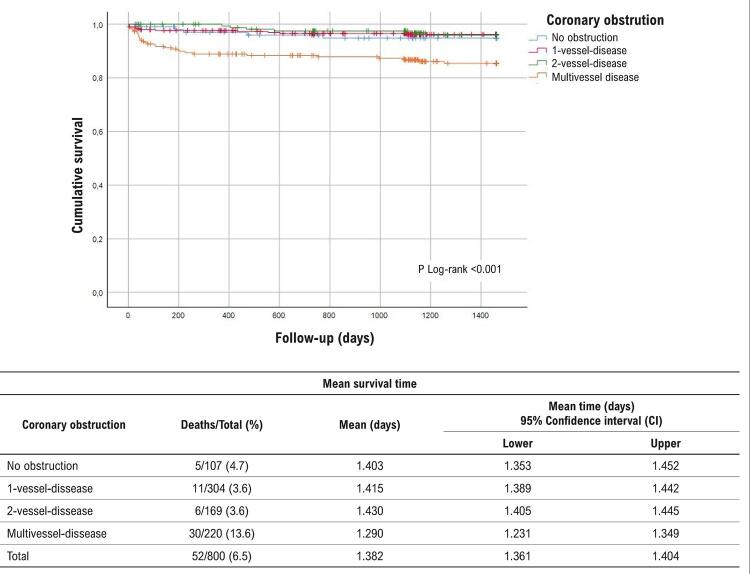
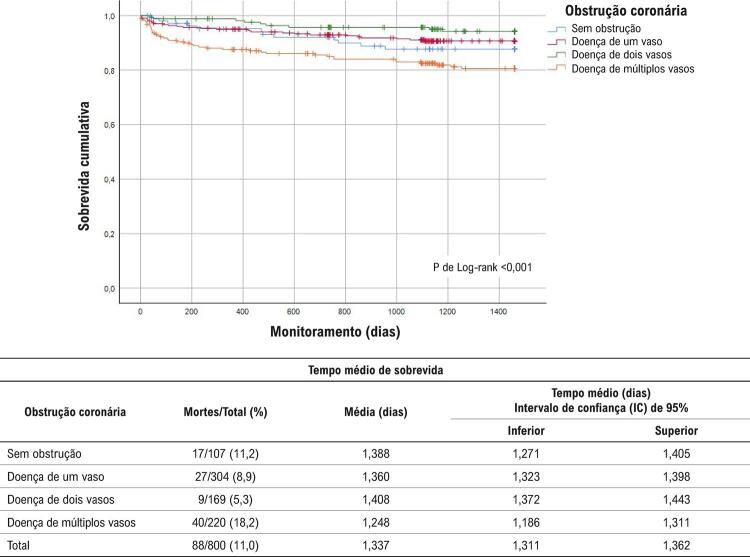
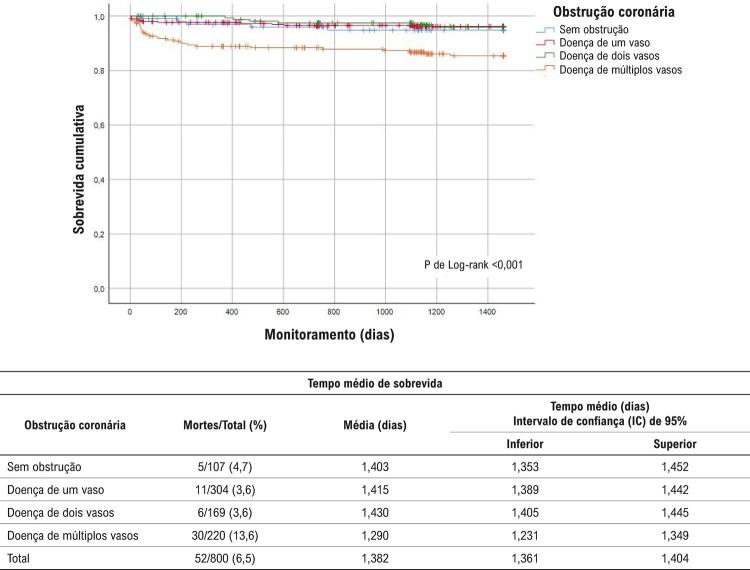
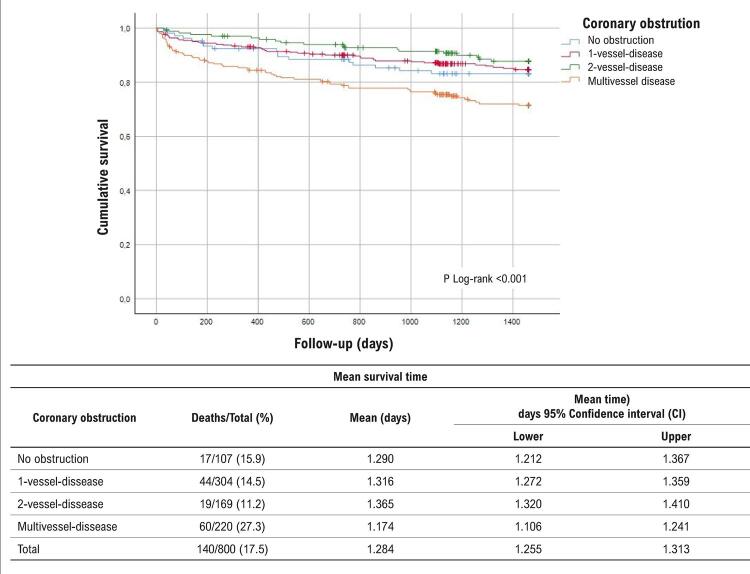
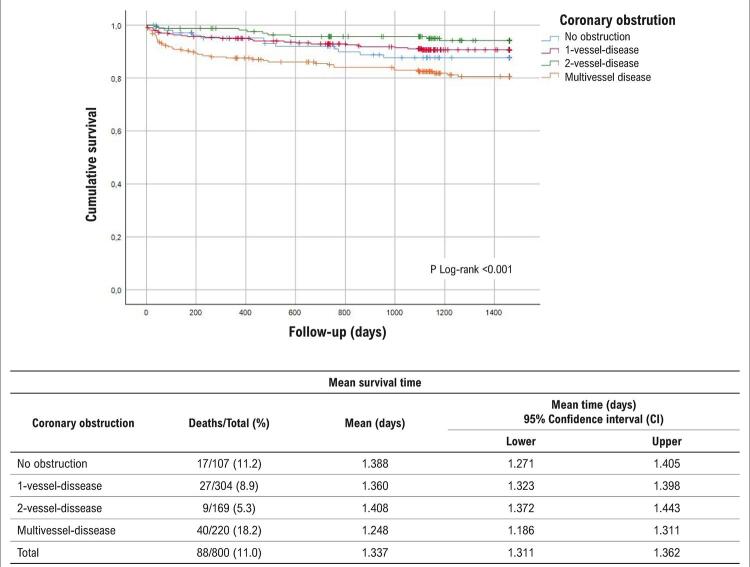
Survival analyses were performed by Kaplan-Meier curves and Cox proportional hazard models (hazard ratios (HR) with respective 95% confidence interval (CI) to evaluate cumulative all-cause, CVD and CAD mortality according the coronary artery obstruction: no-obstruction (reference group), 1-vessel-disease, 2-vessel-disease, multivessel-disease) among 800 adults from an ERICO study during a 4-year-follow-up. HR are presented as crude and further adjusted for potential confounders from 180 days to 4-year follow-up after ACS. A p-value <0.05 was considered statistically significant.
Poorer survival rates were detected among individuals with multivessel-disease (all-cause, CVD and CAD, p-log rank< 0.0001). After multivariate adjustments, multivessel-disease |(HR; 2.33 (CI 95%; 1.10-4.95)) and 1-vessel-disease obstructed (HR; 2.44 (CI 95%; 1.11-5.34)) had the highest risk for all-cause mortality compared to those with no obstruction at 4-year follow-up.
Not only multivessel-disease, but also 1-vessel-disease patients showed a high long-term mortality risk post-ACS. These findings highlight the importance of having a better approach in the treatment and control of cardiovascular risk even in apparently low-risk individuals attended to in secondary care.
在二级医疗机构中,急性冠脉综合征(ACS)后的长期预后并不明确。本研究旨在评估巴西一家社区医院中,冠状动脉疾病(CAD)严重程度作为预测长期死亡率的指标。
我们旨在比较在巴西二级社区医院接受治疗的 ACS 患者中,根据阻塞性疾病的严重程度,评估短期和长期预后(巴西急性冠脉综合征登记研究,即 ERICO 研究)。
通过 Kaplan-Meier 曲线和 Cox 比例风险模型(风险比(HR)及其 95%置信区间(CI))进行生存分析,以评估根据冠状动脉阻塞情况(无阻塞(参考组)、1 支血管病变、2 支血管病变、多支血管病变)的累积全因、心血管疾病(CVD)和 CAD 死亡率。这项研究共纳入 800 名来自 ERICO 研究的成年人,随访时间为 4 年。HR 为粗 HR,并在 ACS 后 180 天至 4 年的随访中进一步校正了 180 天至 4 年随访中的潜在混杂因素。p 值<0.05 为统计学显著。
多支血管病变患者的生存率较低(全因、CVD 和 CAD,p-log rank<0.0001)。多支血管病变(HR;2.33(95%CI 95%;1.10-4.95))和 1 支血管病变(HR;2.44(95%CI 95%;1.11-5.34))在 4 年随访时与无阻塞相比,全因死亡率风险最高。
不仅多支血管病变,而且 1 支血管病变患者在 ACS 后也有很高的长期死亡率风险。这些发现强调了即使在二级医疗机构中治疗和控制心血管风险的重要性,即使在风险较低的患者中也是如此。