School of Medical and Health Sciences, Edith Cowan University, Joondalup, Australia.
Dental School, University of Western Australia, Perth, Australia.
BMC Oral Health. 2021 Oct 13;21(1):521. doi: 10.1186/s12903-021-01887-4.
Early childhood caries disproportionately affects vulnerable groups and remains a leading cause of preventable hospital admissions for Western Australian children. The Western Australia State Oral Health Plan seeks to improve child oral health through universal and targeted health promotion initiatives with primary caregivers. These initiatives require evidence of primary caregiver oral health knowledge and behaviours and baseline data on early childhood caries. The objective of this systematic scoping review was to understand current oral health knowledge and practices of primary caregivers of children aged 0-4 years, identify influential socioecological determinants, and identify data on early childhood caries in the Western Australian context.
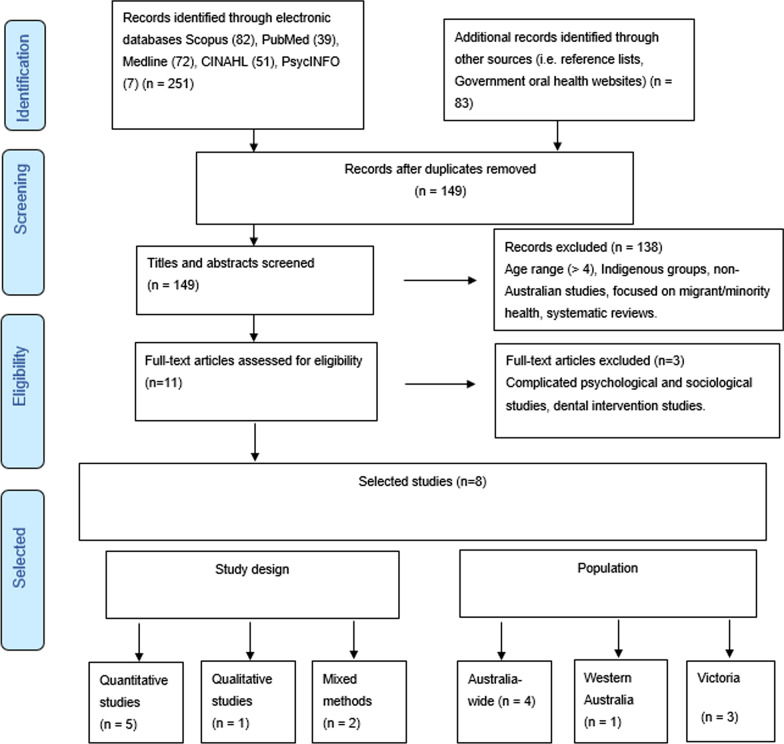
A systematic scoping review framework identified articles published between 2010 and 2021, using Scopus, PubMed, Medline, CINAHL, PsycINFO, selected article reference lists, and oral health websites. The lack of Western Australian specific literature prompted the inclusion of Australia-wide articles. Articles were screened via author consensus, with eight selected.
Western Australia and nation-wide data on early childhood caries are limited and mostly dated. WA data from children aged 2-3 years, collected in 2006, suggests the prevalence is 2.9% in this state, with national data of children from 0 to 3 years, collected from 2006 and 2008, suggesting an early childhood caries prevalence of 3.4-8% of children aged 18 months, rising sharply by 36 months of age. Nationally, fewer than half the primary caregivers reported following evidence-based oral health recommendations for their young children. Perceptions of the role of dental services for young children tends to be focussed on treatment, rather than surveillance and prevention. Knowledge of dietary and oral hygiene practices is inconsistent and awareness of the Child Dental Benefit Schedule low. Young children's oral health status is clearly associated with socioecological factors, including socioeconomic status.
Recent early childhood caries data and evidence of primary care-givers' oral health knowledge and behaviours are unavailable in Western Australia, a similar situation exists nationwide. To realise the Western Australian and National Oral Health Plans, research is required to address this knowledge gap.
幼儿龋齿不成比例地影响弱势群体,仍是西澳大利亚儿童可预防住院的主要原因。西澳大利亚州口腔健康计划旨在通过针对主要照顾者的普及和有针对性的健康促进举措来改善儿童口腔健康。这些举措需要了解主要照顾者的口腔健康知识和行为,以及幼儿龋齿的基线数据。本系统范围界定审查的目的是了解 0-4 岁儿童主要照顾者目前的口腔健康知识和行为,确定有影响力的社会生态决定因素,并确定西澳大利亚州的幼儿龋齿数据。
系统范围界定审查框架使用 Scopus、PubMed、Medline、CINAHL、PsycINFO、选定的文章参考列表和口腔健康网站,确定了 2010 年至 2021 年期间发表的文章。由于缺乏西澳大利亚州特定的文献,因此包括了澳大利亚范围内的文章。文章通过作者共识进行筛选,共筛选出 8 篇文章。
西澳大利亚州和全国范围内的幼儿龋齿数据有限且大多陈旧。2006 年在西澳大利亚州收集的 2-3 岁儿童的数据表明,该州的患病率为 2.9%,而全国范围内的 0-3 岁儿童的数据是从 2006 年和 2008 年收集的,表明 18 个月大的儿童的幼儿龋齿患病率为 3.4-8%,36 个月龄时急剧上升。全国范围内,不到一半的主要照顾者报告说他们遵循了针对幼儿的循证口腔健康建议。对牙科服务在幼儿中的作用的看法往往集中在治疗上,而不是监测和预防上。饮食和口腔卫生习惯的知识不一致,对儿童牙科福利计划的认识也很低。幼儿的口腔健康状况显然与社会生态因素有关,包括社会经济地位。
西澳大利亚州最近的幼儿龋齿数据以及主要照顾者的口腔健康知识和行为的证据都不可用,全国范围内也存在类似情况。为了实现西澳大利亚州和国家口腔健康计划,需要开展研究来解决这一知识差距。