Department of Chemistry, University of Illinois at Chicago, Chicago, IL, 60607, USA.
Department of Physics, University of Illinois at Chicago, Chicago, IL, 60607, USA.
Nat Commun. 2021 Oct 13;12(1):5995. doi: 10.1038/s41467-021-26274-z.
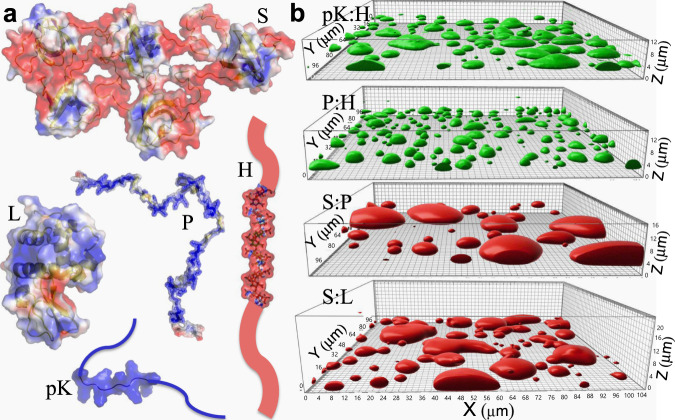
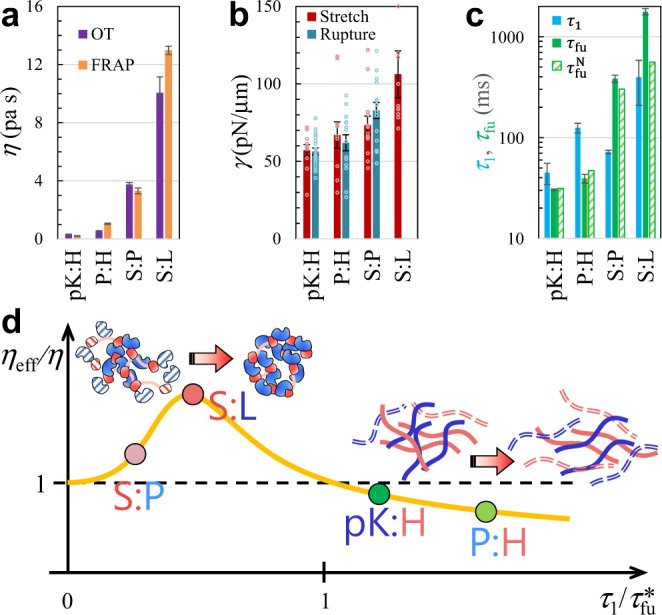
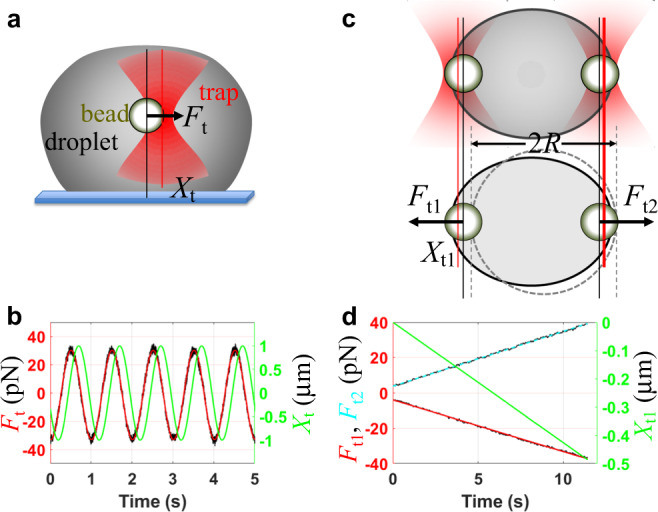
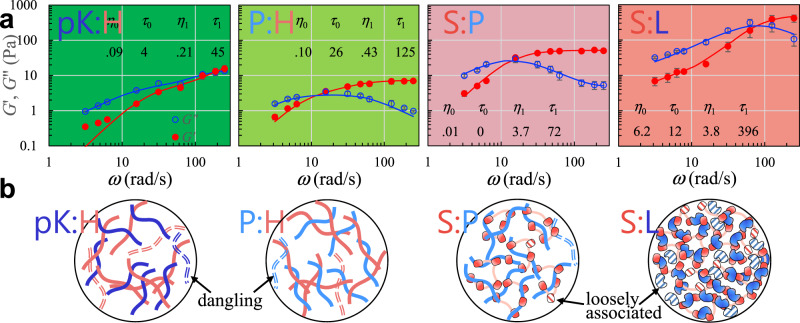
Phase-separated biomolecular condensates must respond agilely to biochemical and environmental cues in performing their wide-ranging cellular functions, but our understanding of condensate dynamics is lagging. Ample evidence now indicates biomolecular condensates as viscoelastic fluids, where shear stress relaxes at a finite rate, not instantaneously as in viscous liquids. Yet the fusion dynamics of condensate droplets has only been modeled based on viscous liquids, with fusion time given by the viscocapillary ratio (viscosity over interfacial tension). Here we used optically trapped polystyrene beads to measure the viscous and elastic moduli and the interfacial tensions of four types of droplets. Our results challenge the viscocapillary model, and reveal that the relaxation of shear stress governs fusion dynamics. These findings likely have implications for other dynamic processes such as multiphase organization, assembly and disassembly, and aging.
液-液相分离的生物分子凝聚体在执行其广泛的细胞功能时,必须对生化和环境线索做出灵活的反应,但我们对凝聚体动力学的理解还很滞后。现在有充分的证据表明,生物分子凝聚体是黏弹性流体,在剪切应力以有限的速率松弛,而不是像粘性液体那样瞬间松弛。然而,凝聚体液滴的融合动力学仅基于粘性液体进行建模,融合时间由黏毛细比(粘度除以界面张力)给出。在这里,我们使用光学捕获的聚苯乙烯珠来测量四种类型液滴的粘性和弹性模量以及界面张力。我们的结果挑战了黏毛细模型,并揭示了剪切应力的松弛控制着融合动力学。这些发现可能对其他动态过程(如多相组织、组装和拆卸以及老化)具有影响。