Yuan Aidong, Nixon Ralph A
Center for Dementia Research, Nathan Kline Institute, Orangeburg, NY, United States.
Department of Psychiatry, NYU Neuroscience Institute, New York, NY, United States.
Front Neurosci. 2021 Sep 27;15:689938. doi: 10.3389/fnins.2021.689938. eCollection 2021.
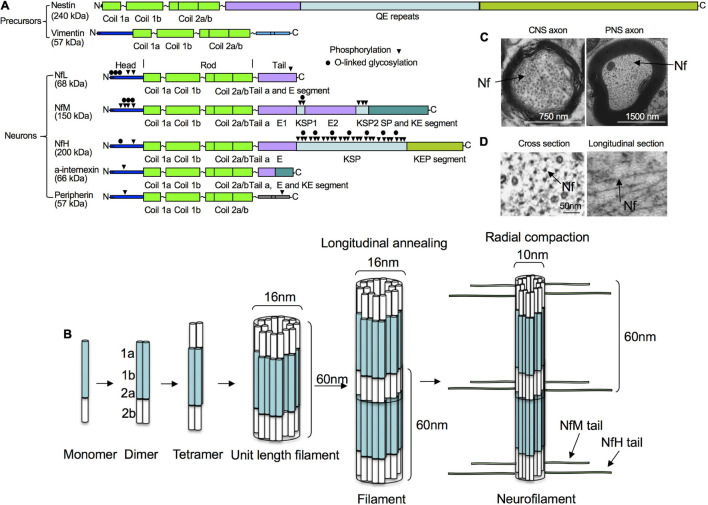
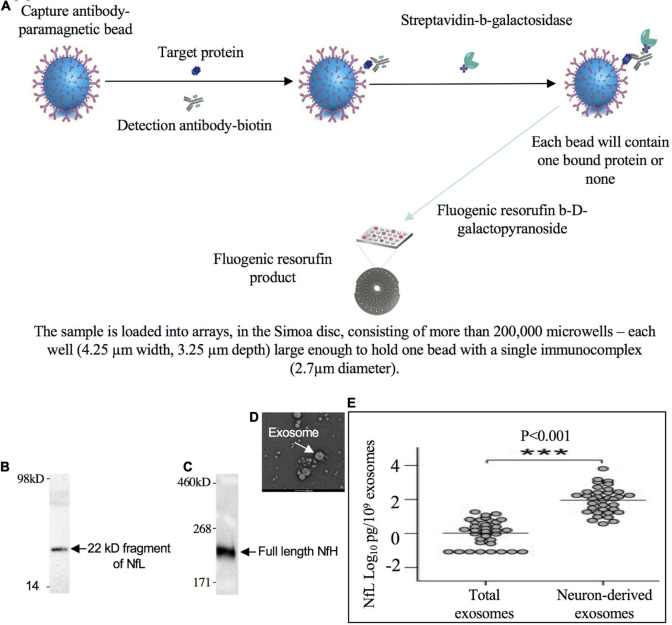
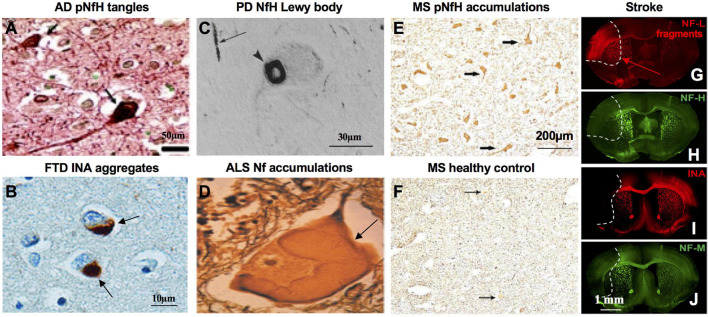
Biomarkers of neurodegeneration and neuronal injury have the potential to improve diagnostic accuracy, disease monitoring, prognosis, and measure treatment efficacy. Neurofilament proteins (NfPs) are well suited as biomarkers in these contexts because they are major neuron-specific components that maintain structural integrity and are sensitive to neurodegeneration and neuronal injury across a wide range of neurologic diseases. Low levels of NfPs are constantly released from neurons into the extracellular space and ultimately reach the cerebrospinal fluid (CSF) and blood under physiological conditions throughout normal brain development, maturation, and aging. NfP levels in CSF and blood rise above normal in response to neuronal injury and neurodegeneration independently of cause. NfPs in CSF measured by lumbar puncture are about 40-fold more concentrated than in blood in healthy individuals. New ultra-sensitive methods now allow minimally invasive measurement of these low levels of NfPs in serum or plasma to track disease onset and progression in neurological disorders or nervous system injury and assess responses to therapeutic interventions. Any of the five Nf subunits - neurofilament light chain (NfL), neurofilament medium chain (NfM), neurofilament heavy chain (NfH), alpha-internexin (INA) and peripherin (PRPH) may be altered in a given neuropathological condition. In familial and sporadic Alzheimer's disease (AD), plasma NfL levels may rise as early as 22 years before clinical onset in familial AD and 10 years before sporadic AD. The major determinants of elevated levels of NfPs and degradation fragments in CSF and blood are the magnitude of damaged or degenerating axons of fiber tracks, the affected axon caliber sizes and the rate of release of NfP and fragments at different stages of a given neurological disease or condition directly or indirectly affecting central nervous system (CNS) and/or peripheral nervous system (PNS). NfPs are rapidly emerging as transformative blood biomarkers in neurology providing novel insights into a wide range of neurological diseases and advancing clinical trials. Here we summarize the current understanding of intracellular NfP physiology, pathophysiology and extracellular kinetics of NfPs in biofluids and review the value and limitations of NfPs and degradation fragments as biomarkers of neurodegeneration and neuronal injury.
神经退行性变和神经元损伤的生物标志物有潜力提高诊断准确性、疾病监测、预后评估以及衡量治疗效果。神经丝蛋白(NfPs)在这些情况下非常适合作为生物标志物,因为它们是主要的神经元特异性成分,可维持结构完整性,并且在多种神经系统疾病中对神经退行性变和神经元损伤敏感。在整个正常脑发育、成熟和衰老过程中,低水平的NfPs不断从神经元释放到细胞外空间,并最终到达脑脊液(CSF)和血液中。脑脊液和血液中的NfP水平会因神经元损伤和神经退行性变而升高,与病因无关。在健康个体中,通过腰椎穿刺测量的脑脊液中NfPs的浓度比血液中高约40倍。新的超灵敏方法现在允许对血清或血浆中这些低水平的NfPs进行微创测量,以追踪神经系统疾病或神经系统损伤中的疾病发作和进展,并评估对治疗干预的反应。在给定的神经病理状况下,五个Nf亚基中的任何一个——神经丝轻链(NfL)、神经丝中链(NfM)、神经丝重链(NfH)、α-中间丝蛋白(INA)和外周蛋白(PRPH)都可能发生改变。在家族性和散发性阿尔茨海默病(AD)中,血浆NfL水平可能早在家族性AD临床发病前22年和散发性AD临床发病前10年就开始升高。脑脊液和血液中NfPs及其降解片段水平升高的主要决定因素是纤维束受损或退化轴突的数量、受影响的轴突管径大小以及在给定神经系统疾病或状况的不同阶段NfP及其片段的释放速率,这些疾病或状况直接或间接影响中枢神经系统(CNS)和/或外周神经系统(PNS)。NfPs正在迅速成为神经学中具有变革性的血液生物标志物,为广泛的神经系统疾病提供新的见解,并推动临床试验的发展。在此,我们总结了目前对细胞内NfP生理学、病理生理学以及生物流体中NfPs细胞外动力学的理解,并综述了NfPs及其降解片段作为神经退行性变和神经元损伤生物标志物的价值和局限性。