P-One Clinic, Tokyo, Japan.
Eli Lilly Japan K. K., Kobe, Japan.
Diabetes Obes Metab. 2022 Feb;24(2):239-246. doi: 10.1111/dom.14572. Epub 2021 Nov 18.
To investigate the safety, tolerability, pharmacokinetics (PK), and pharmacodynamics (PD) of tirzepatide in Japanese participants with type 2 diabetes (T2D).
This phase 1, double-blind, placebo-controlled, parallel-dose, multiple-ascending dose study randomized participants to once-weekly subcutaneous tirzepatide or placebo. The tirzepatide treatment groups were: 5 mg (5 mg, weeks 1-8), 10 mg (2.5 mg, weeks 1-2; 5 mg, weeks 3-4; 10 mg, weeks 5-8), and 15 mg (5 mg, weeks 1-2; 10 mg, weeks 3-6; 15 mg, weeks 7-8). The primary outcome was tirzepatide safety and tolerability.
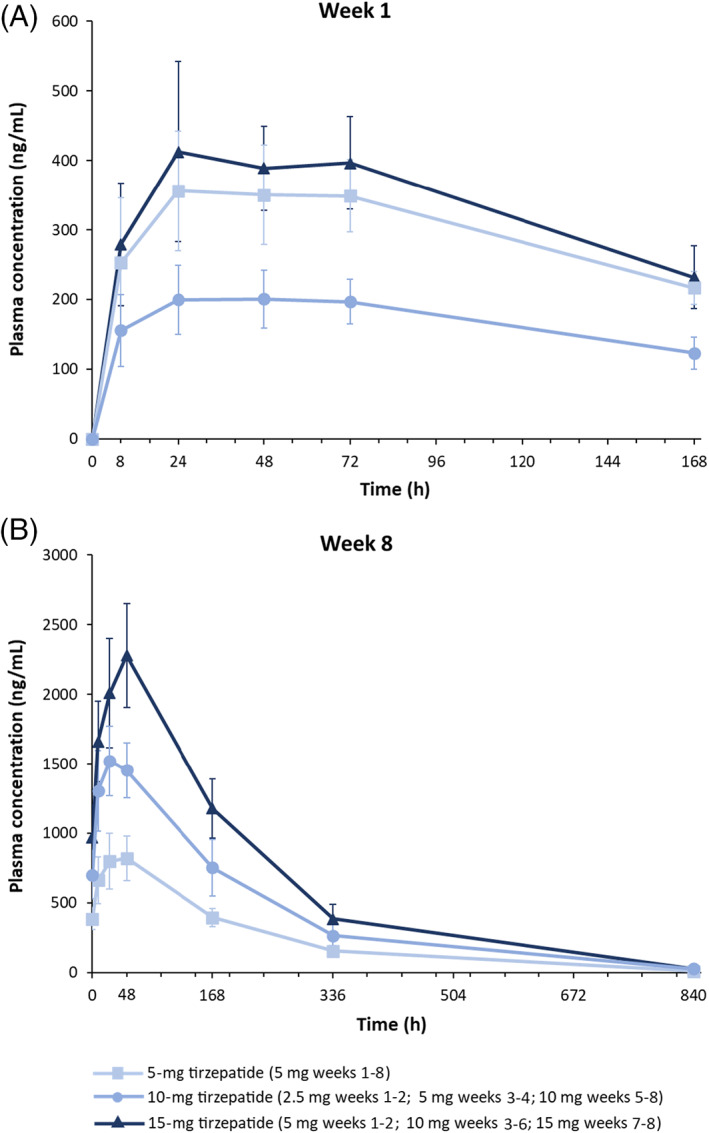
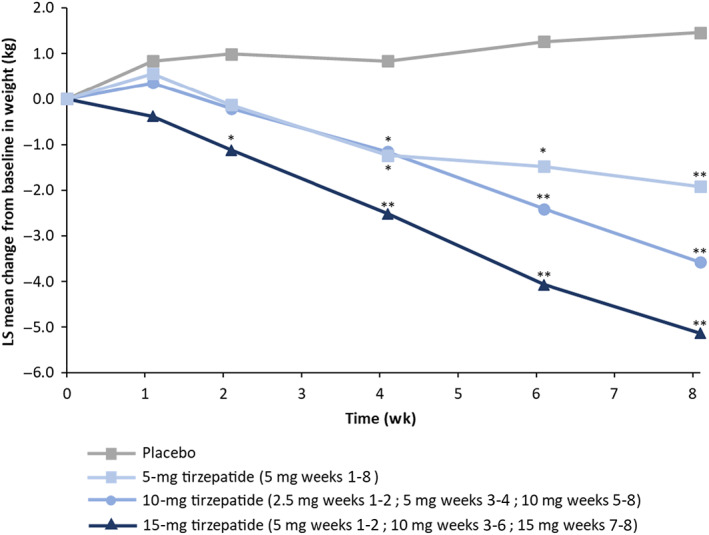
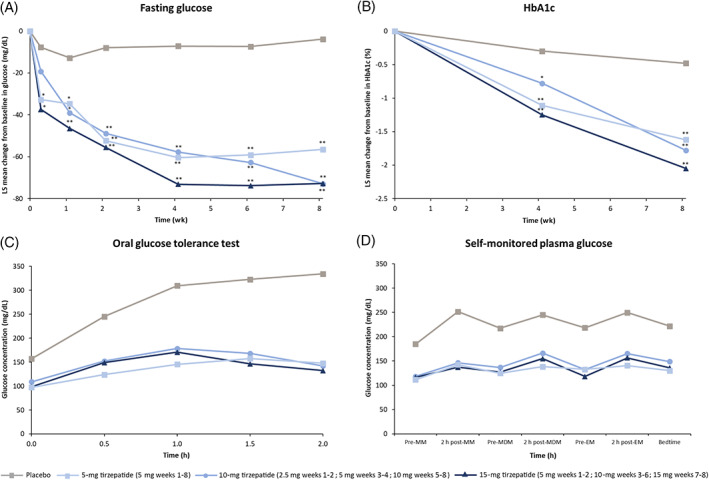
Forty-eight participants were randomized. The most frequently reported treatment-emergent adverse events (AEs) were decreased appetite and gastrointestinal AEs, which were generally dose-dependent and mild in severity. The plasma tirzepatide concentration half-life was approximately 5 days. After 8 weeks of treatment, fasting plasma glucose decreased from baseline with tirzepatide versus placebo; the least squares (LS) mean decrease compared with placebo (95% confidence interval [CI]) was 52.7 (35.9-69.6), 69.1 (52.3-85.9), and 68.9 (53.2-84.6) mg/dL in the 5-, 10-, and 15-mg treatment groups, respectively (P < .0001 for all treatment groups). Tirzepatide also resulted in LS mean decreases from baseline versus placebo at 8 weeks in HbA1c up to 1.6% (95% CI 1.2%-1.9%; P < .0001 for all treatment groups) and body weight up to 6.6 kg (95% CI 5.3-7.9; P < .0001 for all treatment groups).
All tirzepatide doses were well tolerated. The safety, tolerability, PK, and PD profiles of tirzepatide support further evaluation of once-weekly dosing in Japanese people with T2D.
评估在日本 2 型糖尿病(T2D)患者中,司美格鲁肽的安全性、耐受性、药代动力学(PK)和药效学(PD)。
这是一项在日本开展的 1 期、双盲、安慰剂对照、平行剂量、递增剂量研究,将参与者随机分配至每周一次皮下注射司美格鲁肽或安慰剂。司美格鲁肽治疗组包括:5mg(5mg,第 1-8 周)、10mg(2.5mg,第 1-2 周;5mg,第 3-4 周;10mg,第 5-8 周)和 15mg(5mg,第 1-2 周;10mg,第 3-6 周;15mg,第 7-8 周)。主要终点为司美格鲁肽的安全性和耐受性。
共 48 名参与者被随机分配。最常报告的治疗期间出现的不良事件(AE)是食欲下降和胃肠道 AE,这些 AE 通常是剂量依赖性的,且严重程度较轻。司美格鲁肽的血浆半衰期约为 5 天。与安慰剂相比,治疗 8 周后空腹血糖从基线下降;与安慰剂相比(95%置信区间[CI]),司美格鲁肽治疗组的最小平方(LS)均值下降分别为 52.7(35.9-69.6)、69.1(52.3-85.9)和 68.9(53.2-84.6)mg/dL(所有治疗组 P < 0.0001)。与安慰剂相比,司美格鲁肽还使 8 周时的 LS 均值从基线HbA1c下降了 1.6%(95%CI 1.2%-1.9%;所有治疗组 P < 0.0001)和体重下降了 6.6kg(95%CI 5.3-7.9;所有治疗组 P < 0.0001)。
所有司美格鲁肽剂量均耐受良好。司美格鲁肽的安全性、耐受性、PK 和 PD 特征支持在日本 T2D 人群中进一步评估每周一次的给药方案。