
60 至 70 岁老年患者接受急性髓细胞性白血病低强度移植的结果:NCRI 急性髓性白血病 16 号试验的结果。
Outcomes of older patients aged 60 to 70 years undergoing reduced intensity transplant for acute myeloblastic leukemia: results of the NCRI acute myeloid leukemia 16 trial.
机构信息
Department of Haematology, Nottingham University Hospitals.
Nuffield Department of Population Health, University of Oxford.
出版信息
Haematologica. 2022 Jul 1;107(7):1518-1527. doi: 10.3324/haematol.2021.279010.
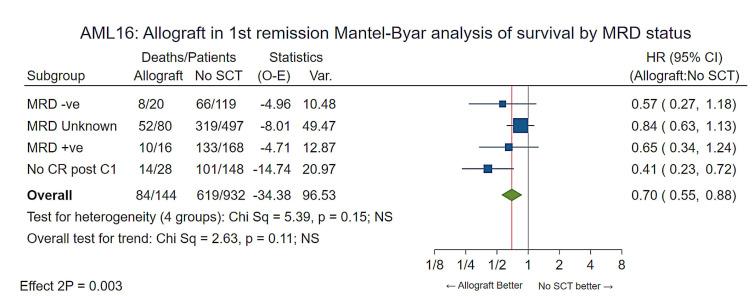
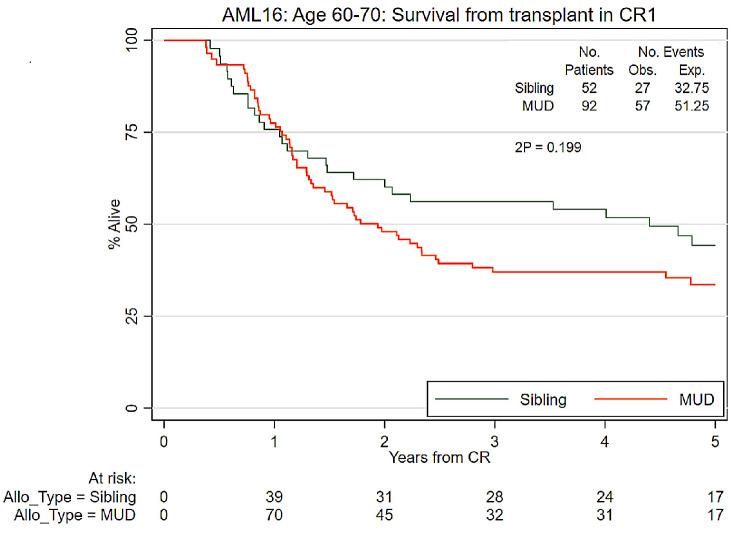
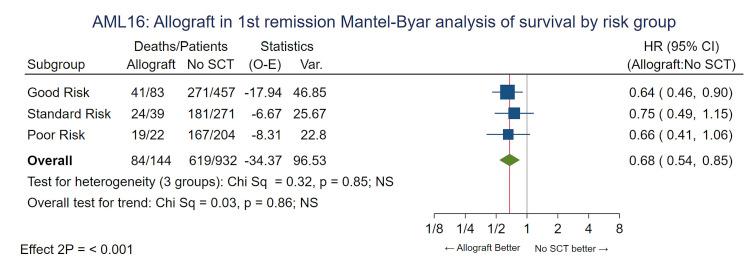
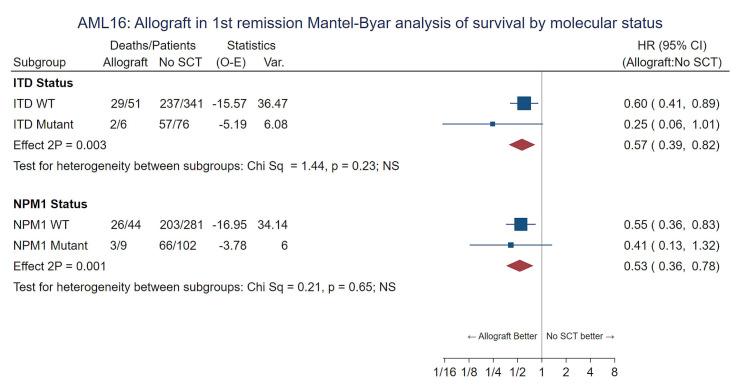
Reduced intensity conditioning (RIC) transplantation is increasingly offered to older patients with acute myeloblastic leukemia. We have previously shown that a RIC allograft, particularly from a sibling donor, is beneficial in intermediate-risk patients aged 35-65 years. We here present analyses from the NCRI AML16 trial extending this experience to older patients aged 60-70 inclusive lacking favorable-risk cytogenetics. Nine hundred thirty-two patients were studied, with RIC transplant in first remission given to 144 (sibling n=52, matched unrelated donor n=92) with a median follow-up for survival from complete remission of 60 months. Comparisons of outcomes of patients transplanted versus those not were carried out using Mantel-Byar analysis. Among the 144 allografted patients, 93 had intermediate-risk cytogenetics, 18 had adverse risk and cytogenetic risk group was unknown for 33. In transplanted patients survival was 37% at 5 years, and while the survival for recipients of grafts from siblings (44%) was better than that for recipients of grafts from matched unrelated donors (34%), this difference was not statistically significant (P=0.2). When comparing RIC versus chemotherapy, survival of patients treated with the former was significantly improved (37% versus 20%, hazard ratio = 0.67 [0.53-0.84]; P<0.001). When stratified by Wheatley risk group into good, standard and poor risk there was consistent benefit for RIC across risk groups. When stratified by minimal residual disease status after course 1, there was consistent benefit for allografting. The benefit for RIC was seen in patients with a FLT3 ITD or NPM1 mutation with no evidence of a differential effect by genotype. We conclude that RIC transplantation is an attractive option for older patients with acute myeloblastic leukemia lacking favorable-risk cytogenetics and, in this study, we could not find a group that did not benefit.
降低强度预处理(RIC)移植越来越多地应用于患有急性髓细胞性白血病的老年患者。我们之前已经表明,RIC 同种异体移植物,特别是来自兄弟姐妹供体的同种异体移植物,对年龄在 35-65 岁的中危患者有益。我们在此介绍 NCRI AML16 试验的分析结果,该试验将这一经验扩展到年龄在 60-70 岁之间且不具有有利风险细胞遗传学的老年患者。研究了 932 名患者,在缓解期给予 144 名患者 RIC 移植(兄弟姐妹供体 n=52,匹配无关供体 n=92),中位随访时间为完全缓解后 60 个月,用于生存分析。使用 Mantel-Byar 分析比较接受移植和未接受移植患者的结局。在 144 名接受同种异体移植的患者中,93 名患者具有中危细胞遗传学特征,18 名患者具有不良风险,33 名患者细胞遗传学风险组未知。在接受移植的患者中,5 年生存率为 37%,而接受来自兄弟姐妹供体的移植物的患者(44%)的生存率优于接受来自匹配无关供体的移植物的患者(34%),但差异无统计学意义(P=0.2)。当比较 RIC 与化疗时,接受前者治疗的患者生存明显改善(37%对 20%,风险比=0.67[0.53-0.84];P<0.001)。按 Wheatley 风险组分为低危、标准和高危,RIC 在各个风险组中均有获益。按疗程 1 后微小残留病状态分层,同种异体移植均有获益。在存在 FLT3 ITD 或 NPM1 突变的患者中,RIC 有获益的趋势,但基因型无差异。我们的结论是,RIC 移植是缺乏有利风险细胞遗传学的老年急性髓细胞性白血病患者的一种有吸引力的选择,在本研究中,我们没有发现没有获益的患者群体。

 Zotero 插件